I haven’t made as much progress as I’d like on Julia’s wedding gown, but I did complete a couple things.
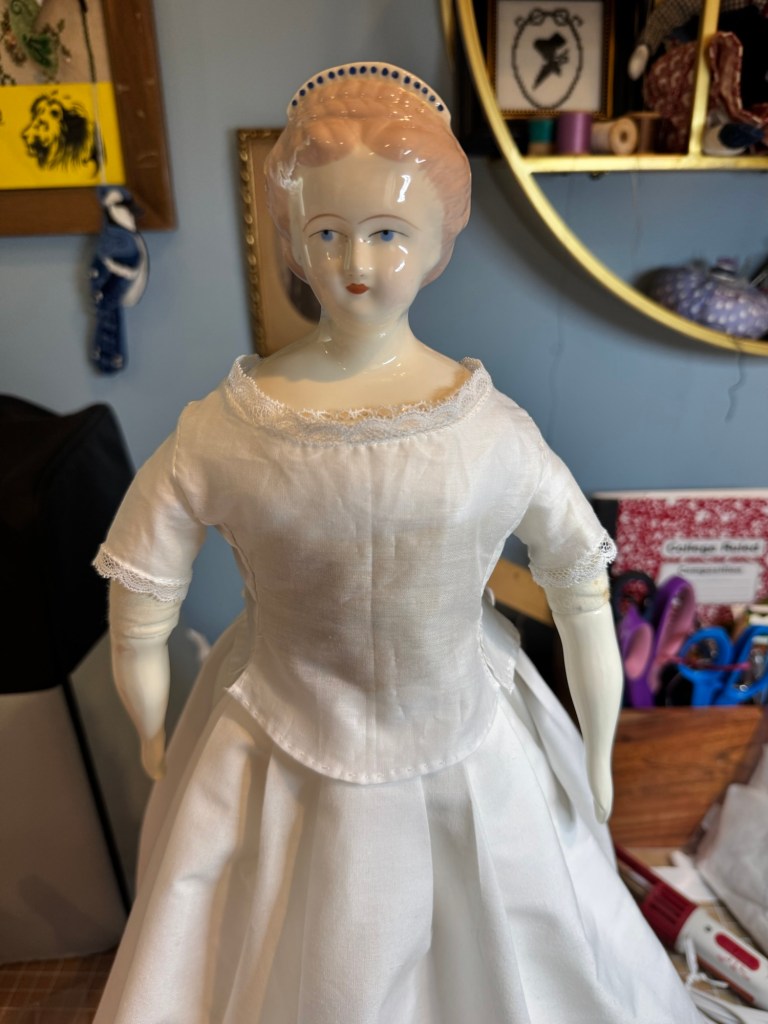
First I made a little batiste corset cover because I just know the gold silk corset could potentially show through the bodice and I don’t want that. It was a little difficult to fit to her, but right now I can’t remember why. I used French lace and mother of pearl buttons – and of course hand sewn button holes. While this pattern came from the Louise Hedrick book, it is very similar to one I made from Le Mode Illustree from 1872 or 1879.
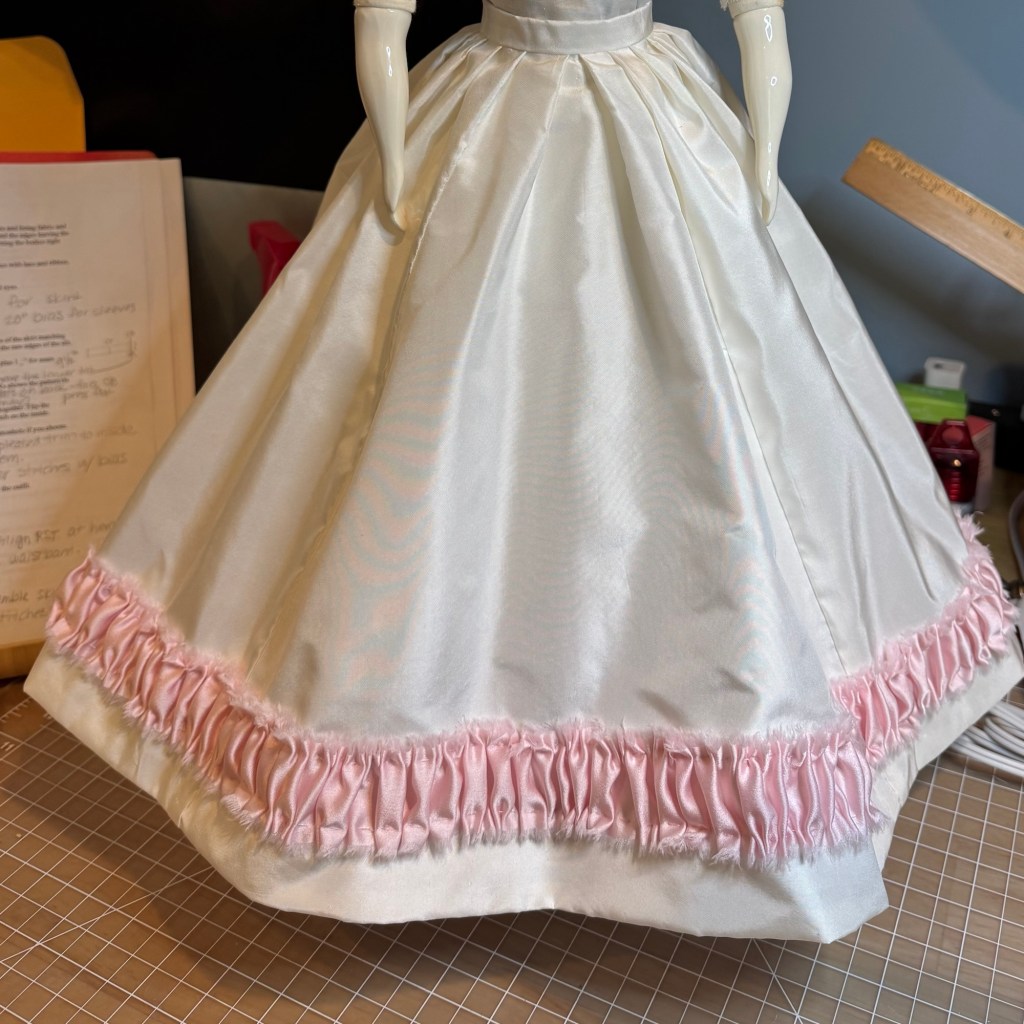
Next I completed the skirt. I actually made a test skirt in plain cotton and that is acting as an additional petticoat. The silk satin is luscious. The skirt is fully lined. I used bias strips to create the hem and the facing is just stitched to the lining.
I had this gorgeous lightweight pink silk satin ribbon and used it to create the ruched trim by running a gathering stitch on either side about 1/8” from the edge. The sweep of the skirt hem is about 36” so I used 90” of the pink to make the trim.
Next up I am working on the undersleeves. During this era, sleeves were still a separate item that was tied on around the bicep. I’m making some organdy sleeves with gorgeous French lace at the cuff edge.
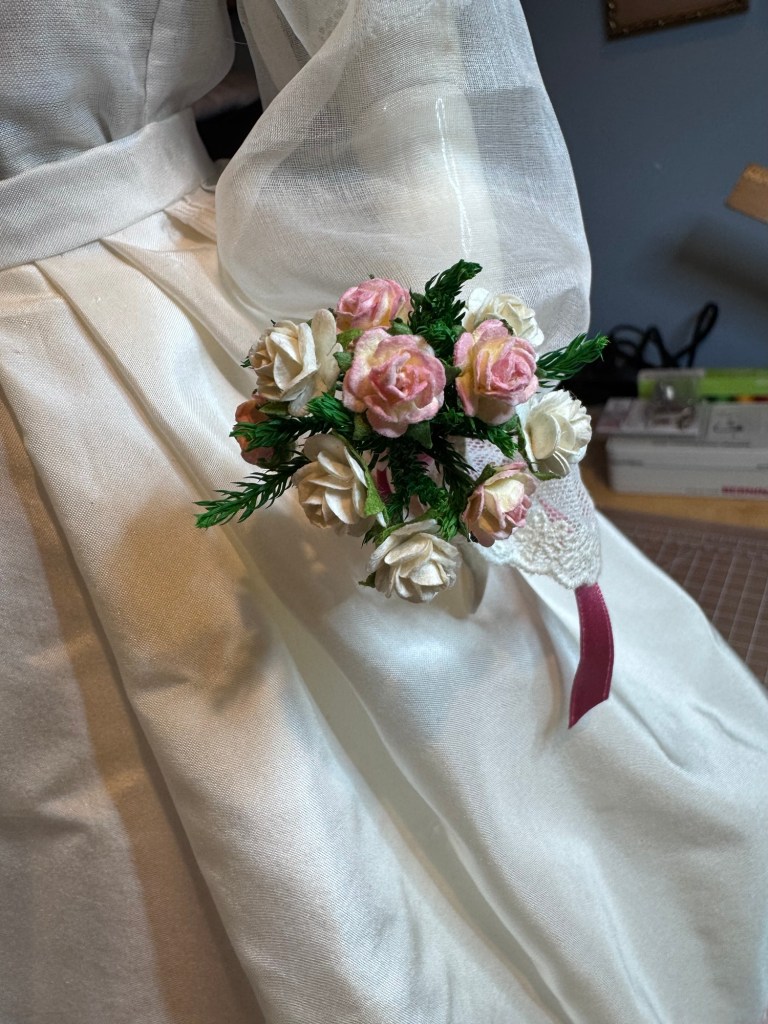
After that I will make the bodice and finally a veil. But just because I have ADHD, I made a bouquet for her to hold. It is bound in a rose colored silk ribbon and I left tails long enough to tie it to her hand.
The flowers are paper and I can’t remember now where I bought them but there was a sale so I bought all the colors. :-)
Stay tuned for more progress soon. I really want to finish the glorious wedding ensemble – of course that will necessitate rearranging my display cabinet and that can always be fun too!
Here’s a project I had to hold onto before sharing because it was made as a Christmas gift.
Block quilt
I followed a basic tutorial which guided me on how to press the seams inside – necessary since this is the first “proper” quilt I have made. I just noodled the previous doll quilt I made.
The pattern is based on antique doll quilt patterns from the 1860s and I also used reproduction fabrics. The quilt top is assembled from blocks of four. It’s important to stay organized. I see where I made a couple mistakes but I bet you don’t.
Quilt back
The quilt is 100% hand sewn, as would have been done by a young lady making a quilt for her dolls in times gone by. It’s interlined with a piece of flannel to give it some body.
The finished quilt is about 16 x 20 inches. Dottie and her friends will be quite comfortable with this quilt to keep them cozy. This is the kind of quilt I used to get lost in, just dreaming about the people who used it before me.
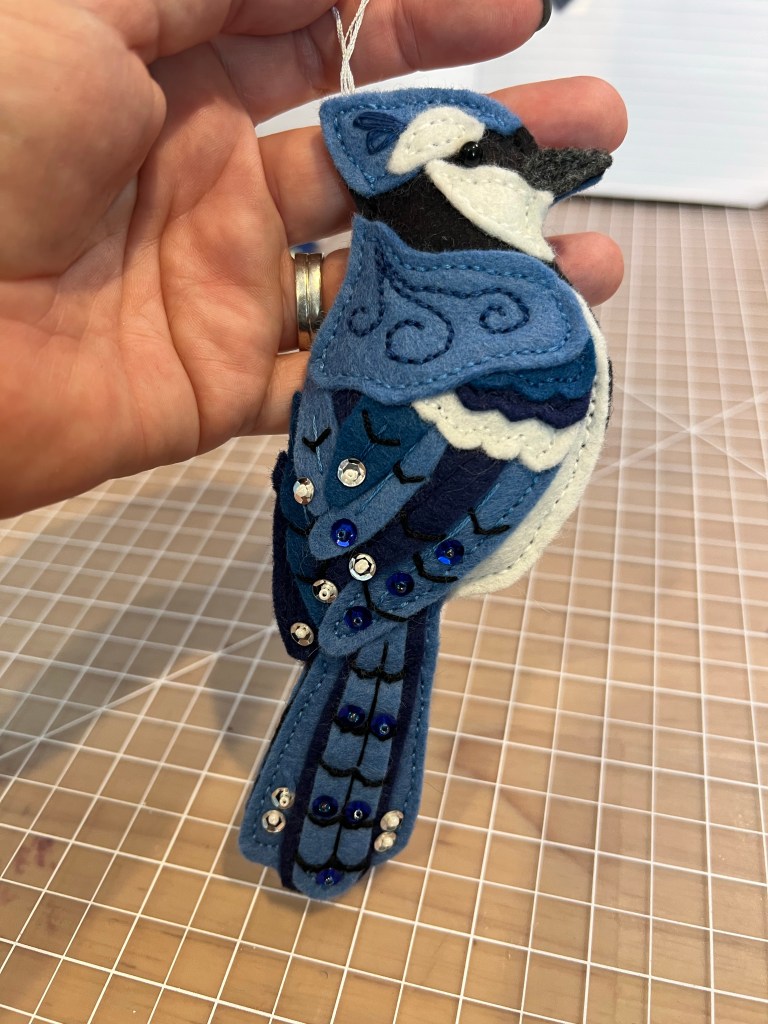
I made this pretty blue jay for my mom. She now has a cardinal, a hummingbird and the blue jay. Hopefully soon I will find the time to make a nuthatch. My mom is in a care home and these and other crafts from my sister brighten up her room.
The next bird in the Squishy Cute line that I made recently is this beautiful hummingbird.
My mother really liked it and it was pretty simple to make, so double win. If you decide to try some of the Squishy Cute patterns, I recommend tracing the pieces onto the felt rather than pinning. For dark colored felt use chalk. This particular one calls for a black sequin and a seed bead but I didn’t have a black sequin. I used a black button.
Find them on Etsy here. They have more than birds, too.
Do you make goals for your sewing projects? I shared at one point that I have been using a project book to keep track of the different dolls I have and what needs to be done for them. The current book is a 8.5×5.5 inch Moleskin type book and it’s getting filled with notes!
Some pages have pictures glued in, while others have my janky sketches of ideas. I say janky because I am NOT an artist but I took one life drawing class so I can at least draw a body or dress – don’t ask for realism or details, and definitely no hands haha.
My idea of drawing
On the front page of the project book I have jotted down some ideas for 2023 sewing projects.
Caroline: drawers, petti, hoop, corset
Dora: practice making new body, make corset as part of torso
Screen shot of a doll on eBay with a corset body
Ruby: make new body, repair what I can, full wardrobe, research Harpers Bazar images 1888
Doll Quilt
Hummingbirds – Mom and A Ruth
We shall see if I stay on task this year. This is a very ambitious project list! Rest assured, I will share my progress with you here and on Instagram. Stay tuned!
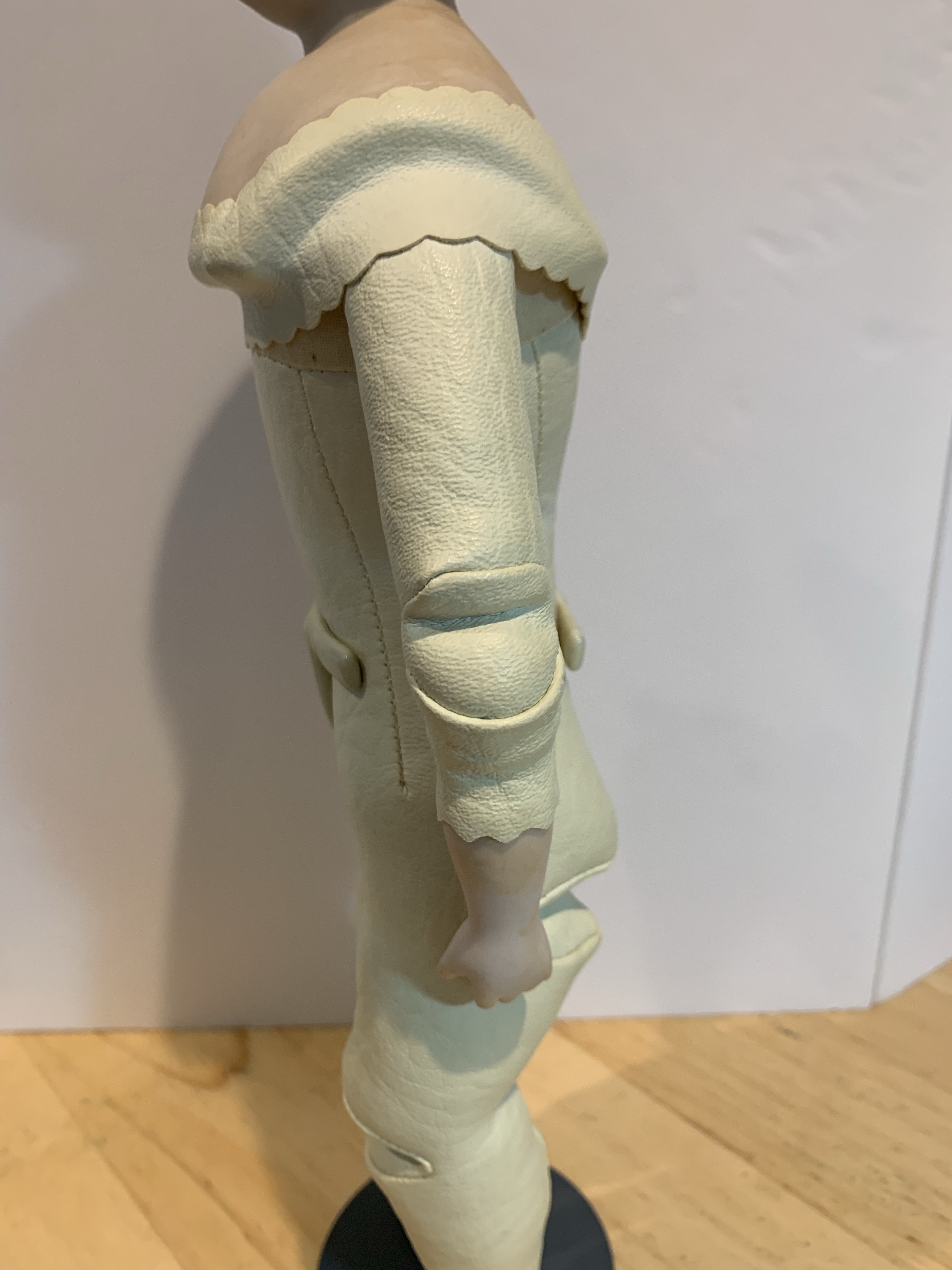
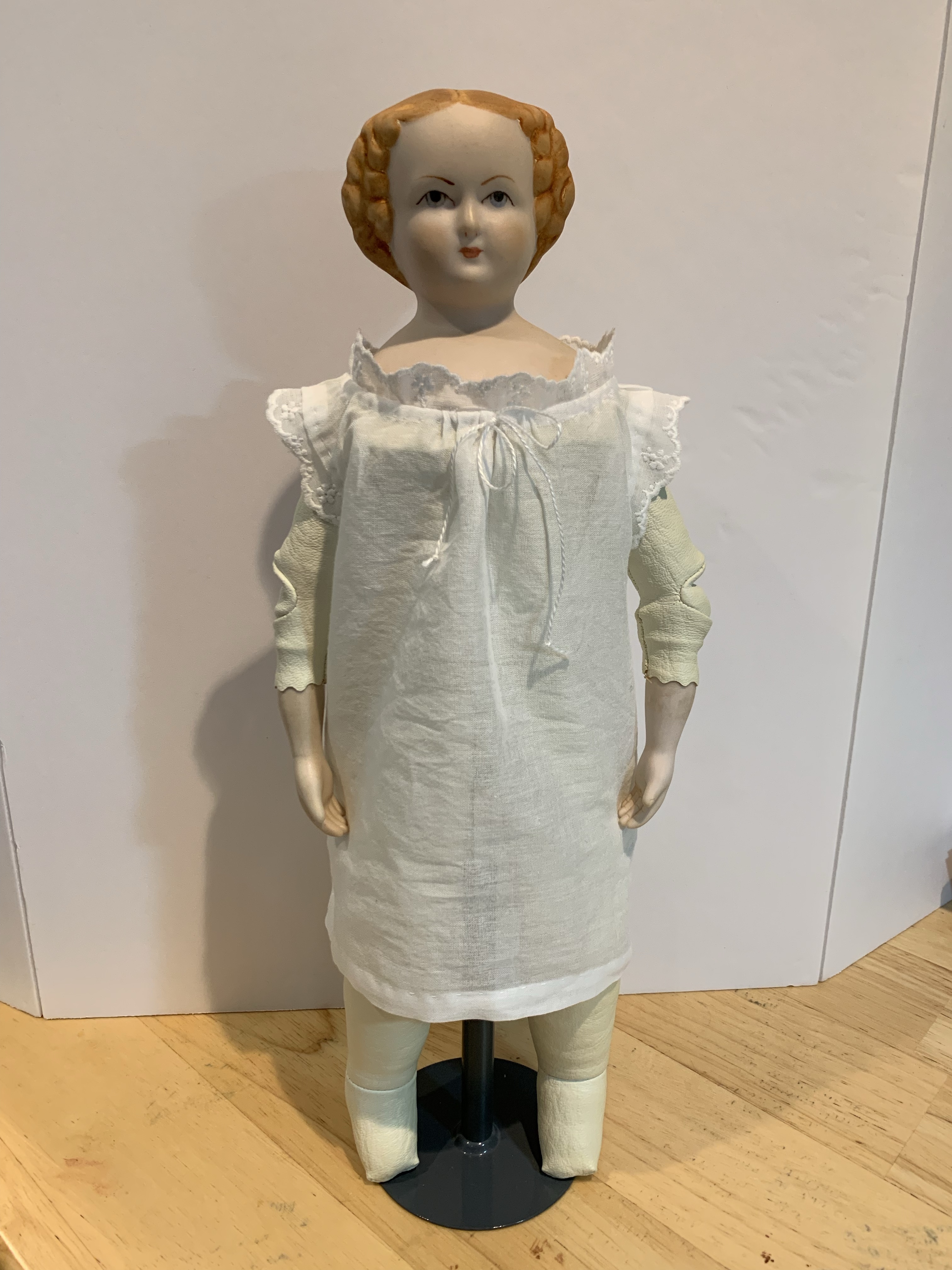
In my haunting eBay and learning about vintage dolls, I found many references to kid-bodied dolls. These doll bodies were made with kid leather instead of cloth. Then one day, I saw this artist’s reproduction made with a kid body, for the right price, and I had to have her.
Poor naked Lydia
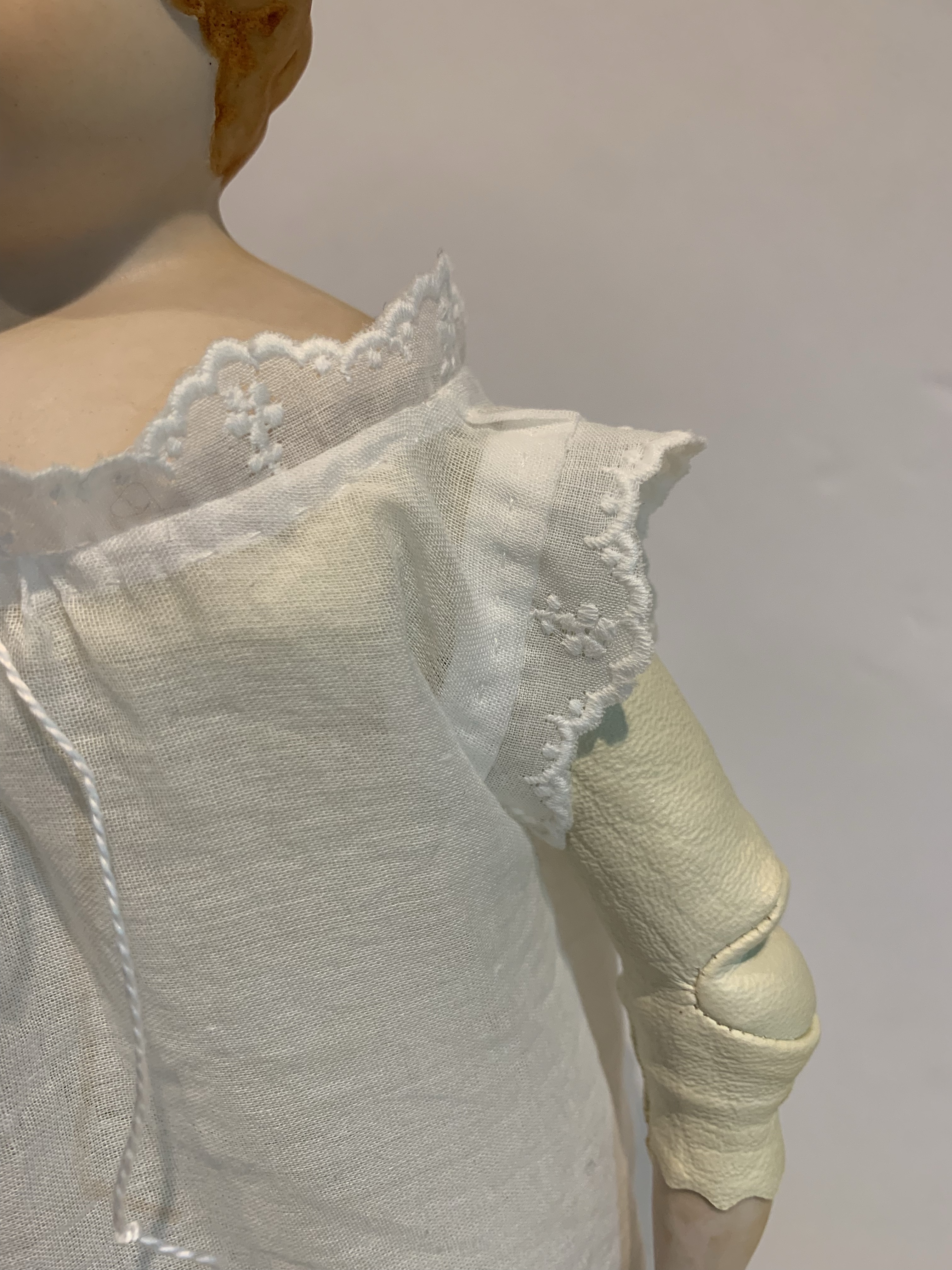
She came with nothing, completely naked, poor love, and has been standing there in her altogether for quite some time now. You can see how her arms and legs were jointed which is fascinating. I can’t imagine the care and skill that went into making her. She is a bit stout around the thighs and her feet are rather chunky, but we can work with that.
Joints
As I was working on Inez, just for kicks I decided to try some of the undergarments on Lydia, fully intending to stop there. As it turns out, the Inez garments were a smidge tight…I made notes in my book and went back to Inez. But Lydia was right there, watching me with a look that said “I am naked as a jaybird, lady!”
Message received!
I resized the chemise pattern and whipped one together. This one has gathers and white work trim, btw. Back to Inez…!
I made the chemisette and sheer low body dress for Inez, honest. I have a sheer dress made of this same fabric and plan to have Inez wear it the same day I do at our upcoming event. But in the meantime, Lydia is going to wear it. It fits her body better than it does Inez for some reason, but it’s too long for Lydia. You will note that Lydia’s petticoat is a fancy embroidered one. I used the edge of an old dust ruffle for it. It just barely shows through the sheer.
Sheer dress with chemisette
The sleeves are a two piece Bishop sleeve, similar to the sleeve on my sheer dress. Lydia is a bit more endowed in the bust than Inez, which fills out the dress differently. Perhaps I need to make some little “bust pads” for Inez. This was actually a thing back in the day!
This is a temporary dress for Lydia – I always pictured her in light pink with roses. I have the fabric but I haven’t decided on the pattern yet. Come back again soon to find out if I’ve made it yet!
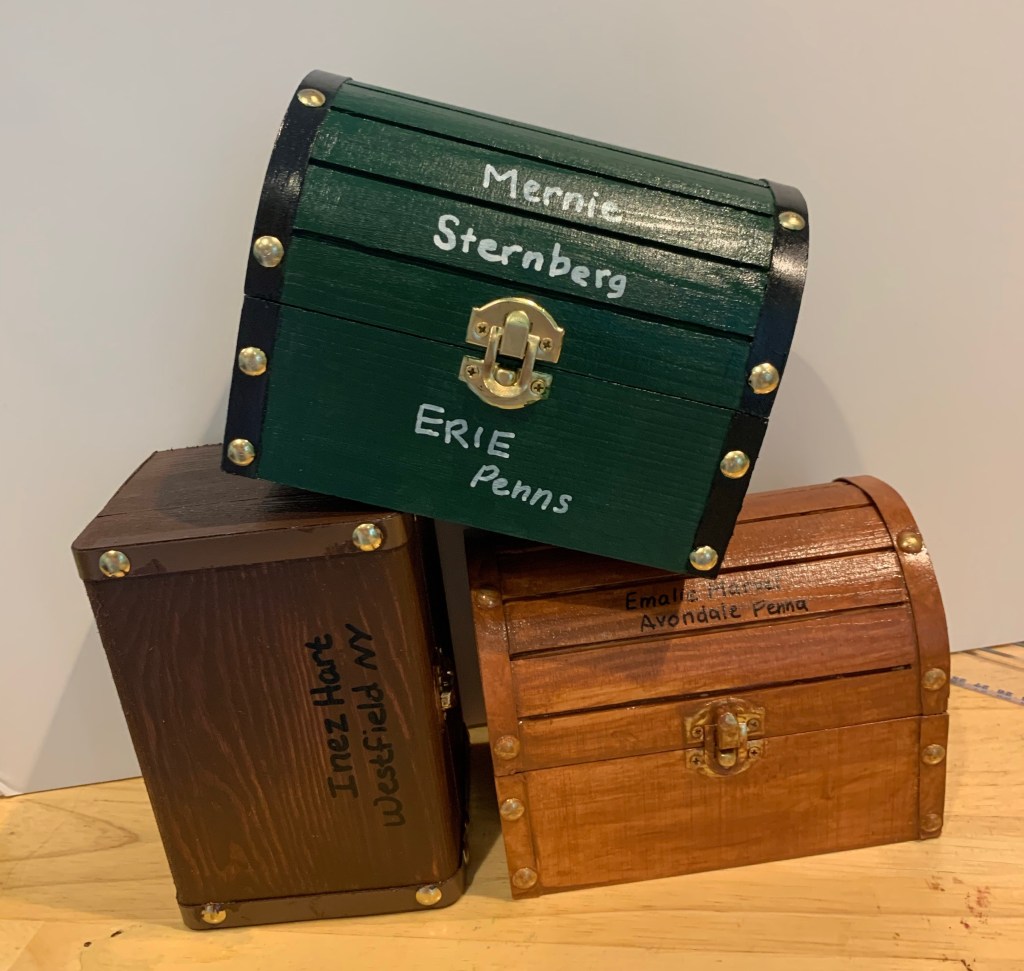
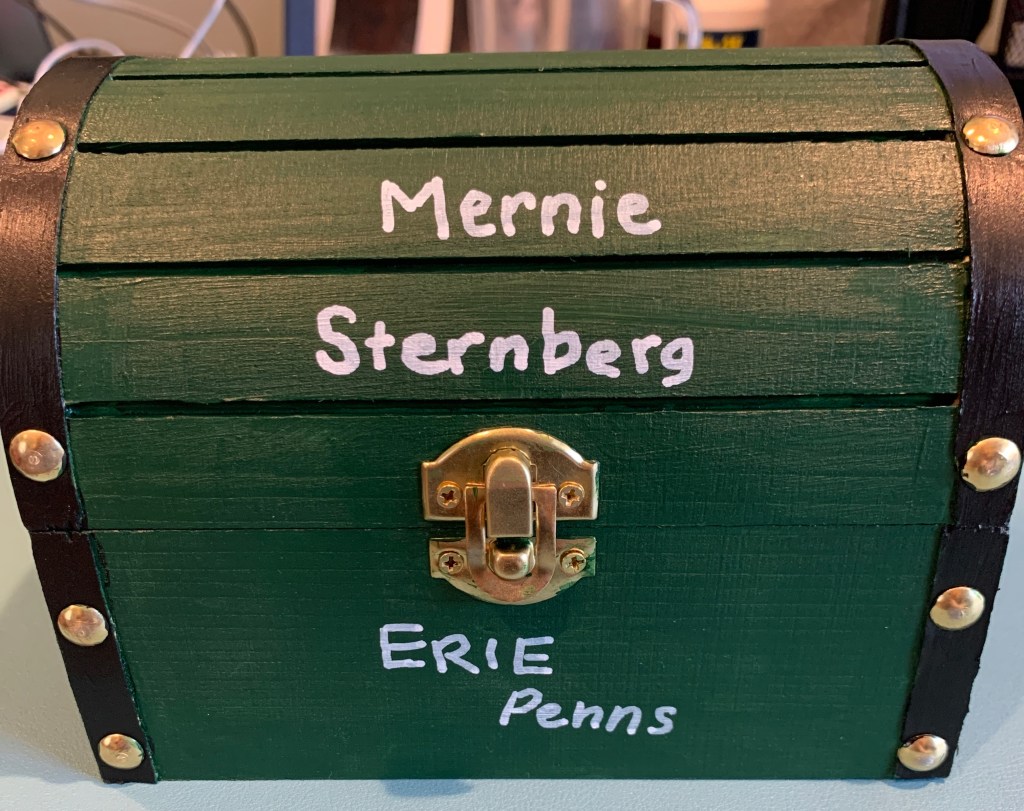
My dolls Emalie and Mernie are going to visit the 1860s soon at the Huntington Beach Civil War Days, so they need to pack their things. In the “olden times” trunks were the primary form of luggage for a long visit. I found these craft boxes that are the approximate shape that was common in the mid 19th century and decided to give them some customization.
Ready for the train
The rounded top isn’t exactly like the original trunks, but it’s close enough for my dollies.
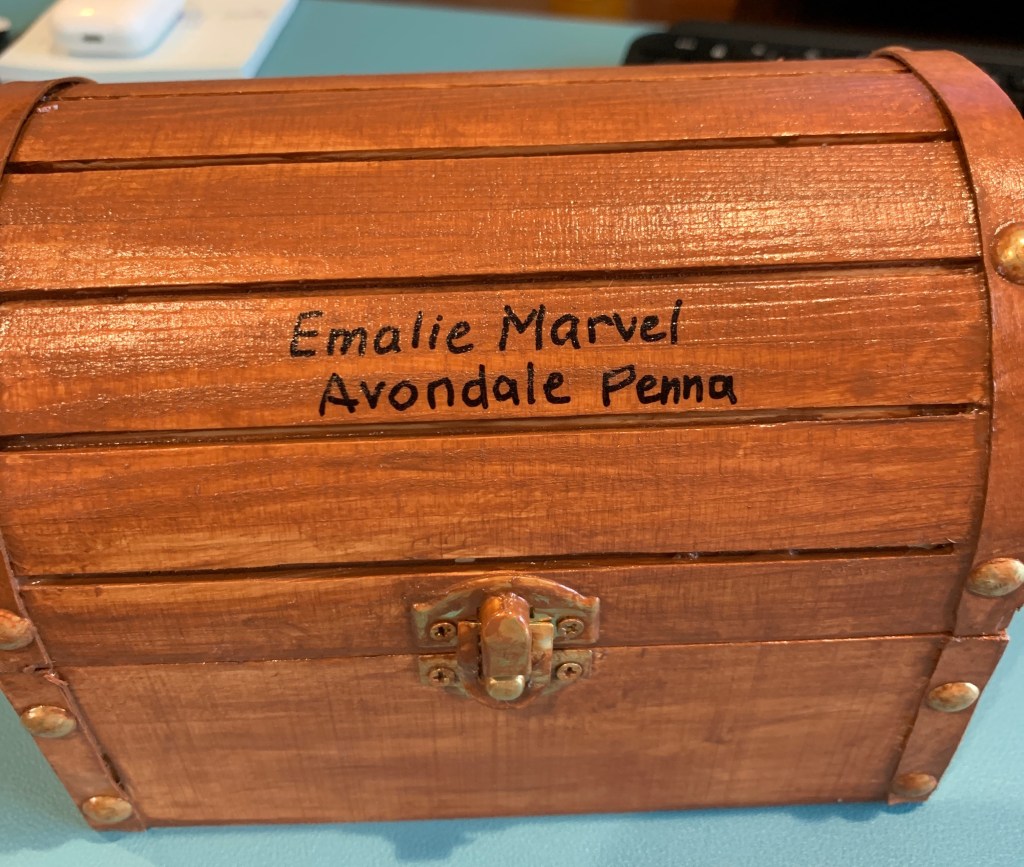
Trunk #1 I stained maple with some MinWax stain. It is super handy for crafty people with small projects and can be found on Amazon for less than $4.
Maple staining cloths
I found them both handy and squirrelly. It’s very convenient that the cloths are presaturated with the stain. They fold easily and have plenty of stain to cover a small project with left over. They were fiddly when I needed to fold them to find a new bit of stain as I used it up in one area of the cloth. Holding the project in one hand and the cloth in the other prevented me from using both hands. They also didn’t work in the small space inside the box very well and the corners were tricky. My final criticism is that they got caught going against the grain and would stop in place, so be sure to sand your work surface very smooth. Some of this may be operator error as my next attempt at staining is much better (more on that in a minute).
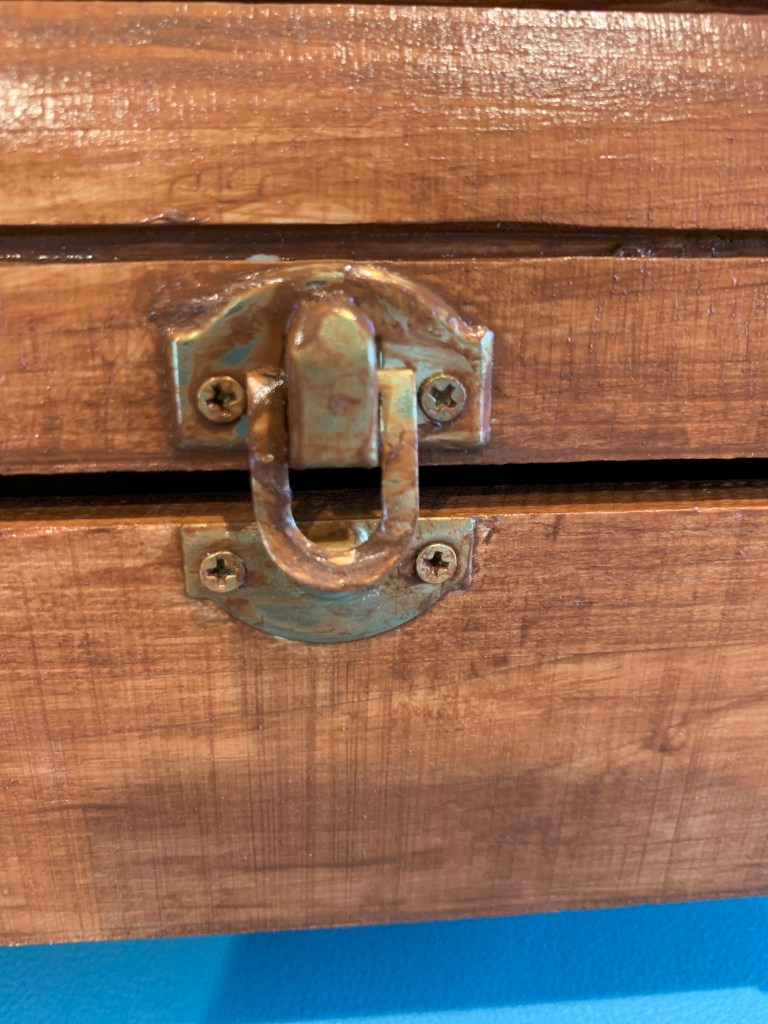
After the stain dried – in about an hour – I noticed areas where I had hit the brass fittings and was not able to rub the stain off. I don’t love that. But again, that’s operator error.
Oopsie
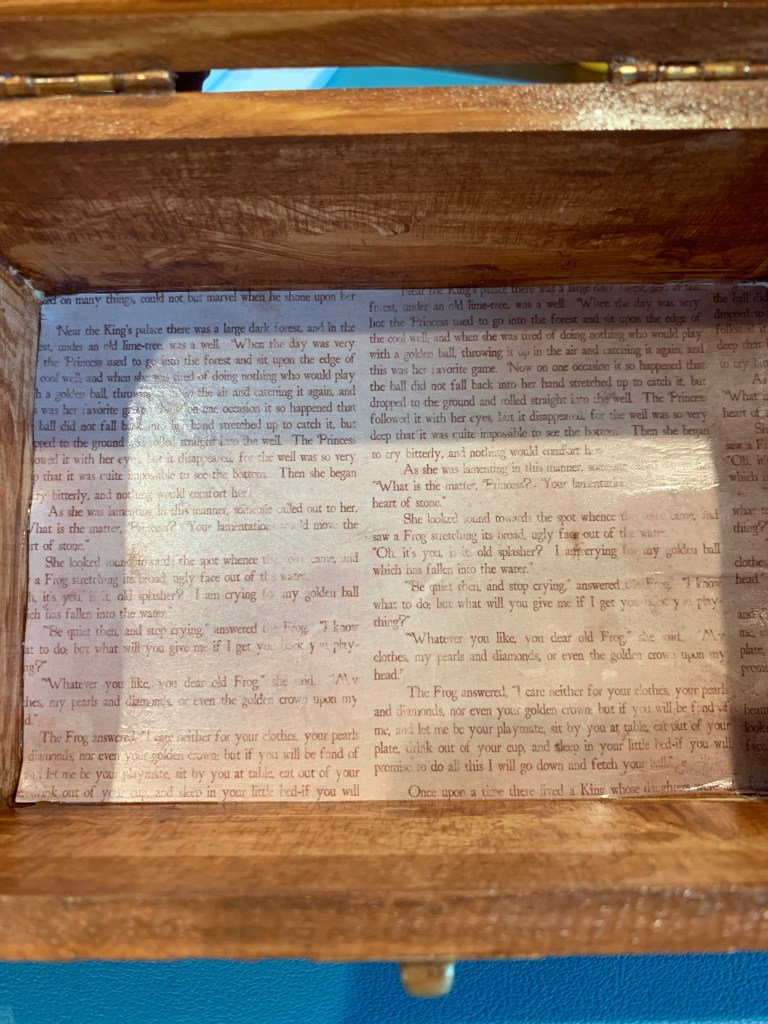
I fitted some paper in the bottom that looks a bit like newspaper and then wrote Emalie’s direction on the front.
Finally I applied a clear varnish from DecoArt to protect it while in transit. I’m looking forward to putting all of Emalie’s belongings into the trunk. Note to self: make some more belongings.
The next trunk is Mernie’s. I decided on this one I would try painting. This gave me much more control and I realized it would be better to break the painting into smaller sections. First I painted the inside black, and then part of the outside was painted green.
Black inside
It was much easier to keep the paint off the fittings although I’m not a pro so I still got a little bit on the hinges.
More tidy
Finally after putting a fancy paper on the inside of the lid I added Mernie’s hometown to the front. the straps are painted black and this trunk is finished with a Krylon spray finish.
Trunk #3 might be used at the event or might not. I haven’t decided if Aunt Inez will be made by then – or if I will have time to make Aunt Inez haha. Regardless, Inez has a very nice trunk, probably because I practiced on the first two.
This trunk I used the same staining cloths from MinWax but in the mahogany stain. It’s lovely. Kind of like with the green trunk, I broke it up into smaller sessions and I attempted to tape over the fittings to best protect them.
Lovely Papered inside
I also discovered I could use a fine paintbrush to get into the cracks. I just pressed it against the stain cloth to soak up some stain. This gave me the most control over the tricky spaces.
I’m pleased with these trunks for my dolls. They are available on Amazon or probably craft store sites. I hope you can learn a little bit from me and have a nice outcome too.
A couple years ago I discovered the beautiful doll creations of Tasha Tudor. I have written about them in other posts, and one consistency is that there is little information to be found so far about the dolls she designed, how many she designed, or any descriptions such as what inspired her designs. I am aware that Tasha Tudor loved dolls and is famous for her books and drawings.
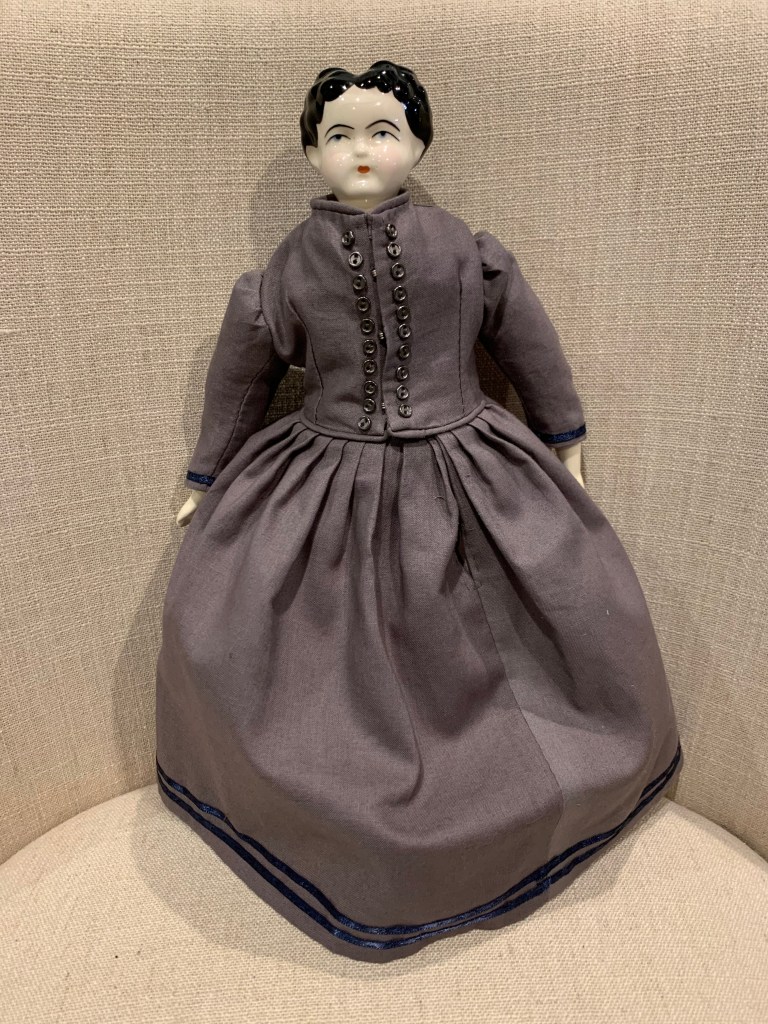
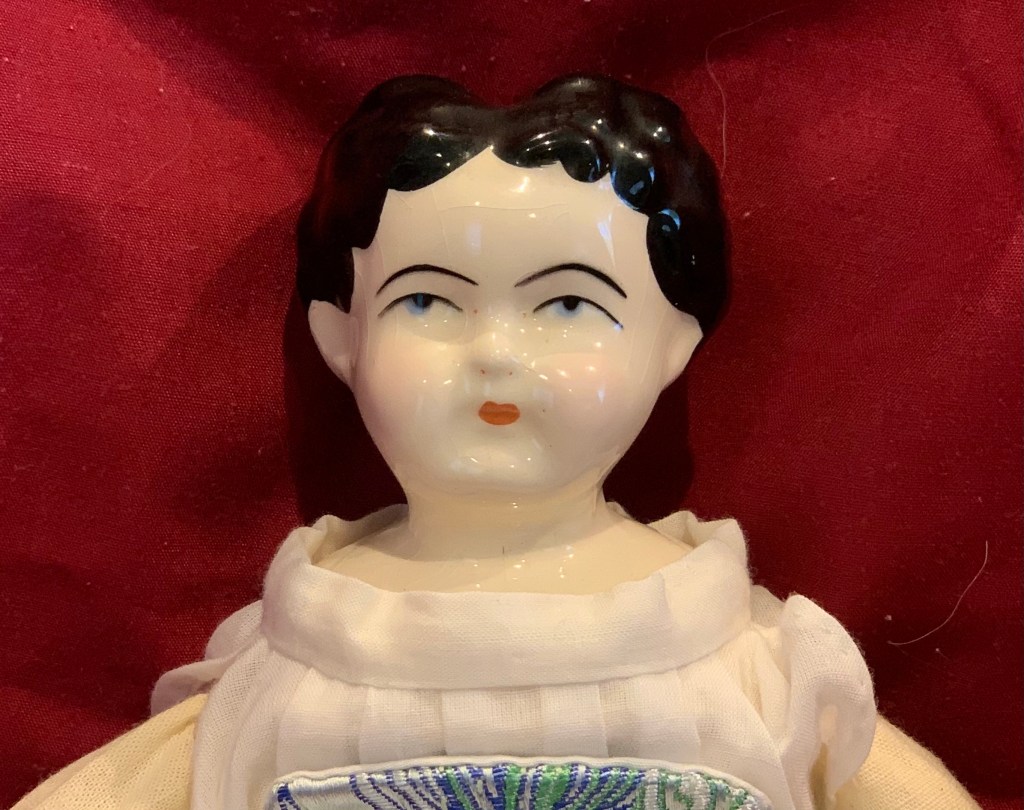
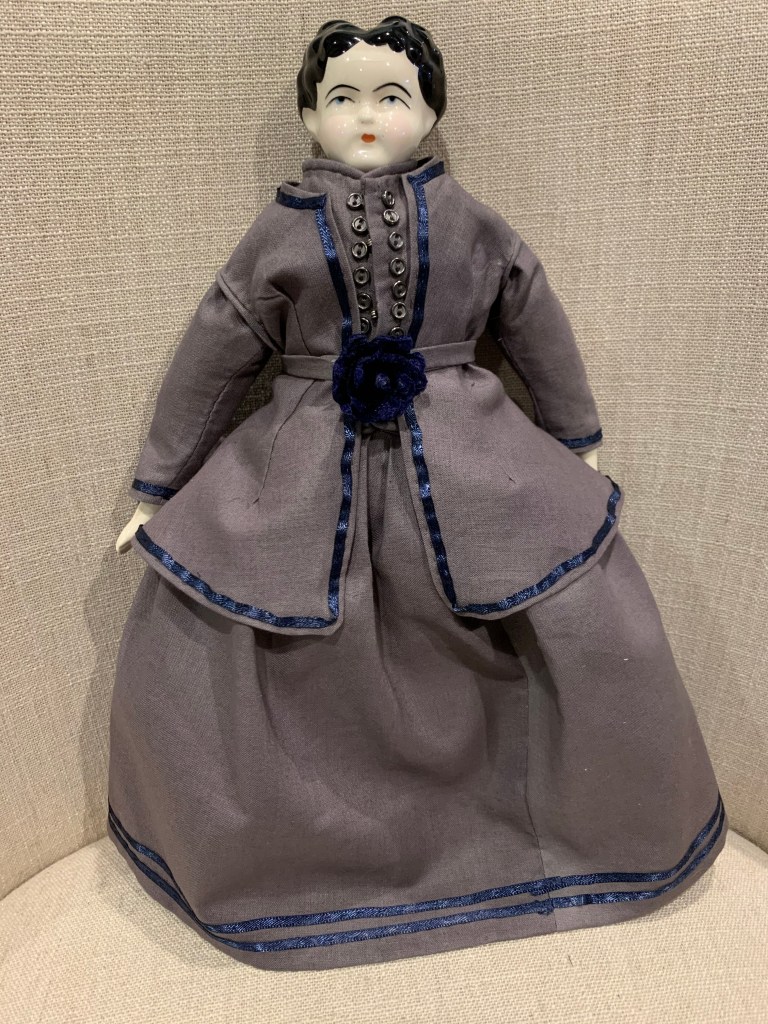
For me, it started with Nell. This lovely doll was my first china doll and my first Tudor doll. She has quite a lovely face, black hair, red lips and a slight pink on her cheeks. Nell was produced in 1977 and stands about 12″ tall. I liked working with her so much I made her two dresses, a corset, multiple chemises. She currently wears the gray 1866 promenade dress that I detailed in this post.
Pretty Nell Tudor
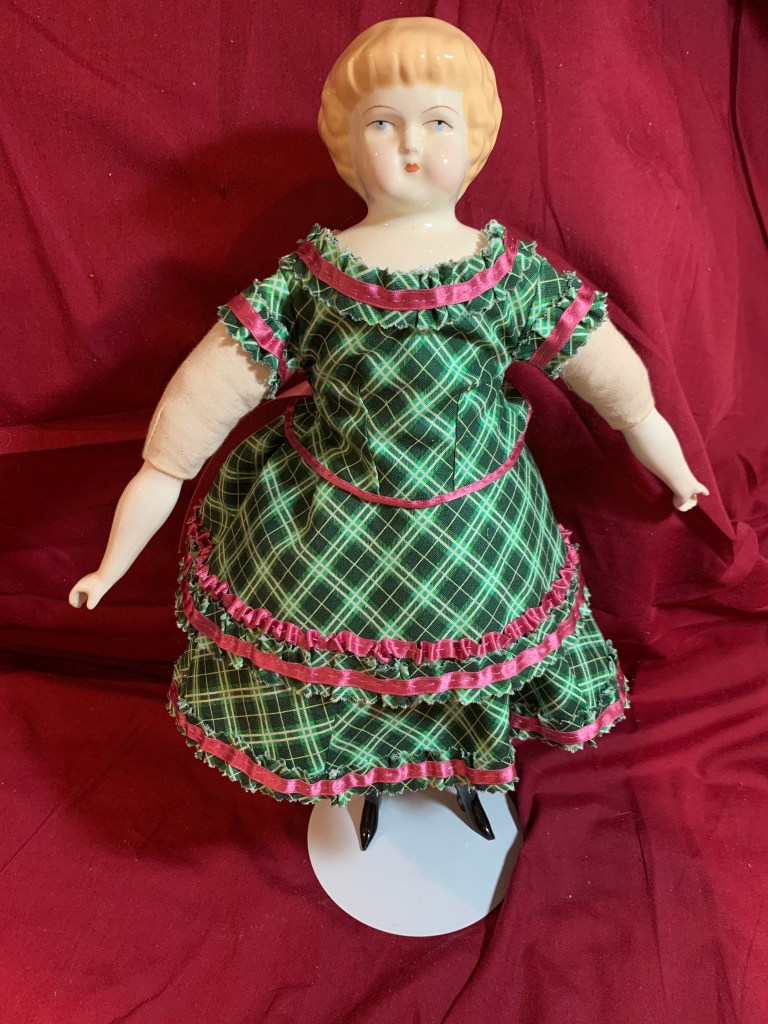
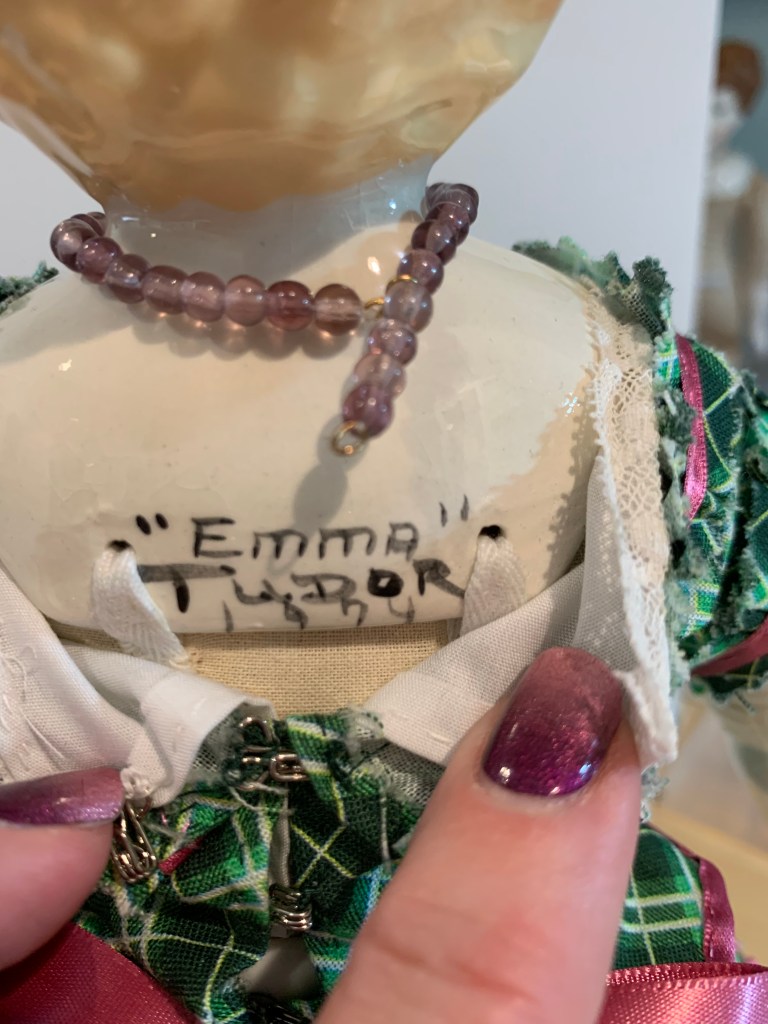
The next Tudor doll to come my way was Emma. Emma Tudor was produced in 1974 and came to me wearing a very purple polyester dress. I chose to redress her in an 1876 child’s dress detailed in this post. I don’t particularly love the fact that her cloth arms show, but I love the work that went into her dress and that it is drafted from an original French magazine. It was a tremendous amount of work, so I doubt I’ll change her clothes any time soon. Frankly I’m considering how to make her a hat. Emma is 14 1/2″ tall and has a decidedly child-like look.
Emma Blue Eyes
The next Tudor doll I worked on was one I built completely. Styled as a Meg Tudor, I changed her name to Hannah. This doll was produced in 1976 but others are dated up to 1983. Here, Meg/Hannah is styled in an 1870s bustle dress. She is tiny, only 11 1/2″ tall! I detailed the creation of her costume in this post.
Ooh, la la!
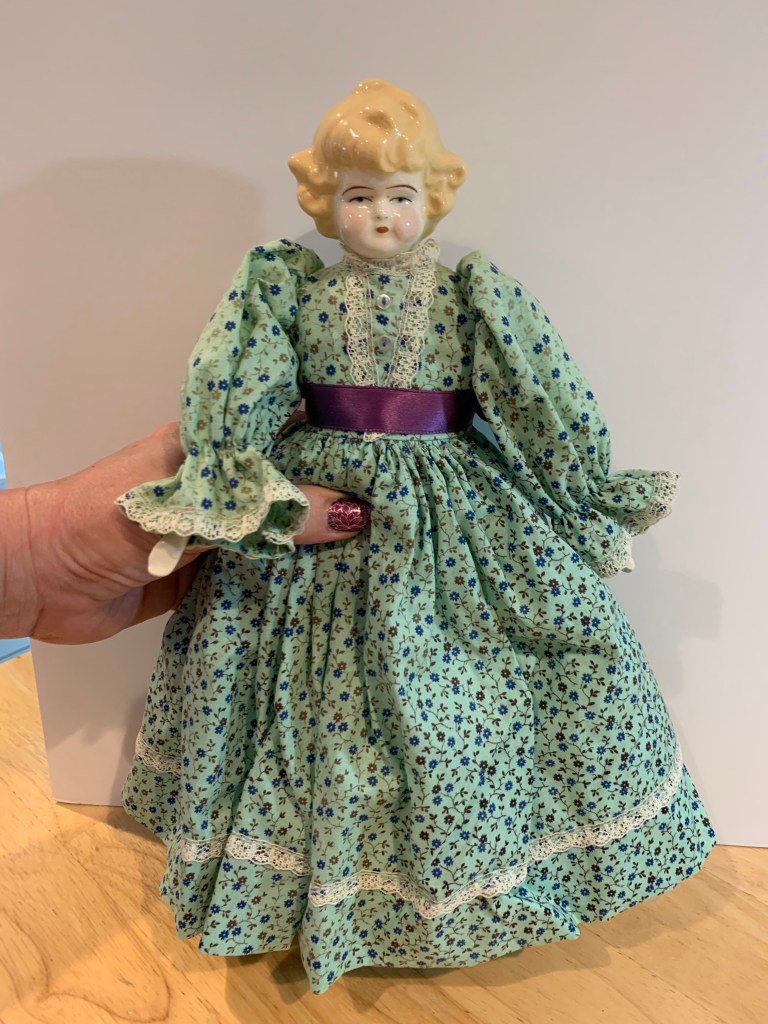
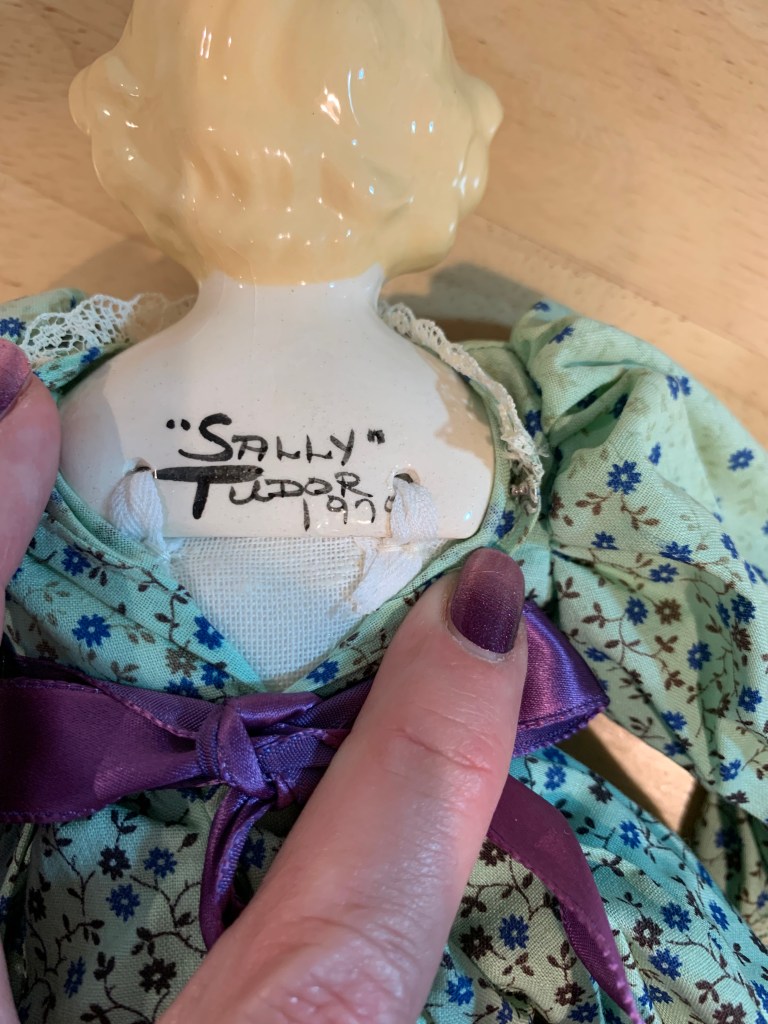
I had frequently seen Sally Tudor dolls, and wasn’t completely captivated by them until I saw this one. I didn’t want to build another doll, so the fact that Sally appeared to be well made and dressed nicely was a plus for me. Sally was produced in 1979 and is another diminutive doll standing around 11″. She is also rather child-like to me with her short haircut, and even feels a little bit 20th century. She has blue eyes and her dress is well made but a bit too long. I won’t change it any time soon.
Sweet youth Sally
After Sally, I thought maybe those were all the dolls Tasha Tudor designed. Four dolls from 1974-1979 doesn’t seem like too much or too little, and these were the dolls I would see on Ebay all the time. Then one day, just for kicks, I searched for Tudor Doll, and found two more!
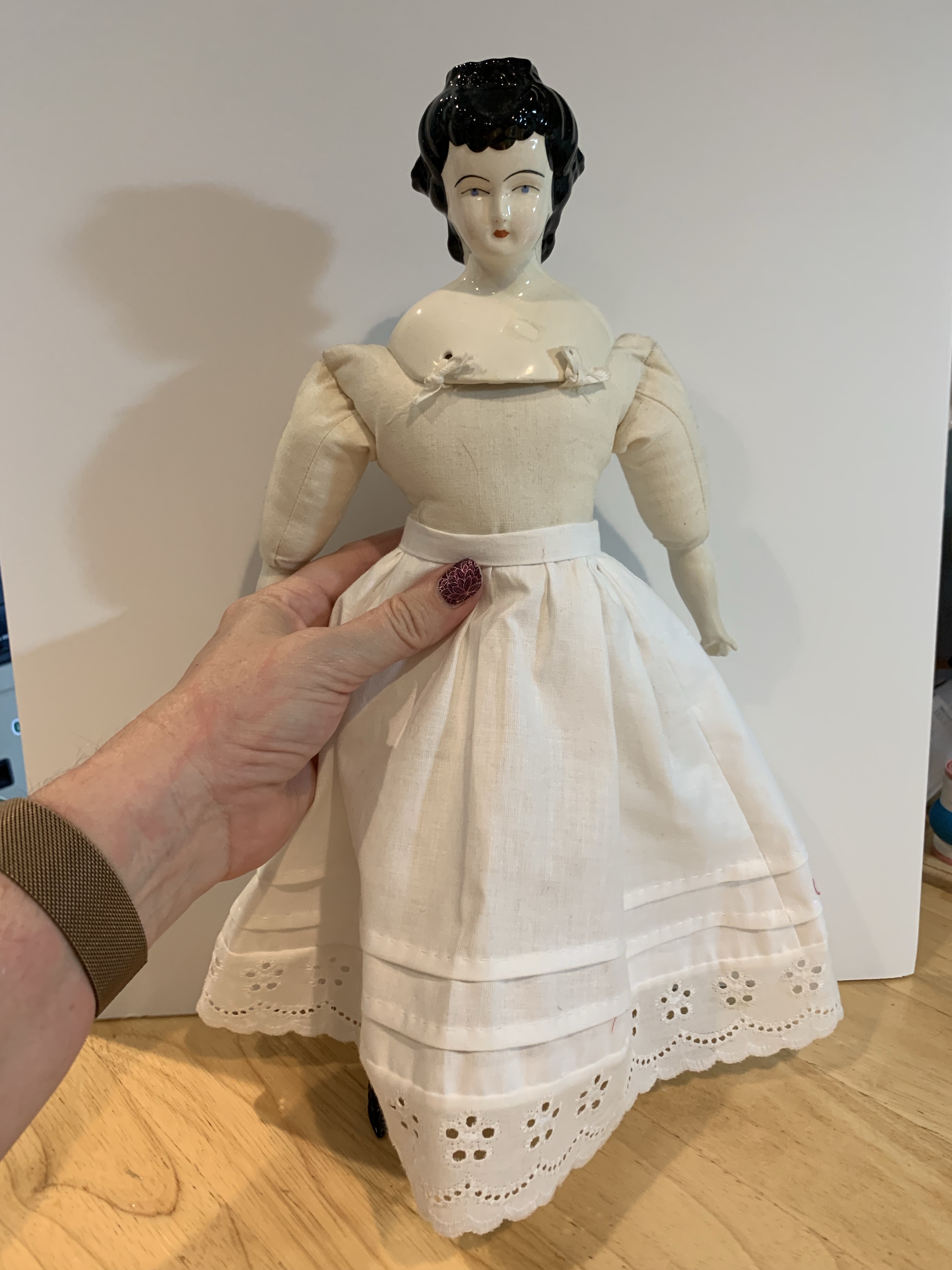
First was Julia, produced in 1973. I don’t know much about her except to say that she is quite tall! She stands about 20″ in height. Also note her hair is styled with a crown and braid, perhaps for a ball. Her clothing was pinned on her, and features an open neckline which made me think of the ball. At some point I’ll make her a new dress as this one is cotton and I’d like to make her a ball gown in satin. I think.
Get ready to dance, Julia
Next is Lady Patricia. There were actually two of these on ebay and I had never seen her at all in the past several years. Poor Patricia was completely naked and I had this petticoat that I had originally made for Emma. It fits her perfectly. Patricia Tudor was produced in 1973 and stands about 12” tall. I’ll have to make her some clothes of course and her hairstyle of a pretty up-do will inform her style.
Nearly naked but soon to be dressed
So there you have all of my Tasha Tudor dolls! If there are more out there I am not aware of them but would love to know about them. There is just something about the glossy finishes and the fine features that I really like. If you know of additional Tasha Tudor dolls please let me know!
I admit it has been decades since I last watched a Little Women film so I had to refer to the crib notes for a bit of background on Meg. She is the oldest of the 4 sisters and what I read described her as fun loving with a penchant for luxury.
I purchased this Yield House Meg doll completed with the intention of remaking her clothing. As a young woman she would have wanted to wear the latest fashions and not the frumpy frock she arrived in. Since I have been wanting to explore this category for a while it seemed the perfect opportunity.
Red and black with obvious box pleats
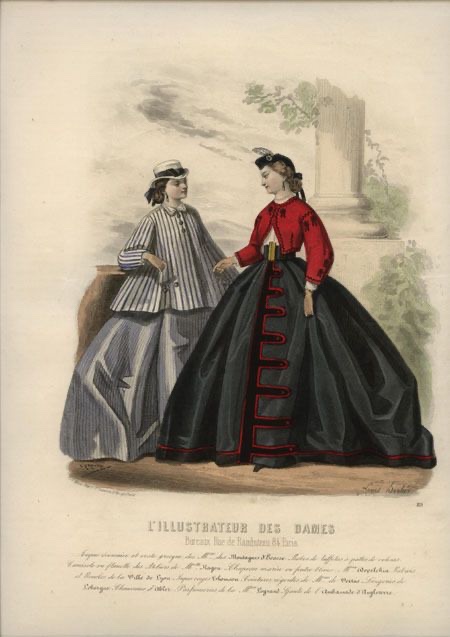
Looking at Victorian fashion plates and photos from the mid 1860s I was consistently drawn to the Garibaldi shirtwaist and skirt combination. This was a high fashion look and was sometimes paired with a bolero jacket. On a small scale I decided just the shirtwaist and blouse would be sufficient.
Inspiration drawing
In a previous post I detailed how I made Meg a cage crinoline. She arrived with a decent set of drawers and one petticoat I reused. Additionally I made her a chemise and petticoat of fine lawn.
New chemise & petticoat Cage crinoline and underpetticoat
I found a lovely red silk charmuse at a local yardage store and originally thought to make her skirt in black velvet. It might have been made that way originally but I realized working the waist would be complicated and it would likely turn out bulky. Taking to eBay I found a remnant on Japanese kimono silk.
I’m getting better at drafting patterns for dolls but I feel I could have done better on this shirtwaist. It’s not my best output. I like the skirt – it’s made with double box pleats and I loved the hand of the silk. So nice to work with! But honestly I like her undergarments better.
For historical costumers, a cage crinoline is a necessity, but you may ask yourself what exactly that is. Modern lingo for this garment is “hoop skirt” which describes a skirt with hoops in it, typically made with plastic bands and sometimes flounced. But for the original cast, a cage crinoline was a modernization of the crinoline petticoat. A crinoline petticoat was a starched cotton underskirt, often times many layers were worn to achieve the desired bell shape to a skirt. In 1856, however, the cage crinoline was patented and allowed women to achieve the shape without all the heavy skirts! They were made with steel bands – not heavy ones – that were strong enough to carry the weight of one or two petticoats on top, plus the skirt of the dress being worn.
And of course, where fashion for people goes, so goes fashion for dolls. There are remaining doll-sized cage crinolines in private collections, and they are of course on a smaller scale and not as robust as human sized garments. They can be used to fill out a skirt for a doll, or simply for the fun of putting a hoop skirt on your dolly.
Looking at how the originals were constructed, I realized this is a simple project I could make and share the instructions here. My doll is an 18″ Yield House Meg doll, but you can adjust these measurements to fit your dolls.
Supplies
I found this trim that is 5/8″ wide, 95% cotton and reminds me of Petersham. It’s a nice woven, flat trim that will do nicely. I’m also using some aluminum jewelry wire here but you can use what is available to you. You want something that is malleable enough to bend into your shape but strong enough to hold the round hoop shape once completed. All told, I spent less than $10 on the supplies.
First you need to do some thinking and measuring. For a Yield House doll, the skirt is made from a 36” length of fabric. This results in a nicely full skirt similar to those worn in the 1860s. Consider how tall your doll is and how full her skirt is. You want the bottom hoop to be less than the full circumference of the outer skirt. I chose to make the bottom hoop 30” around. The top hoop should be wide enough to fit over the hips of your doll. Meg here needed 15” for decent clearance. For the middle bone I split the difference and made it 23”
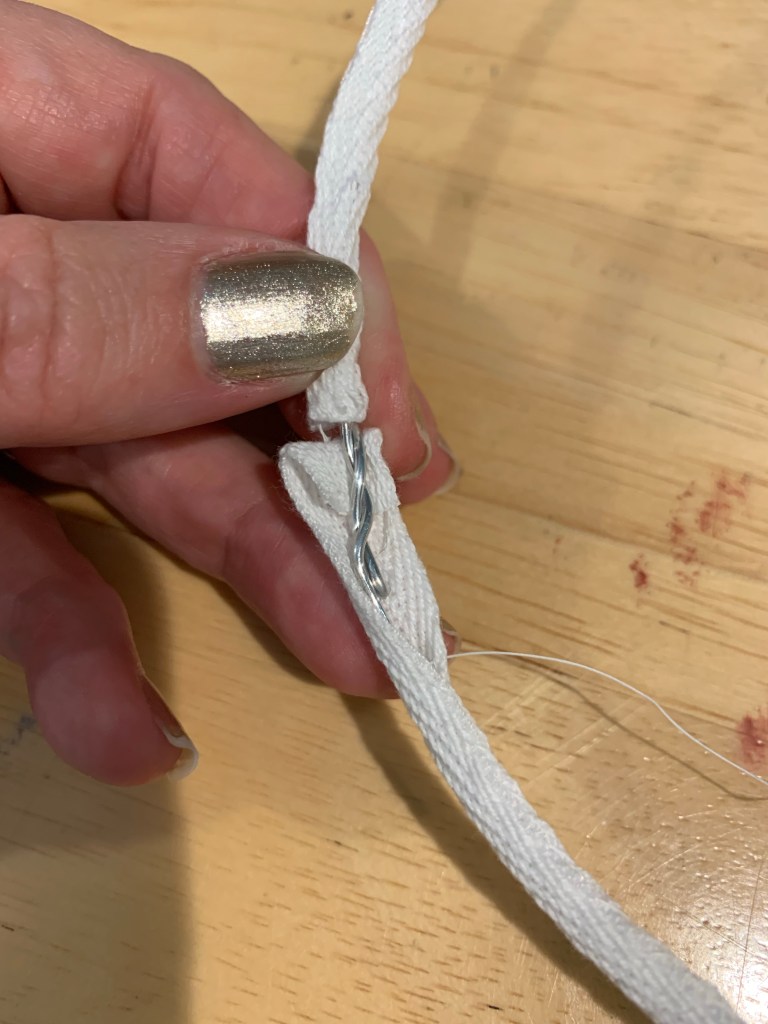
Once you have your hoop circumferences, measure your wire to that length plus 2-3” overlap. Cut the wires and then twist the ends together.
Twist the ends together
Make all three hoops, then you can measure the tape to cover them exactly. Allow at least 1/2” on either end to turn the raw edges under. Beginning at the joint, fold the tape around the wire to encase it and then whipstitch it closed.
I used quilting thread but any type will do
Once you get to the end, tuck the end under and whip all the way around the joint.
Bring the folds together and stitch
Repeat on the second and third hoop until all three are covered. The next step will be to find the quarters on each hoop and place a small mark. This will ensure the vertical tapes will hang straight. these marks will be covered, don’t worry.
Mark the quarters
Determine the drop of your hoop skirt next. This is the length from the waist to where you want the lowest bone. I chose a 9 1/2” drop so the lowest bone would be near the tops of the doll’s boots. This is about where my life size hoops hang as well. Consider you need 1/2” on either end to tuck under – so add this onto the drop measurement. This gave me a 10 1/2” vertical tapes. Cut 4 of these. Don’t forget to measure the waist of your doll and cut a waistband to that length plus 1”.
The hoops should be equally spaced on your vertical tapes. Don’t forget that you will attach them at the top and the bottom. I measured and pinned the placement for the first and second hoop. The hoops attach at 3”, 6 1/2”, and 10” (the bottom).
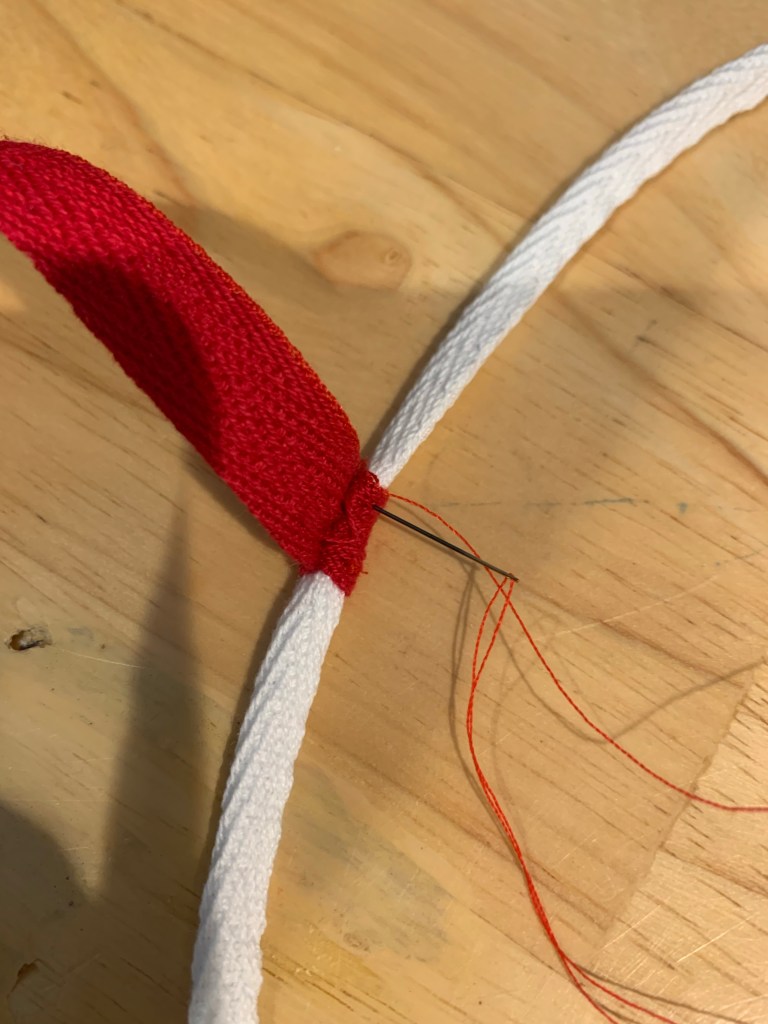
Beginning with the lowest hoop, wrap the tape around so the raw edge will be enclosed. Stitch that in place. Repeat at all four quarters.
Enclose the raw edge
Moving to the middle bone, fold the tape over the hoop so you can stitch through the vertical tape, through the hoop covering under that, then out the vertical tape. You aren’t stitching behind the hoop wire, just catching the tape wrapping it. Repeat on all quarters and then move on to the top hoop.
Pin it into place until you stitch it
Once all the hoops are attached to the vertical tapes you are ready to attach the waistband. Turn the ends of the waistband under and stitch so the raw edges are inside. Remember, the waistband is the measure of your doll’s waist plus 1”.
Finished edges
Find the quarters of the waistband, place a small mark, then pin the tapes in place.
Stitch these in a square that will secure the tape and keep the raw edge inside. Once that has been done you can add a hook and eye or thread bar. You are done!
Finished cage crinoline
My doll happens to have a modesty petticoat under her new cage crinoline and then a fine starched cotton petticoat over it. I’m making a silk skirt for her next and this should do nicely to help it hold it’s shape.
All told I used less than the full amount of wire I purchased and less than a full spool of the white tape. Had I made the vertical tapes in white I might have used close to the full spool. I hope you found this little article helpful in demystifying the cage crinoline and will feel confident in trying one for yourself!
Supply List
5/8” Petersham or similar woven cotton flat trim (don’t use twill tape as it will ravel)
2 1/2 yards white
1/2 yard red (to make in all white add this to the length above)
























 Notes from the Melody Maker