Martha Tudor’s Spring Dress

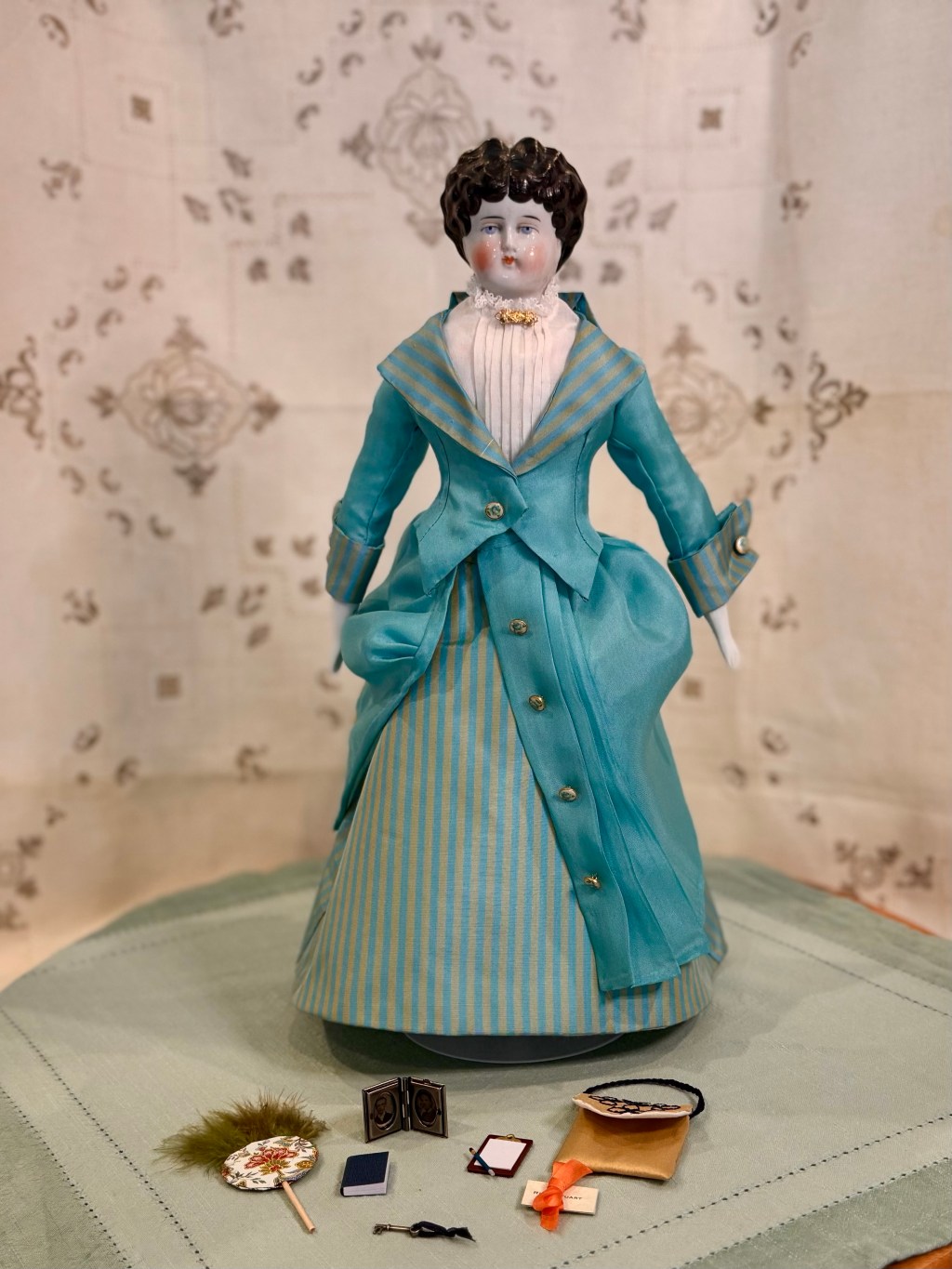
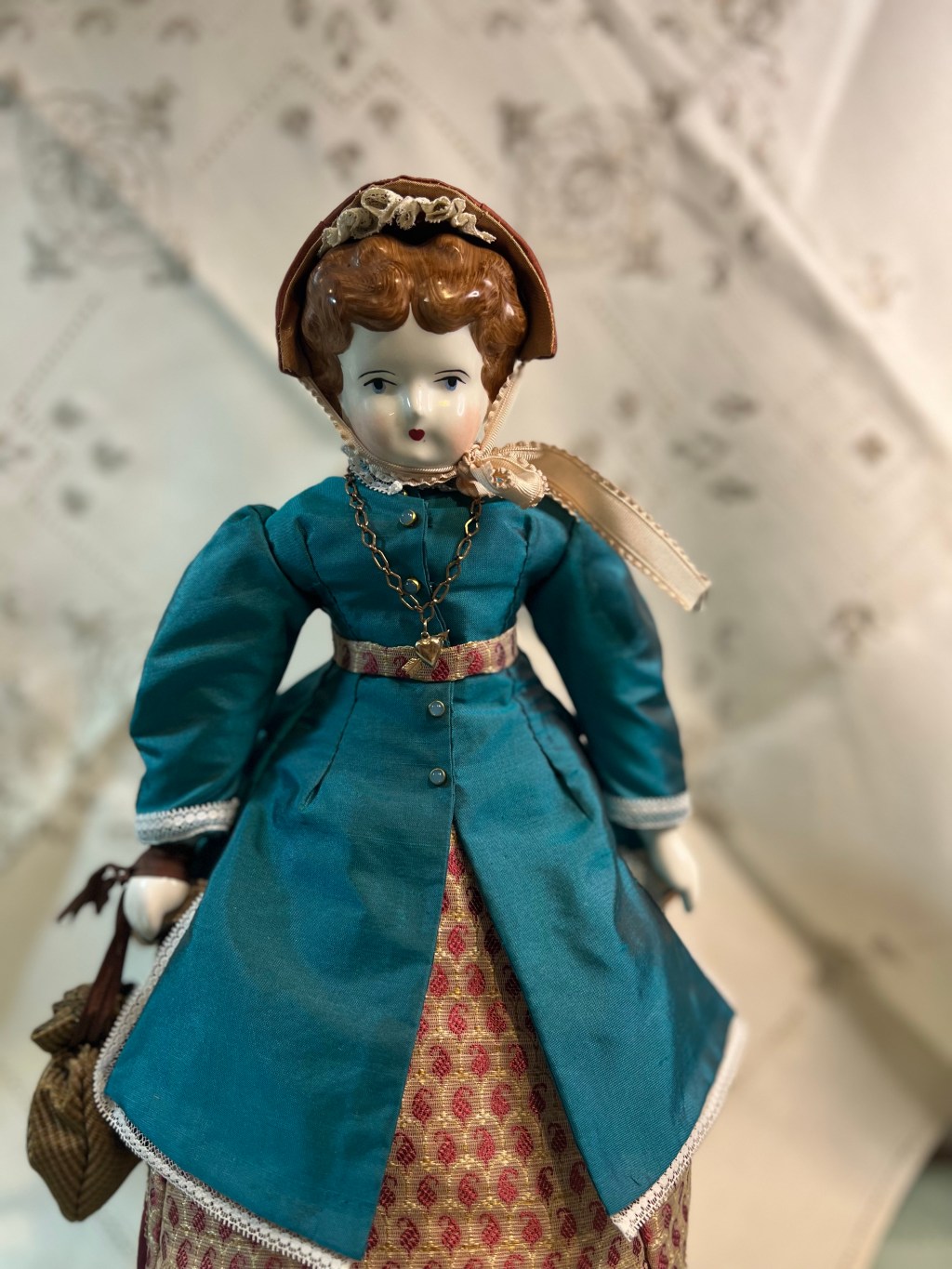
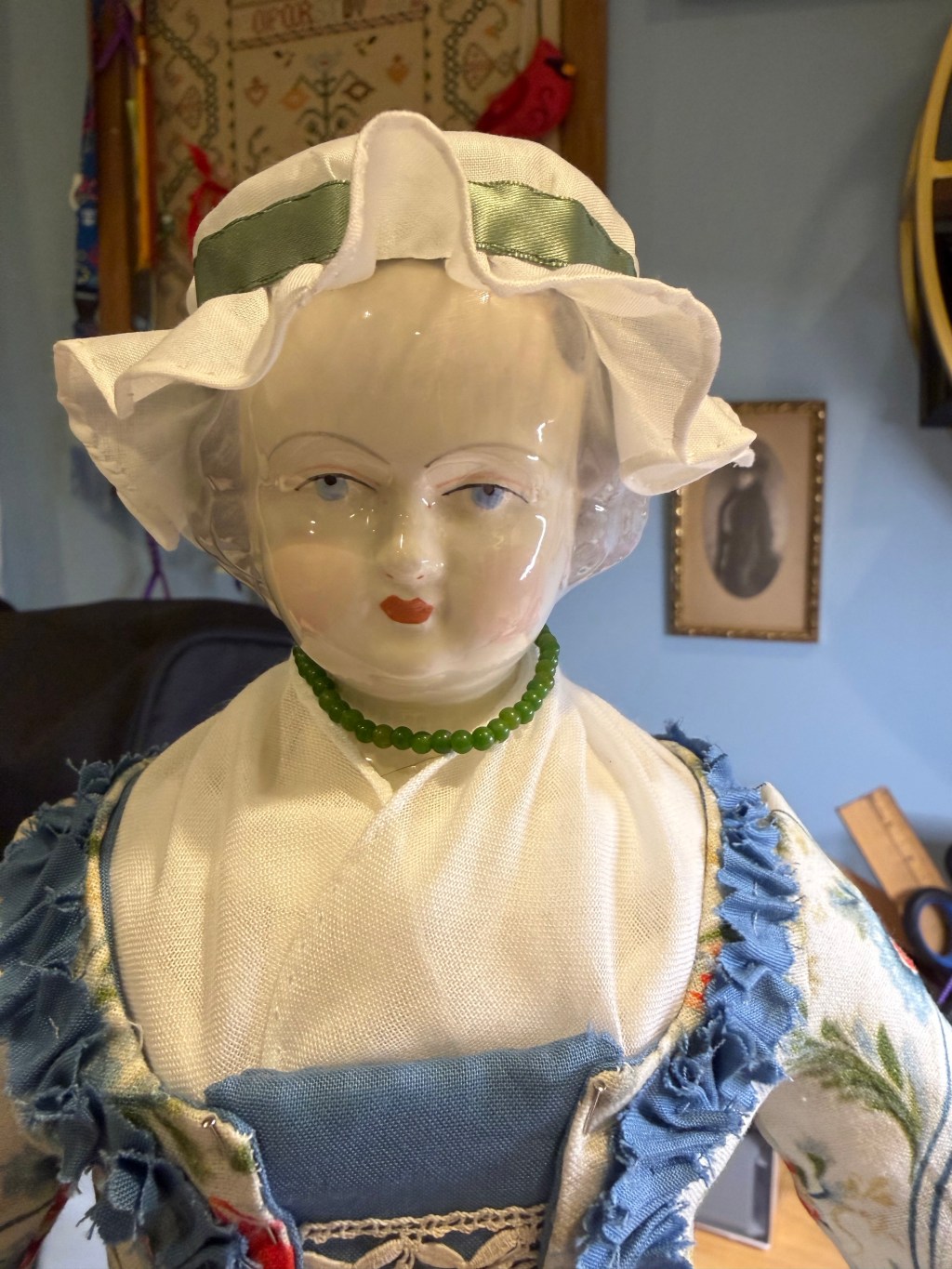
The last time I posted, Martha Tudor was in her undergarments. I’ve made tremendous progress and she now has a lovely robe à la francaise for the spring.

The fabrics are cotton, which was popular in the 18th century.

The robe à la francaise is characterized by pleats at the center back of the gown. I found the instructions from The Doll Book downright confusing so I drafted my own pleats.

The bodice also includes a lining that is separate from the outer fabric. I do not know if this is historically accurate but it did allow for lovely draping of the pleats in back.

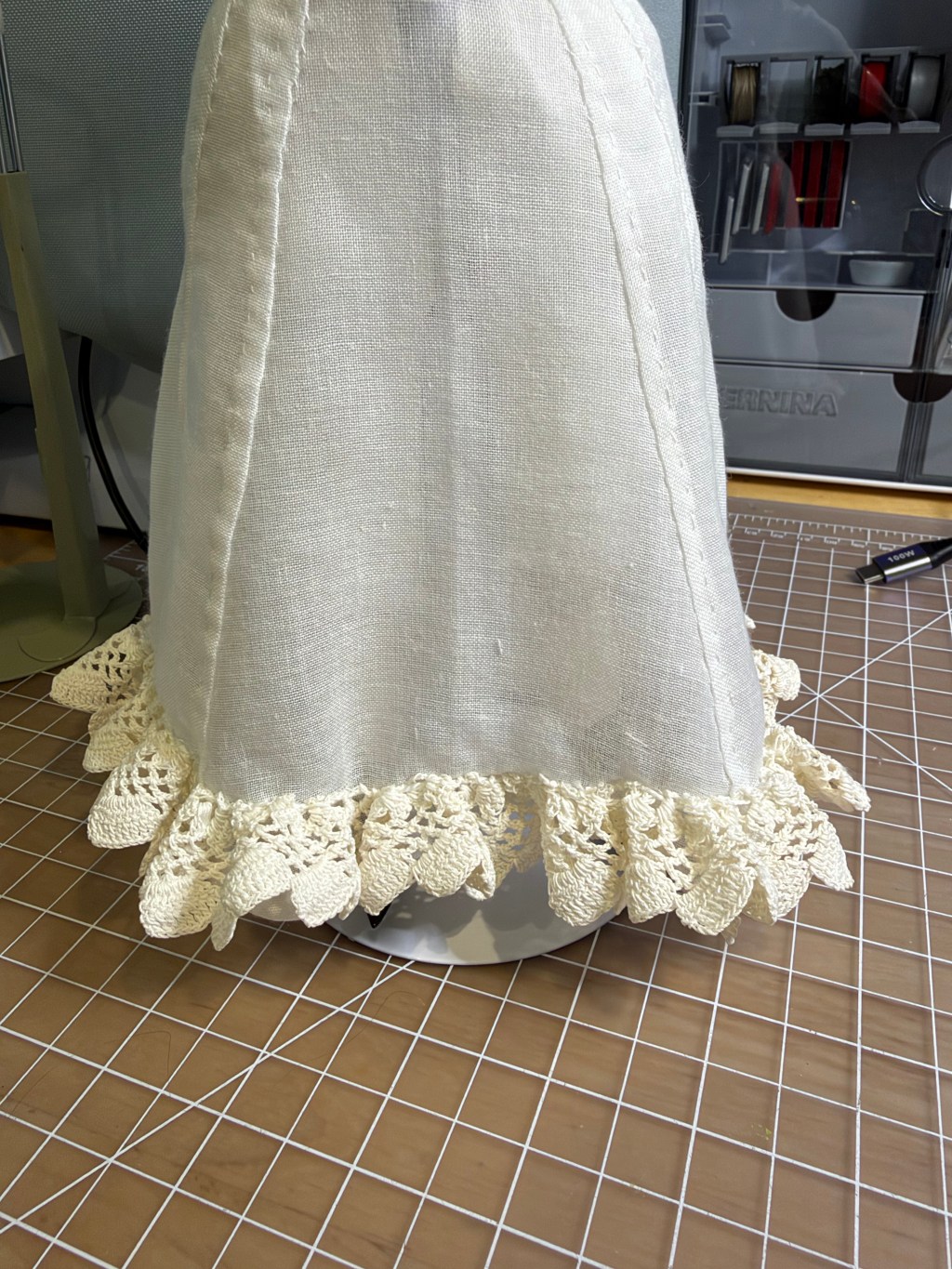
Here you can see the quilting on the front panel of her petticoat. This was sewn by machine and is backed by a piece of plush flannel to give dimension.

This center piece of the bodice is called a stomacher. It is a firmer piece that is pinned in between the two sides of the bodice. In this case, I cut the base from the back of a notepad, then made a “pocket of the blue and also added a piece of the flannel to soften the front. The lace decoration is vintage tatting I had in my stash.

Yes I hand gathered all the trim. It was more of a pain to stitch it down than it was to make it, honestly!

These are the 3/4 sleeves with French lace. This was a popular style of sleeve in the 18th century apparently.

Modesty dictated a fichu be placed in the neck opening of a gown, like this. This piece is batiste and I hand rolled & whipped the edges. It took forever but it’s perfect for such delicate fabric. The fichu here also hides all the repairs where Martha’s chest plate had been broken. The green beaded necklace came with her.

I also made the mobcap. I measured the distance from ear to ear over the top of her head and then added an inch. I used my compass (thank you high school geometry!) to draw the circle and also an outer circle for the brim. The mobcap is made from lawn, which is a little more still than batiste but still a fine and delicate fabric.

I painted on shoe buckles. My thinking here is that Martha Tudor is already broken and repaired, so changing her feet isn’t going to destroy some collector’s value. Unless it’s 100 years from now. In which case I won’t be around. :-)

I quite like the results! I’m not sure who is next in the project list – I have several to choose from. Stay tuned to find out!

More undergarments

I kept working on Martha Tudor the last couple weeks and completed two more items. First up was a set of stays.

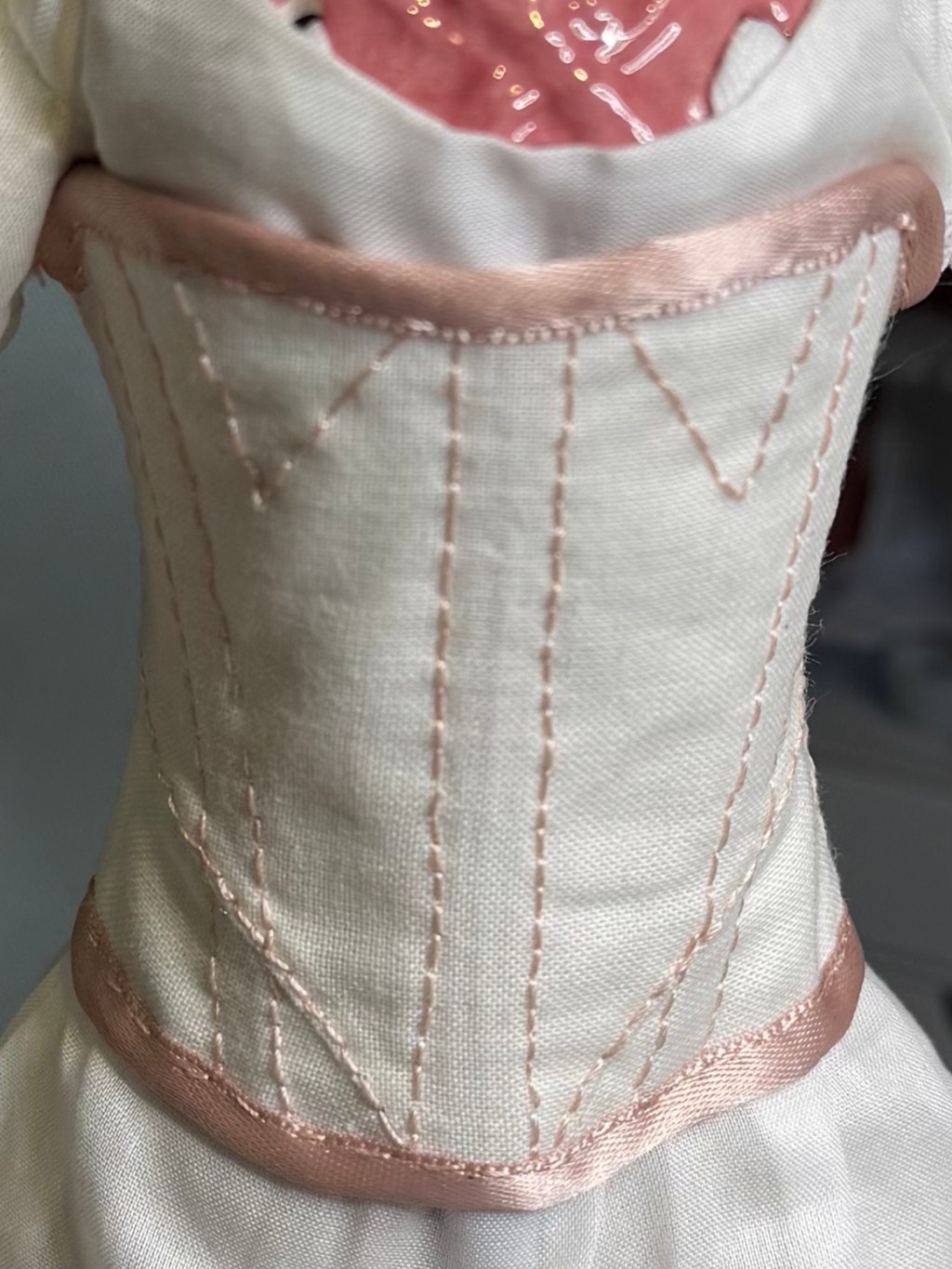
18th century stays

I used the Susan Sirkis WB14 stays pattern, upscaled it, adjusted it to fit, redrafted the adjusted pieces and then went to work.

I chose to make it in two layers as I find the garments just fit more authentically with enough fabric in them. So I cut all the pieces, transferred the marks and then assembled an inner and an outer layer.

Partially completed stays

The pieces are sewn from the top edge to the waist marking. This allows for the creation of the tabs which were seen on 18th century stays. All seams are pressed toward the back. I found turning to be fiddley mostly in the tabs. I think making these stays in their original size (approximately Barbie doll size) would really be a big pain.

Final steps

I used this white cotton Petersham to bind the top edge and also stitched down all the seams. I also stitched in mock boning channels on the center front panel. I was able to use my machine for some of this work which saved so much time and gave a really clean finish. The final steps were then to stitch the eyelets and the shoulder straps.

A blood sacrifice

I quite like making eyelets for some reason. It’s a sort of zen process to me. But this one got me and I left some of my blood in the stays. That surely portends the rest of the clothes will come together easily, right?

Back lacing

Here you can see I laced the stays from bottom to top which was apparently how they were done in this era. I’ve seen multiple videos and photos of people lacing their stays this way.

Padded panniers

Here are the padded panniers I made. They are basically a figure 8 shape, then folded over the waistband and stitched together. They kind of look like saddlebags to me. The panniers are lightly stuffed with cotton to give them body, but not so firmly they won’t give a little under the weight of the skirt.

So that’s the completed undergarments! I’ve been working on the skirt – it was called the petticoat in this era but didn’t hide underneath the main skirt, it was the main skirt. Interesting how terminology evolved. Stay tuned for that garment coming up next.

Martha Tudor Part 2

I completed the very first piece of her wardrobe: a basic linen shift.

My intention with Martha is to dress her in a 1750s style. Probably I will make a robe à la francaise. This is the type of dress with a wide skirt to the sides.

Met Museum

Now, since she is from the Colonies, she isn’t going to have the exaggerated width of a court gown.

British Court Gown – Met Museum

I’ll be making some small pannier pads to hold out the sides. The robe à la francaise is characterized by Watteaux pleats on the back of the gown. These back pleats were in fashion off and on through the 19th century!

Watteaux pleats

I do have lovely fabrics selected for this project. I do not have patterns. I’ll be drafting and/or upscaling pieces from a variety of sources. The shift I made, for instance is based on a 19th century style nightgown with some changes and I drafted the sleeve.

And since Martha is another 20” doll, I’m going to try using my sewing machine for parts of the clothing. Of course no setting in sleeves, they are just too small for my sanity, but much of the rest of the garments can be machine sewn. That should save my eye sight a little bit.

Stay tuned for future updates!

A few completions

Since finishing Julia I took a short break from china dolls so I could work on Christmas. First up is Inez. In September 2024 I started this dress. Thankfully Inez is incredibly patient!

Happy Christmas!

I love the bias plaid. The bodice is a gathered front bodice with long slim sleeves and a small tuck at the cuff. I had completed most of the bodice back in 2024 and then set this project aside for others. While out shopping with my sister I found this lovely grosgrain ribbon to adorn the skirt, but it still needed something. I then found this perfect red trim. I love the festive colors all together. I actually have two additional holiday dress cuts so maybe by 2030 Emalie and Mernie will have Christmas dresses, too.

Next, for a Christmas gift, I have been planing this cute bathing costume for my sister’s doll, Dottie.

Let’s go to the beach, beach

Emalie of course is the model because it’s a gift. Many years ago, my sister and I and another friend made ourselves Victorian bathing costumes. My sister’s was this color scheme and I thought it would be so cute for her and Dottie to match.

I used the Elizabeth Stewart Clark patterns as a base, but made the standard back opening bodice into a front opening. Then, I used the drawers pattern, cut short, and joined the top and bottom with a waistband.

Union suit

It’s kind of like combination underwear. I gathered the sleeves and legs, then added the red ribbon trims. The buttons aren’t functional, it closes with hooks and eyes.

Finally, I made a sweet little skirt, not as full as the standard dress pattern calls for. This is gathered to the waistband, then the skirt buttons to the center front of the bathing costume and has a center back closure.

Ready to take a dip

I’m really pleased with this gift and I hope Dottie likes it too.

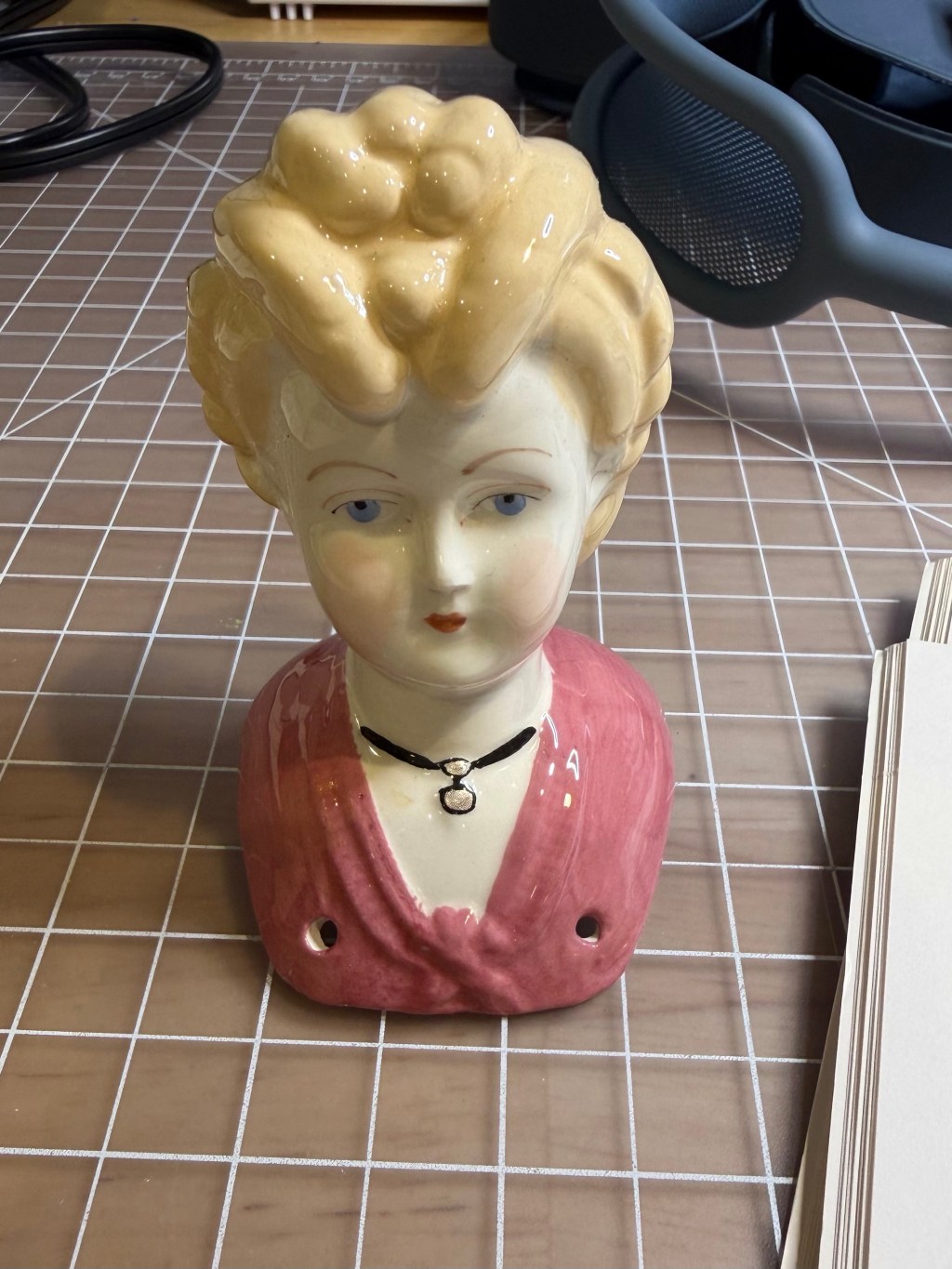
Finally, one funny little thing for me! With my hand sewing, I felt that I would like a pin cushion to keep handy. On eBay I was seeing half dolls made into pin cushions, then one day I saw these legs. I thought this was just hilarious and I knew exactly what I wanted to do!

Leggy Linda

I pictured her with frilly skirts all around, but in all honesty that would not be very practical for a pin cushion. She does have a purple silk skirt and a batiste petticoat, and that’s probably just fine. The pin cushion itself is a cotton base with emery inside.

Whoopsie!

I say that Leggy Linda the Lush had a bit too much eggnog and fell into a snowbank. Her legs are about 1.75” btw, she’s tiny.

That’s the latest for now. I am working on drafting patterns for Martha Tudor after finding a perfect 18th century inspired fabric. Stay tuned for that project coming soon!

Martha Tudor – Part 1

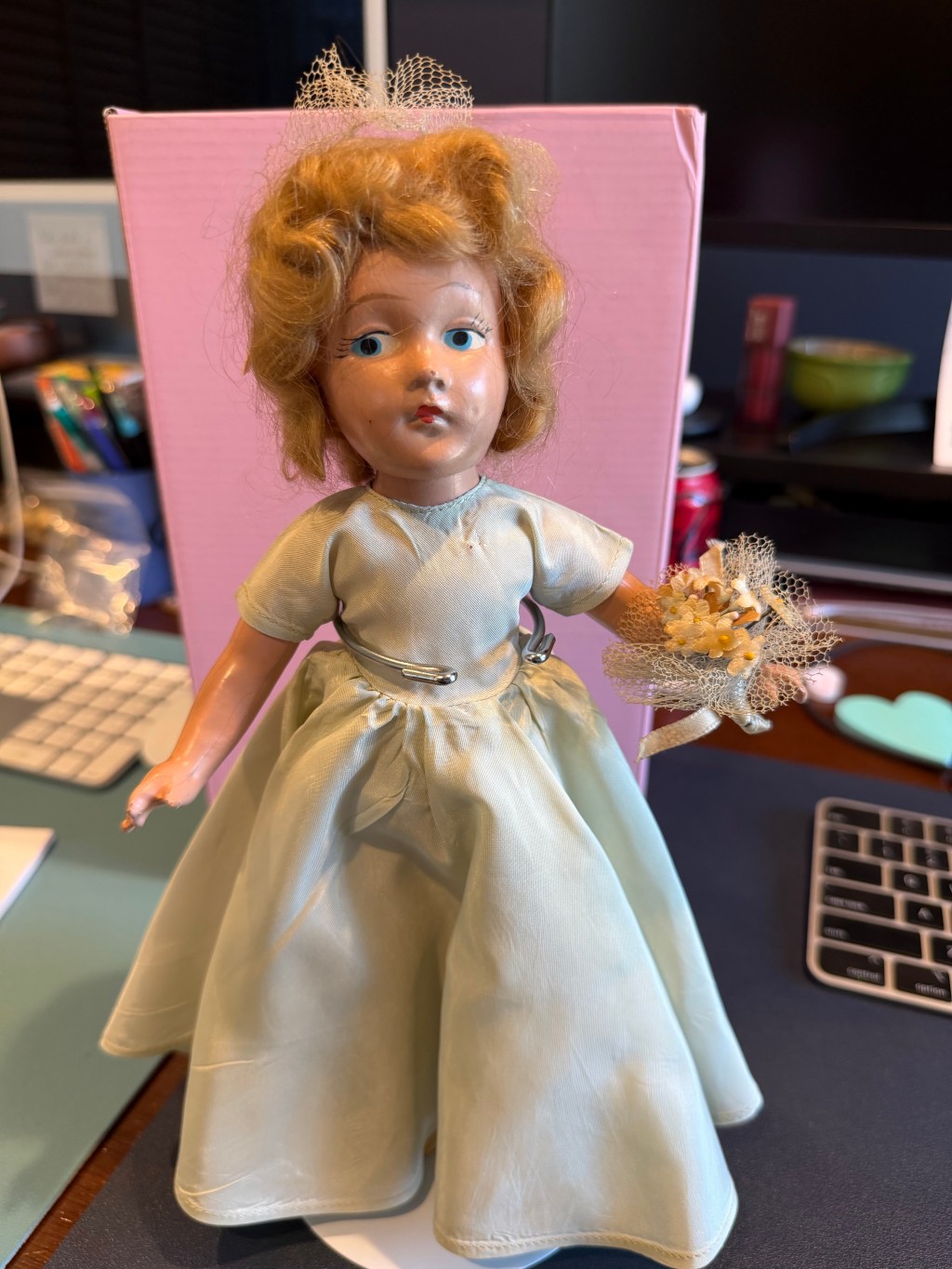
As a fan of Tasha Tudor dolls I regularly check eBay for new items listed. The most common dolls are Meg, Emma, Sally and Nell. Less common but still occasional are Molly and Dora. I have seen Amy, Julia, Lady Patricia, Trudy and Martha only once. When I see these uncommon dolls listed I usually put on a really high maximum bid because I don’t want to lose them.

While I was finishing Julia, I saw an auction for Martha, placed my stupidly high bid and waited for the auction to close. I hate auctions lol. Anyway, I won her and waited with great excitement to receive her because I have only heard of her from a site visitor – never seen before the auction.

The box arrived. Crushed.

Martha had a visit to the French Revolution via USPS or UPS or however she was shipped.

The seller has refunded me.

I lamented this happening to my family and my daughter suggested trying to glue her back together. Could I do that?

I found a number of articles online about fixing a broken chest plate on a doll. A couple referred to this porcelain and ceramic glue.

It comes with some very fine tube tips for highly precise glue application. I felt a bit like one of those artisans at a museum putting together shards of pottery. Ok not really. I actually was thinking of all the moms and dads through the years gluing dolls and cookie jars after the kids got too rambunctious.

Fortunately Martha’s head is intact! I carefully removed the pieces from the body, then tried to figure out how the parts would fit together. A bit of glue on the broken edges, then pressing them together for 30 seconds created the basic bond. This glue needs to cure up to 24 hours.

I’m not thrilled with one seam. I didn’t want to force the porcelain into place and the seam is off just a smidge.

I applied glue to the cracks inside and outside as well. There are a couple of holes where bits of the porcelain has been lost.

When it comes time to reunite her head with her body I may use glue instead of sewing tapes because I don’t want to put too much stress on the china. I am also considering strapping over her shoulders. I had to do that with Julia as her chest plate had cracked between the hole and the edge. There may be a few other alterations in her future as well – painting on gold shoe buckles, stitching in elbows and knees, little things like that.

Needless to say, Martha will have a high necked dress. I will also be trying to style her in Colonial attire. That’s an era I know nothing about clothing wise, so this one will really be a learning experience for me!

I was going to dress Lady Patricia next, but I think she’s going to have to wait a bit longer!

I also need to do something about her linebacker shoulders haha.

Here Comes The Bride

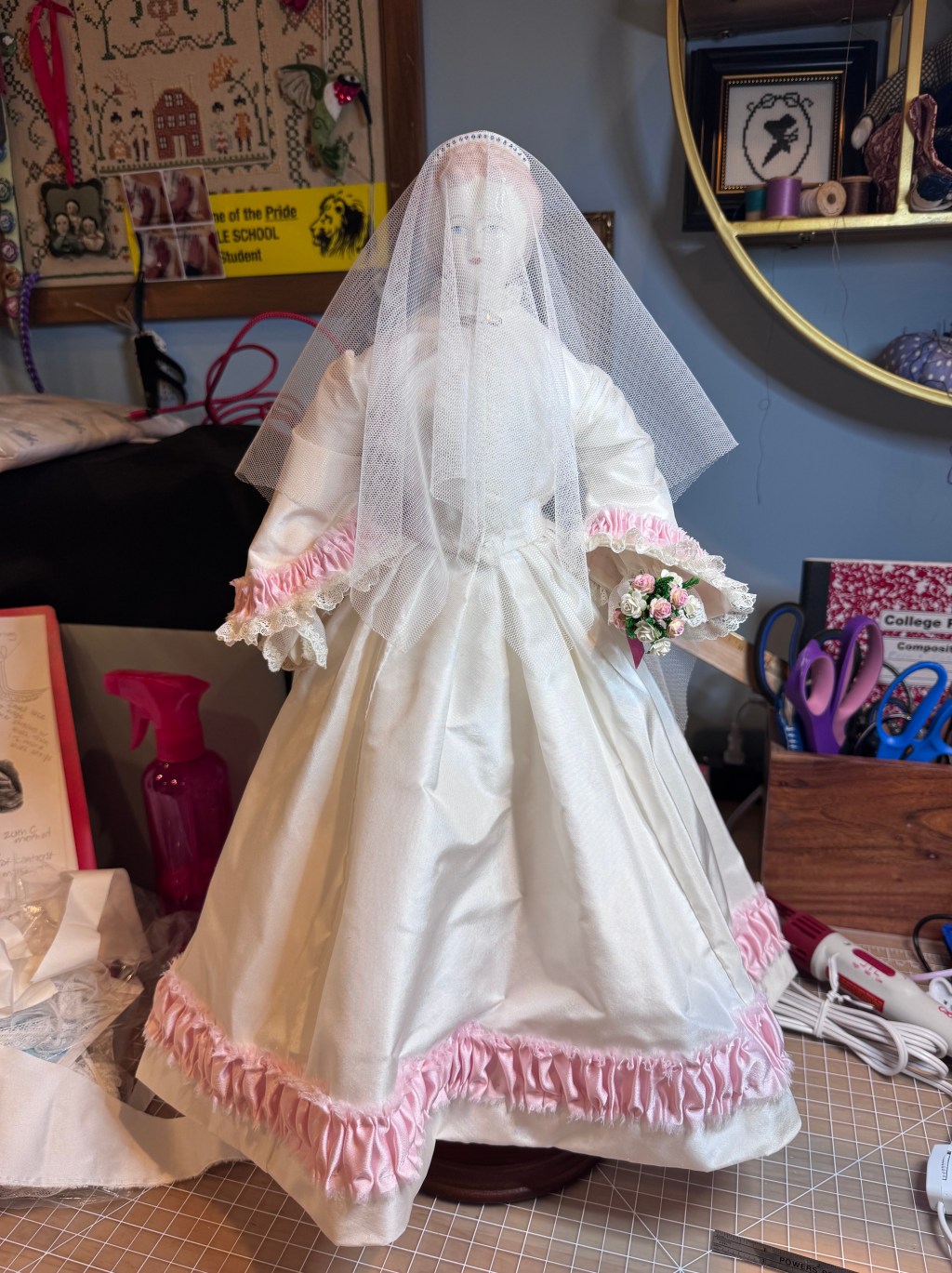
When last we met, I was just about ready to make the final garment for Julia Tudor, our lovely bride in 1872. Last night, I took the last stitch. I placed a demure pin on her bodice and then draped her veil over her head.

Yes, the work table is a mess. I was so excited to be finished with this project that I could not wait to snap some pictures!

Unfortunately you cannot see the under sleeves that I made from silk organdy. They have a bishop sleeve (meaning gathered at the wrist) and then I added some gorgeous, lightweight French lace. The bouquet is made from paper flowers and is tied to her wrist with a rose pink silk ribbon. During the dress construction process, I added a seam across the part of her arm where an elbow should be, so the hand holding the bouquet is a bit easier to place.

Here you can better see the trims and the bar pin. It is a vintage pin that I bought some time ago and always thought would be perfect for a pretty doll. The sleeves of the bodice are wide pagoda sleeves which allow for movement of the hands. I’m not normally a lace and ruffles person, but I felt that for this wedding dress, the more lace the better. The pink silk satin ribbon I used on the skirt is seen here. I had to cut its width by half and then fray out the cut side. That was a project in itself, but very worth it!

And here we have the butterfly basque, something today we might call a peplum or bustle. It is attached to the bodice and features the pleats that allow it to stand out. I found an image of an extant gown from 1872 with this exact basque style with the lace trim. I had to emulate it!

Screenshot

The full dress is lined with silk organza, which isn’t the best lining material, but I’d gotten too far into the project by the time I realized it. So, onward and upward I suppose!

I’m now considering what doll will be next. Julia was entirely hand sewn, but as a 20″ doll I could have used my sewing machine except for the very small bits or delicate parts. I may consider making Amelia, the bloomer suit wearing progressive from the 1850s as I found an 1850’s modeled doll kit and she will be 18-20″ when completed. My hands might appreciate the break. I can also make that outfit from a less finicky fabric like wool or a wool/cotton blend. So stay tuned and I’ll catch you up again soon!

Progress on Julia – corset cover and skirt

I haven’t made as much progress as I’d like on Julia’s wedding gown, but I did complete a couple things.

First I made a little batiste corset cover because I just know the gold silk corset could potentially show through the bodice and I don’t want that. It was a little difficult to fit to her, but right now I can’t remember why. I used French lace and mother of pearl buttons – and of course hand sewn button holes. While this pattern came from the Louise Hedrick book, it is very similar to one I made from Le Mode Illustree from 1872 or 1879.

Next I completed the skirt. I actually made a test skirt in plain cotton and that is acting as an additional petticoat. The silk satin is luscious. The skirt is fully lined. I used bias strips to create the hem and the facing is just stitched to the lining.

I had this gorgeous lightweight pink silk satin ribbon and used it to create the ruched trim by running a gathering stitch on either side about 1/8” from the edge. The sweep of the skirt hem is about 36” so I used 90” of the pink to make the trim.

Next up I am working on the undersleeves. During this era, sleeves were still a separate item that was tied on around the bicep. I’m making some organdy sleeves with gorgeous French lace at the cuff edge.

After that I will make the bodice and finally a veil. But just because I have ADHD, I made a bouquet for her to hold. It is bound in a rose colored silk ribbon and I left tails long enough to tie it to her hand.

The flowers are paper and I can’t remember now where I bought them but there was a sale so I bought all the colors. :-)

Stay tuned for more progress soon. I really want to finish the glorious wedding ensemble – of course that will necessitate rearranging my display cabinet and that can always be fun too!

Better Petticoat

I talked myself off the ledge and I’m not making a wired bustle or cage for Julia. I really just don’t have the time and as I always remind myself, she is a doll. A beautiful doll, but a doll nonetheless.

Instead, I am using the small bum roll I previously made, the petticoat I didn’t love, a second petticoat I made a bit longer than the first, and finally a petticoat made from the skirt pattern.

I think this gives the posterior enough fullness to achieve the look of 1872, while also giving me experience with the skirt pattern.

One thing I discovered from this exercise is that the pattern does not tell you what to do with the side-to-back fullness at the waist. And, the pleats in the front do not take up enough fabric to evenly distribute the front between the two sides.

Now, luckily, I have made human sized clothes with these same design elements but better instructions!

I added two pleats on either side of center front. This serves to take up enough fabric that the side panels of the skirt are actually on her sides. They were previously more to her back.

Second, I used 1/4” pleats on the back and then pressed them toward the center back. These are similar to cartridge pleating except the pleats are pressed toward the back, where cartridge pleats would hang from the waistband. Anyway, that’s what I did.

I used bias tape to create the hem because it is curved. You can see the nice train the finished wedding dress will have. I suppose I will start on the bodice mockup next but probably with paper towels.

Better Petticoat

I talked myself off the ledge and I’m not making a wired bustle or cage for Julia. I really just don’t have the time and as I always remind myself, she is a doll. A beautiful doll, but a doll nonetheless.

Instead, I am using the small bum roll I previously made, the petticoat I didn’t love, a second petticoat I made a bit longer than the first, and finally a petticoat made from the skirt pattern.

I think this gives the posterior enough fullness to achieve the look of 1872, while also giving me experience with the skirt pattern.

One thing I discovered from this exercise is that the pattern does not tell you what to do with the side-to-back fullness at the waist. And, the pleats in the front do not take up enough fabric to evenly distribute the front between the two sides.

Now, luckily, I have made human sized clothes with these same design elements but better instructions!

I added two pleats on either side of center front. This serves to take up enough fabric that the side panels of the skirt are actually on her sides. They were previously more to her back.

Second, I used 1/4” pleats on the back and then pressed them toward the center back. These are similar to cartridge pleating except the pleats are pressed toward the back, where cartridge pleats would hang from the waistband. Anyway, that’s what I did.

I used bias tape to create the hem because it is curved. You can see the nice train the finished wedding dress will have. I suppose I will start on the bodice mockup next but probably with paper towels.

Oops I was incorrect

I recently shared that I need to make an elliptical hoop for Julia. I really procrastinated on this, partly because it seemed like a lot of work. But also because in the back of my mind, it didn’t seem correct.

With all the fashion changes in the 19th century, why would an elliptical hoop stay in use from 1865 to 1872? It just didn’t make sense.

I’m glad I didn’t dive into that project, because after doing a bit more research and asking people more knowledgeable than me, I discovered the shape I am looking for is somewhat in between the older hoop and the not-yet invented bustle.

Wow. That is very different.

Here is an extant wedding dress from 1871 that better shows the shape achieved.

So I’m really thankful again that I didn’t start making that hoop! But now I need to figure out how to make those wire channel pocket thingies.

It was suggested I design the garment after the Truly Victorian TV108 Grand Bustle, although that seems like the next fashion era to me.

Then there is the Truly Victorian TV101 Petticoat with Wire Bustle, which again feels later to me.

I must continually remind myself this is for a 20” doll. No one would even blink if I made no bustle garment at all!!