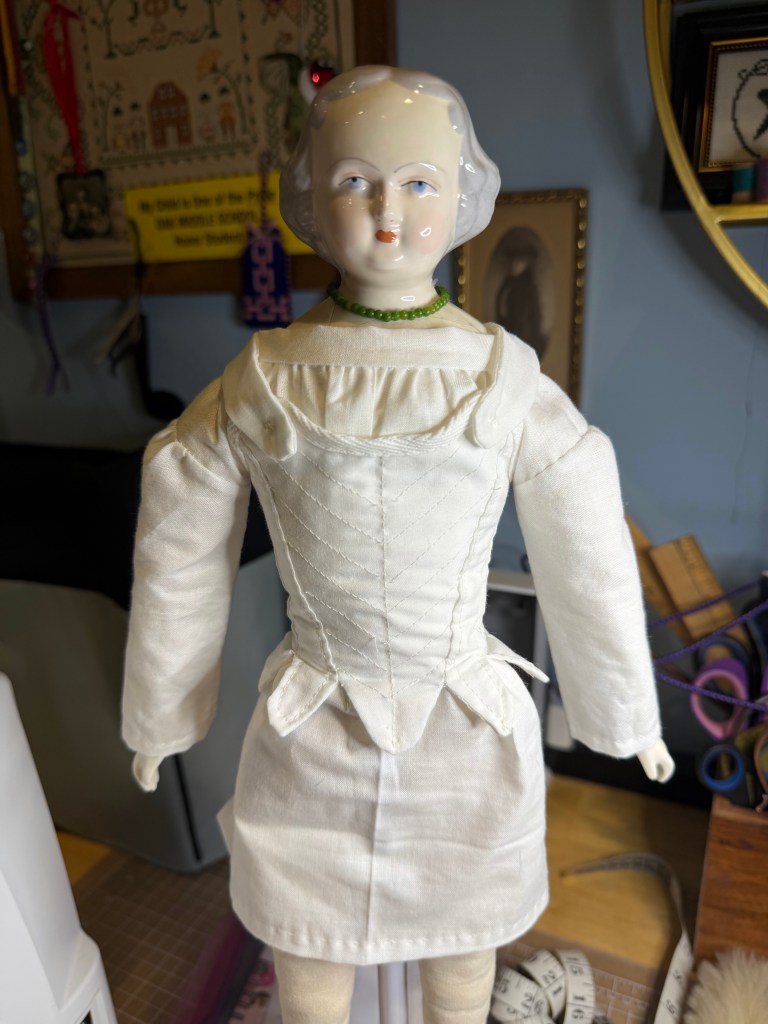
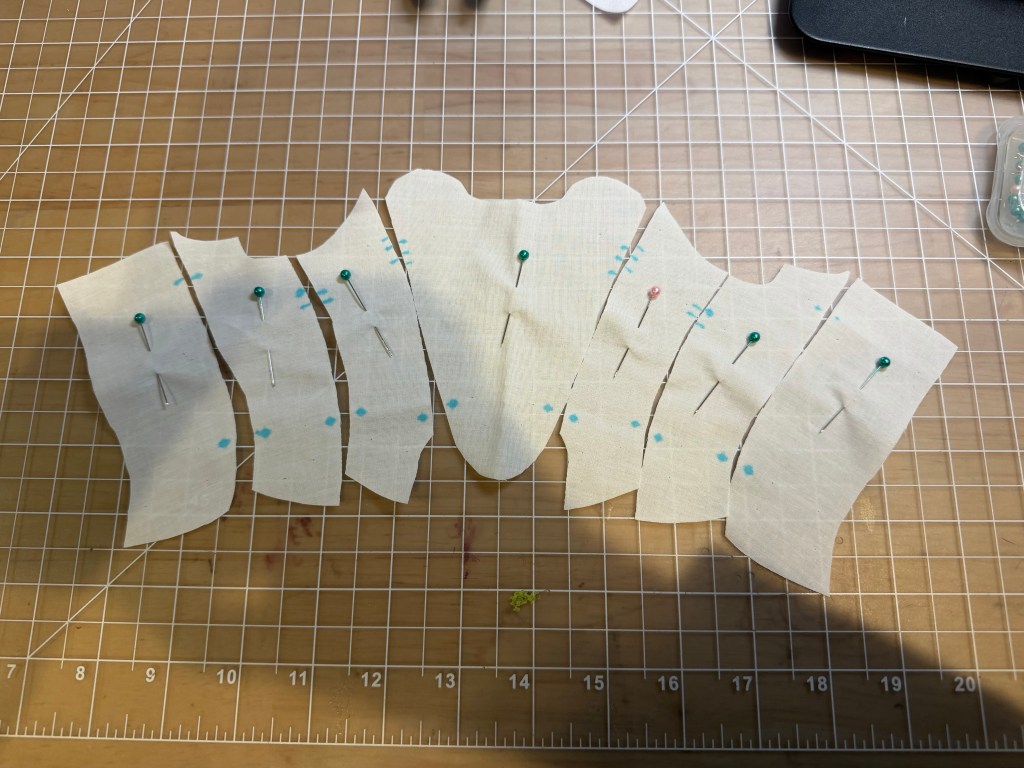
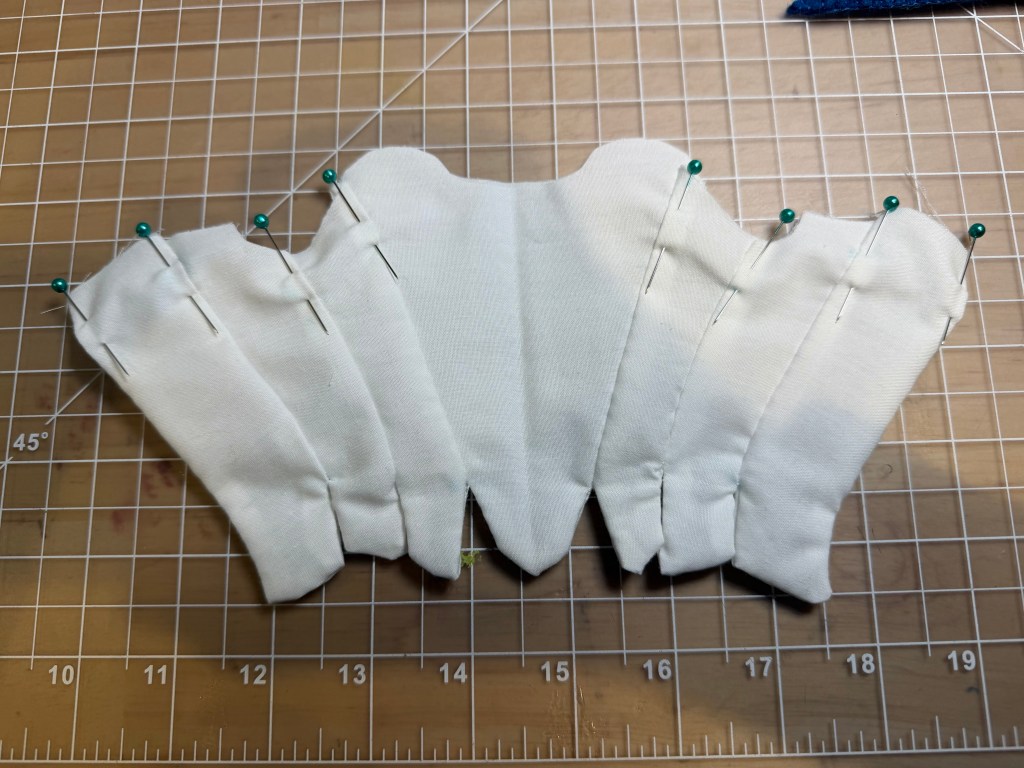
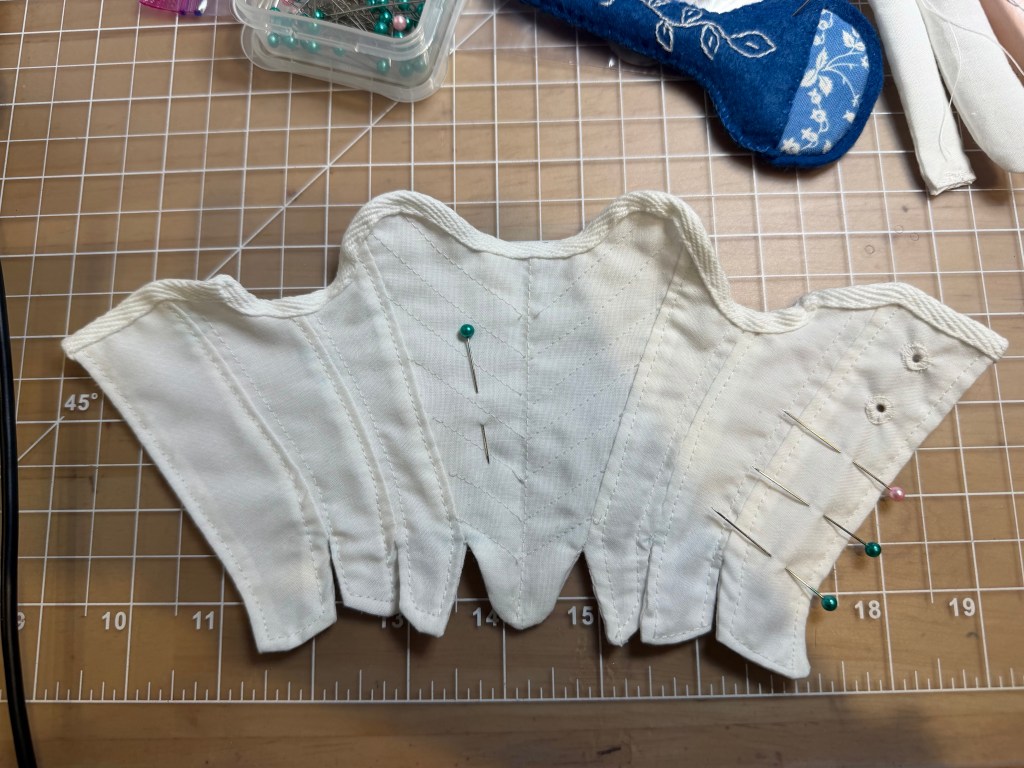
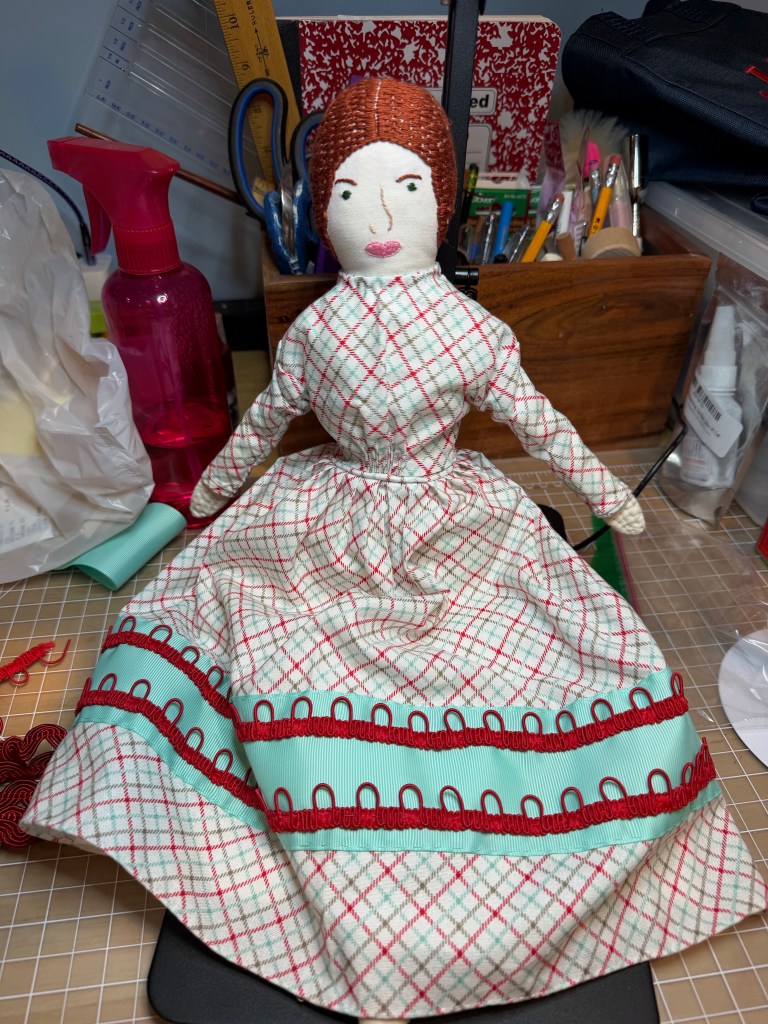
I haven’t made as much progress as I’d like on Julia’s wedding gown, but I did complete a couple things.
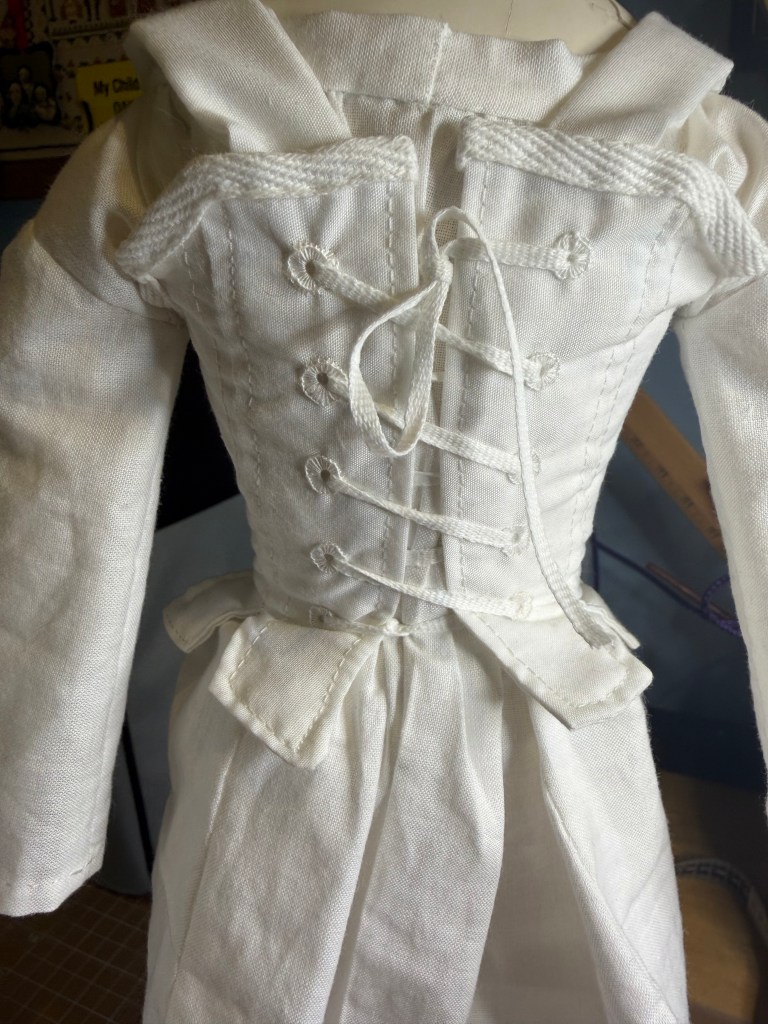
First I made a little batiste corset cover because I just know the gold silk corset could potentially show through the bodice and I don’t want that. It was a little difficult to fit to her, but right now I can’t remember why. I used French lace and mother of pearl buttons – and of course hand sewn button holes. While this pattern came from the Louise Hedrick book, it is very similar to one I made from Le Mode Illustree from 1872 or 1879.
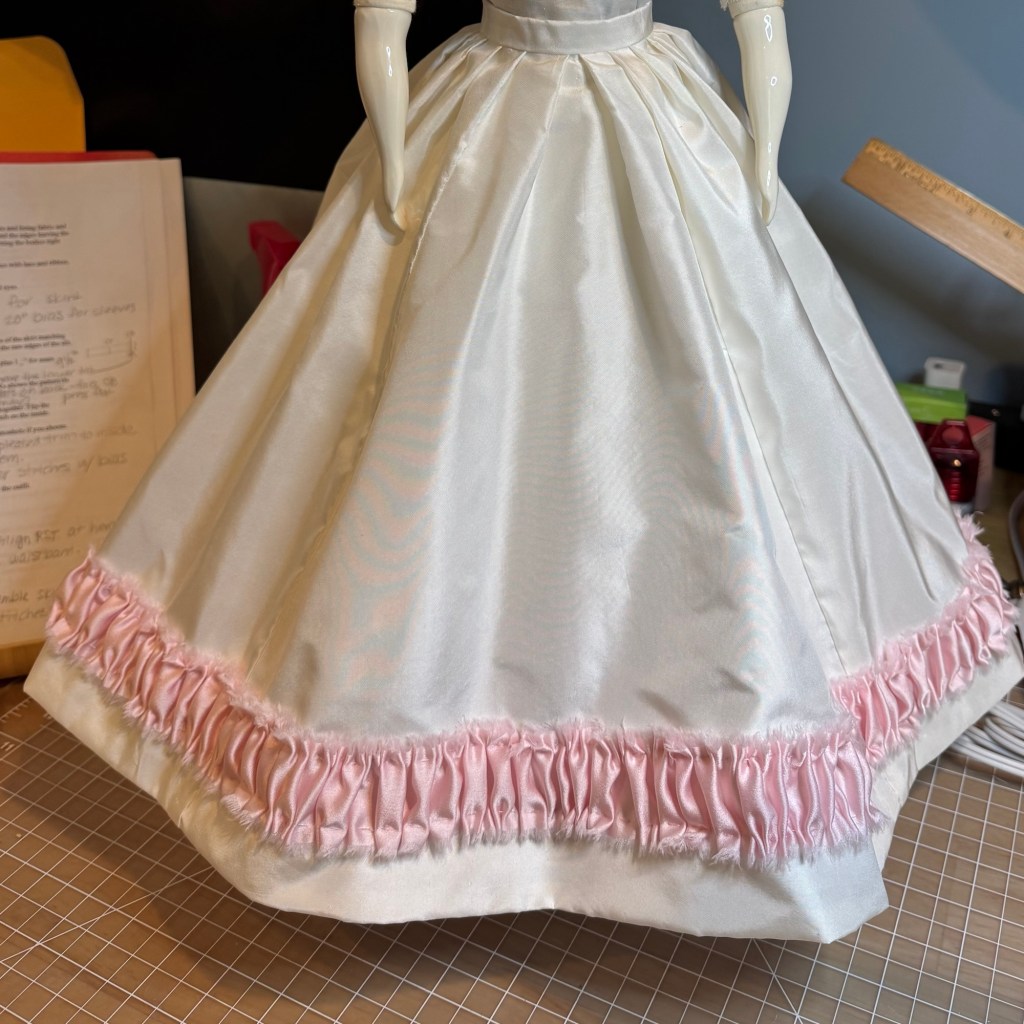
Next I completed the skirt. I actually made a test skirt in plain cotton and that is acting as an additional petticoat. The silk satin is luscious. The skirt is fully lined. I used bias strips to create the hem and the facing is just stitched to the lining.
I had this gorgeous lightweight pink silk satin ribbon and used it to create the ruched trim by running a gathering stitch on either side about 1/8” from the edge. The sweep of the skirt hem is about 36” so I used 90” of the pink to make the trim.
Next up I am working on the undersleeves. During this era, sleeves were still a separate item that was tied on around the bicep. I’m making some organdy sleeves with gorgeous French lace at the cuff edge.
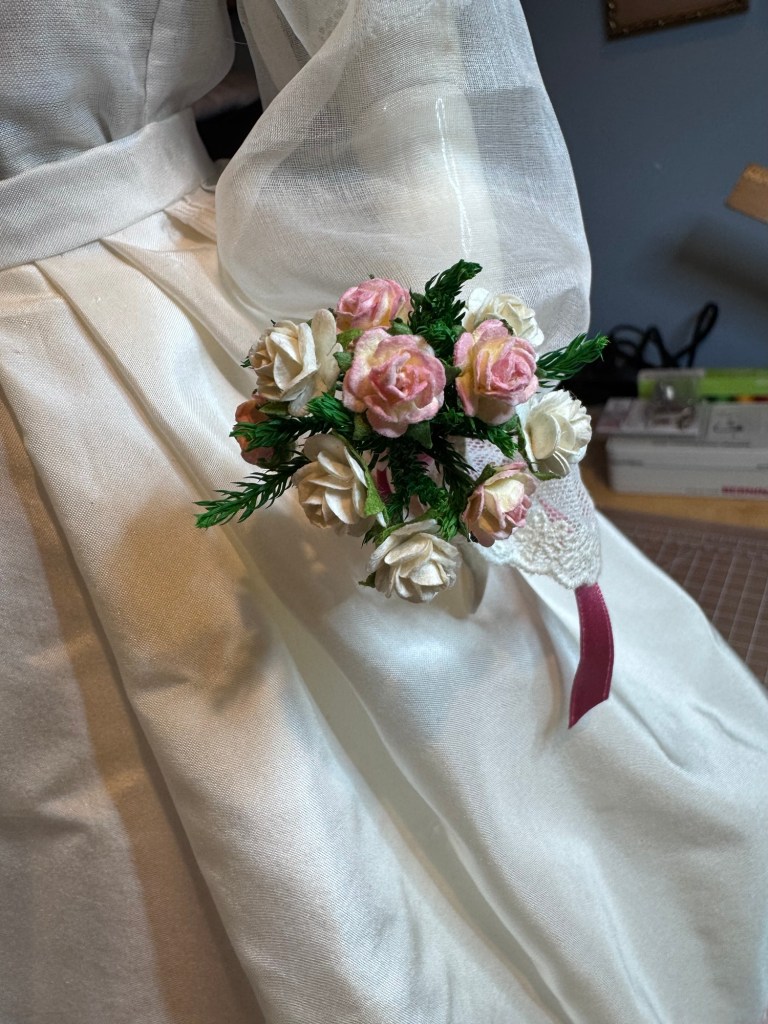
After that I will make the bodice and finally a veil. But just because I have ADHD, I made a bouquet for her to hold. It is bound in a rose colored silk ribbon and I left tails long enough to tie it to her hand.
The flowers are paper and I can’t remember now where I bought them but there was a sale so I bought all the colors. :-)
Stay tuned for more progress soon. I really want to finish the glorious wedding ensemble – of course that will necessitate rearranging my display cabinet and that can always be fun too!
I talked myself off the ledge and I’m not making a wired bustle or cage for Julia. I really just don’t have the time and as I always remind myself, she is a doll. A beautiful doll, but a doll nonetheless.
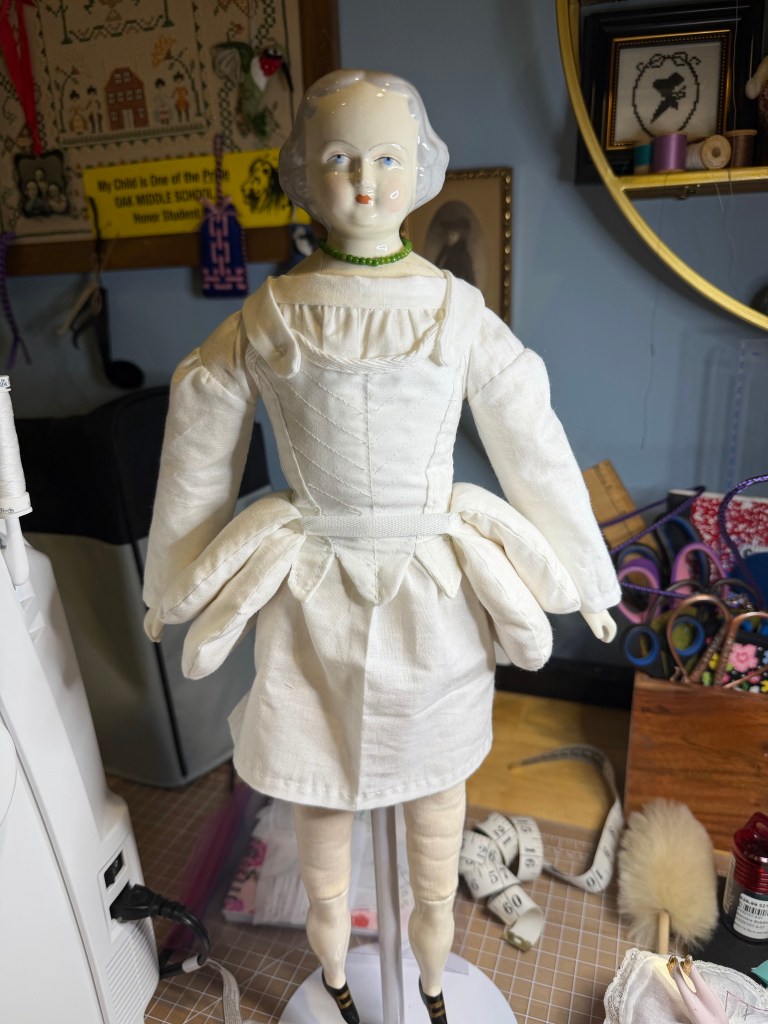
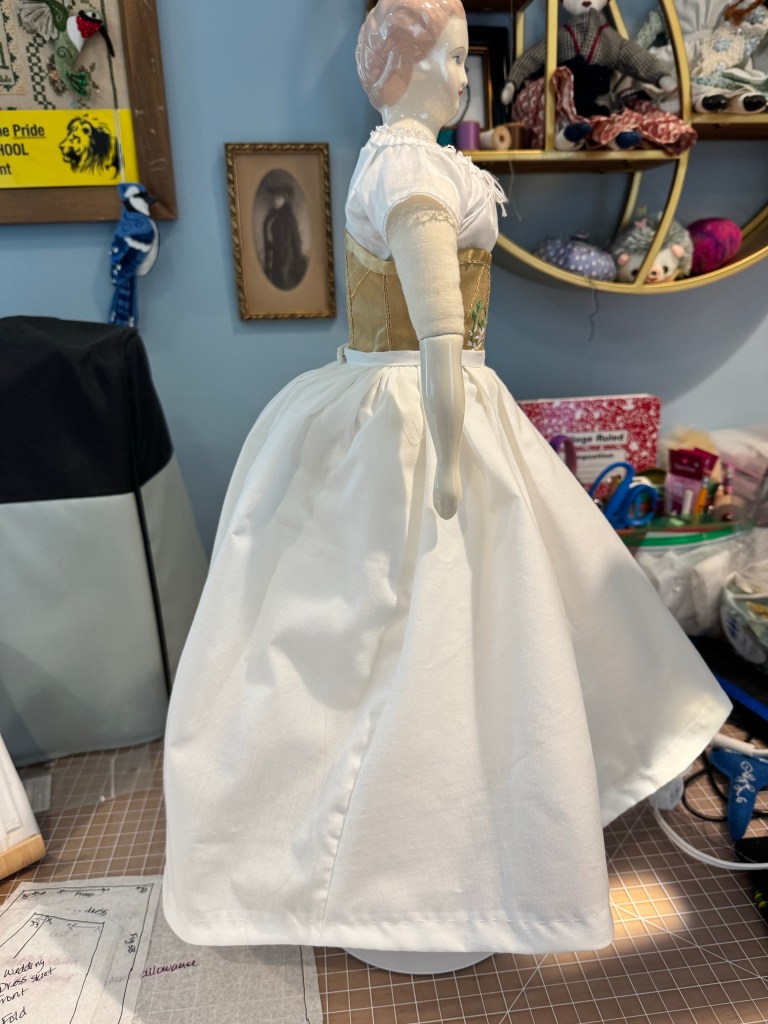
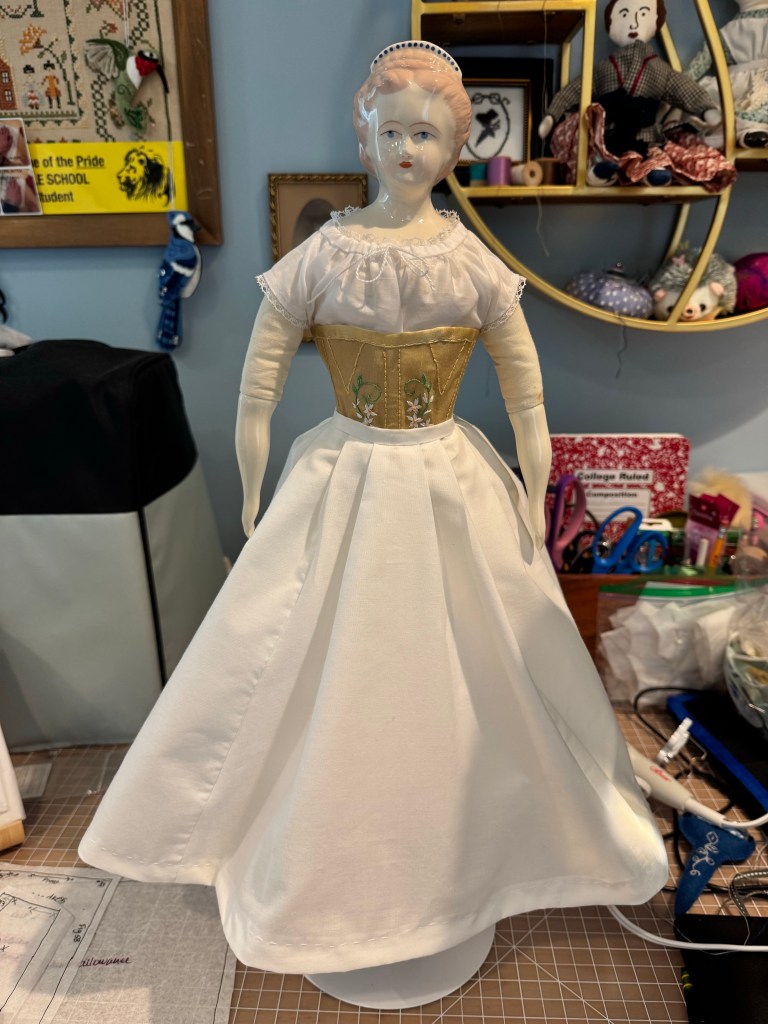
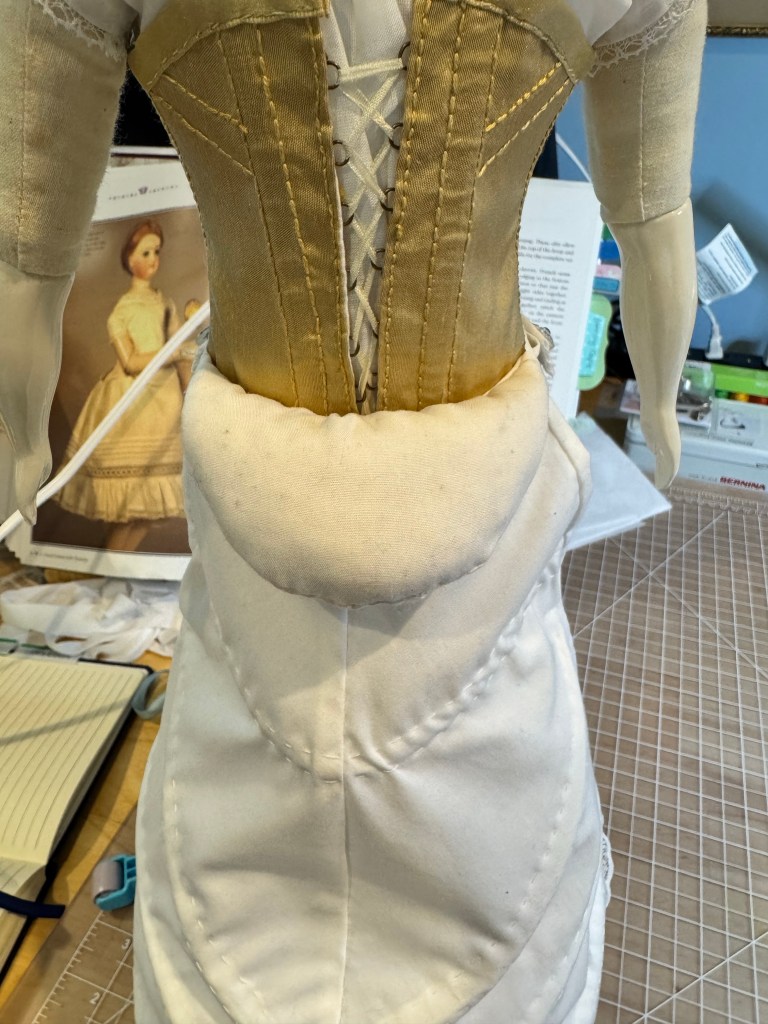
Instead, I am using the small bum roll I previously made, the petticoat I didn’t love, a second petticoat I made a bit longer than the first, and finally a petticoat made from the skirt pattern.
I think this gives the posterior enough fullness to achieve the look of 1872, while also giving me experience with the skirt pattern.
One thing I discovered from this exercise is that the pattern does not tell you what to do with the side-to-back fullness at the waist. And, the pleats in the front do not take up enough fabric to evenly distribute the front between the two sides.
Now, luckily, I have made human sized clothes with these same design elements but better instructions!
I added two pleats on either side of center front. This serves to take up enough fabric that the side panels of the skirt are actually on her sides. They were previously more to her back.
Second, I used 1/4” pleats on the back and then pressed them toward the center back. These are similar to cartridge pleating except the pleats are pressed toward the back, where cartridge pleats would hang from the waistband. Anyway, that’s what I did.
I used bias tape to create the hem because it is curved. You can see the nice train the finished wedding dress will have. I suppose I will start on the bodice mockup next but probably with paper towels.
I talked myself off the ledge and I’m not making a wired bustle or cage for Julia. I really just don’t have the time and as I always remind myself, she is a doll. A beautiful doll, but a doll nonetheless.
Instead, I am using the small bum roll I previously made, the petticoat I didn’t love, a second petticoat I made a bit longer than the first, and finally a petticoat made from the skirt pattern.
I think this gives the posterior enough fullness to achieve the look of 1872, while also giving me experience with the skirt pattern.
One thing I discovered from this exercise is that the pattern does not tell you what to do with the side-to-back fullness at the waist. And, the pleats in the front do not take up enough fabric to evenly distribute the front between the two sides.
Now, luckily, I have made human sized clothes with these same design elements but better instructions!
I added two pleats on either side of center front. This serves to take up enough fabric that the side panels of the skirt are actually on her sides. They were previously more to her back.
Second, I used 1/4” pleats on the back and then pressed them toward the center back. These are similar to cartridge pleating except the pleats are pressed toward the back, where cartridge pleats would hang from the waistband. Anyway, that’s what I did.
I used bias tape to create the hem because it is curved. You can see the nice train the finished wedding dress will have. I suppose I will start on the bodice mockup next but probably with paper towels.
I recently shared that I need to make an elliptical hoop for Julia. I really procrastinated on this, partly because it seemed like a lot of work. But also because in the back of my mind, it didn’t seem correct.
With all the fashion changes in the 19th century, why would an elliptical hoop stay in use from 1865 to 1872? It just didn’t make sense.
I’m glad I didn’t dive into that project, because after doing a bit more research and asking people more knowledgeable than me, I discovered the shape I am looking for is somewhat in between the older hoop and the not-yet invented bustle.
Wow. That is very different.
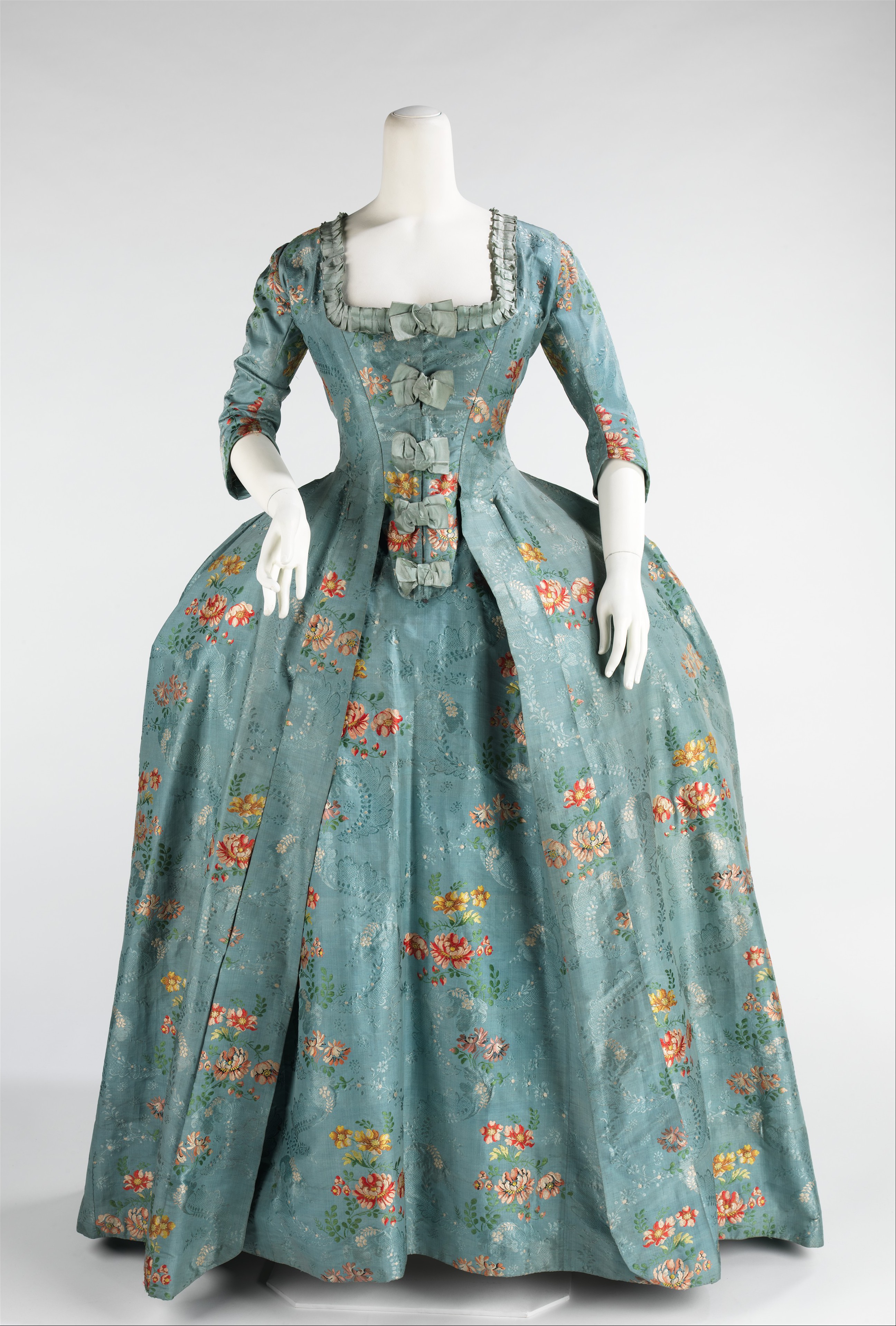
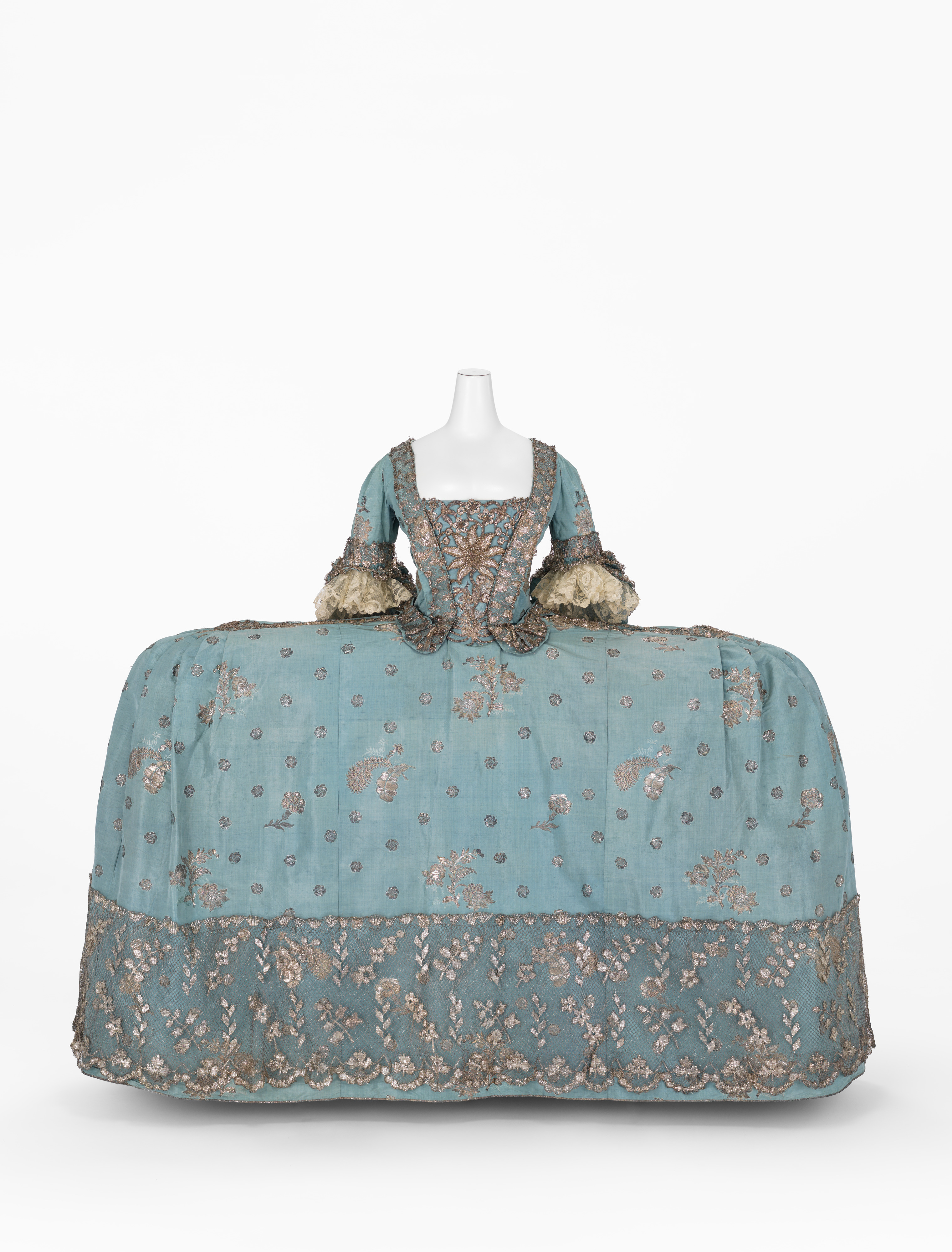
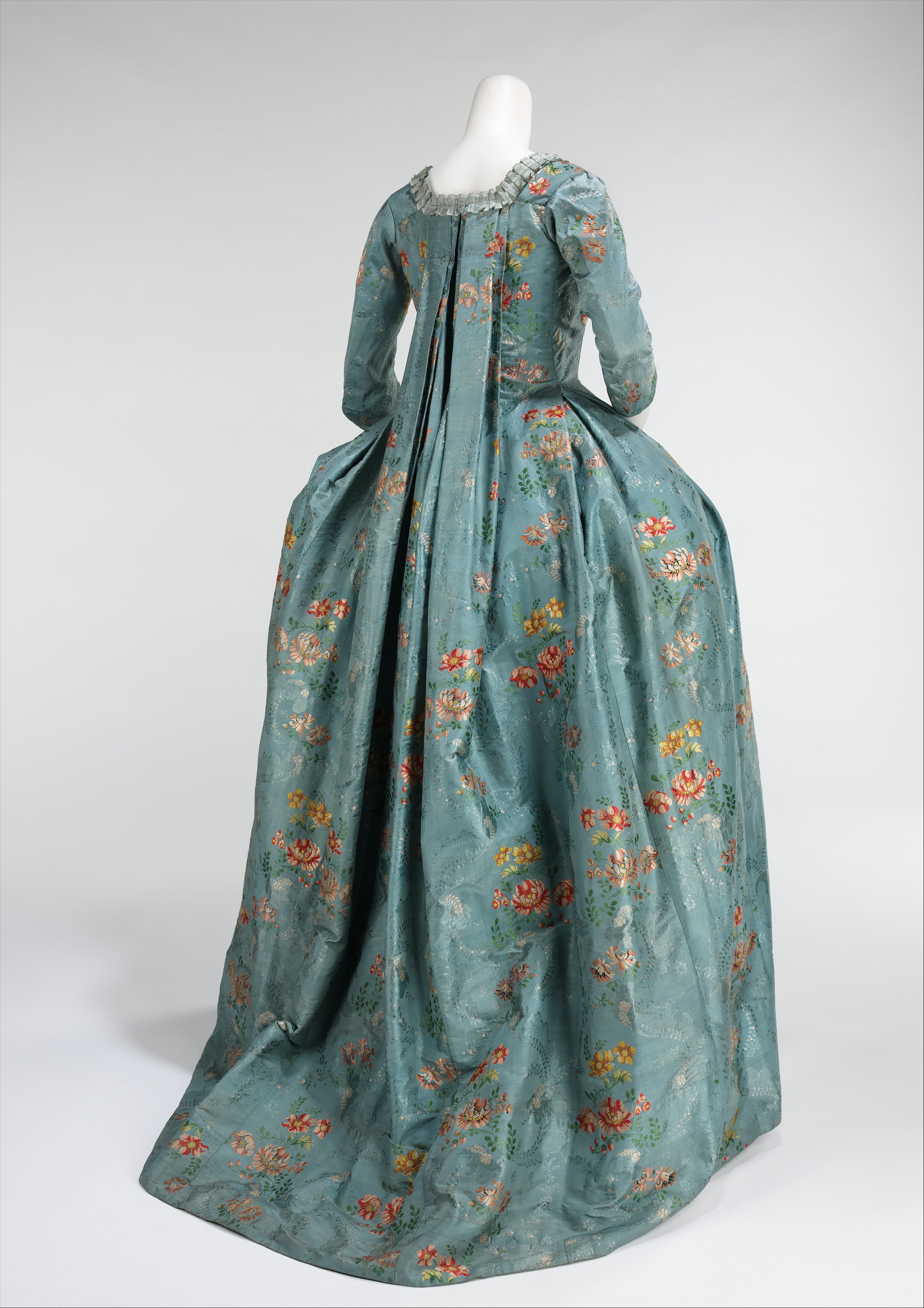
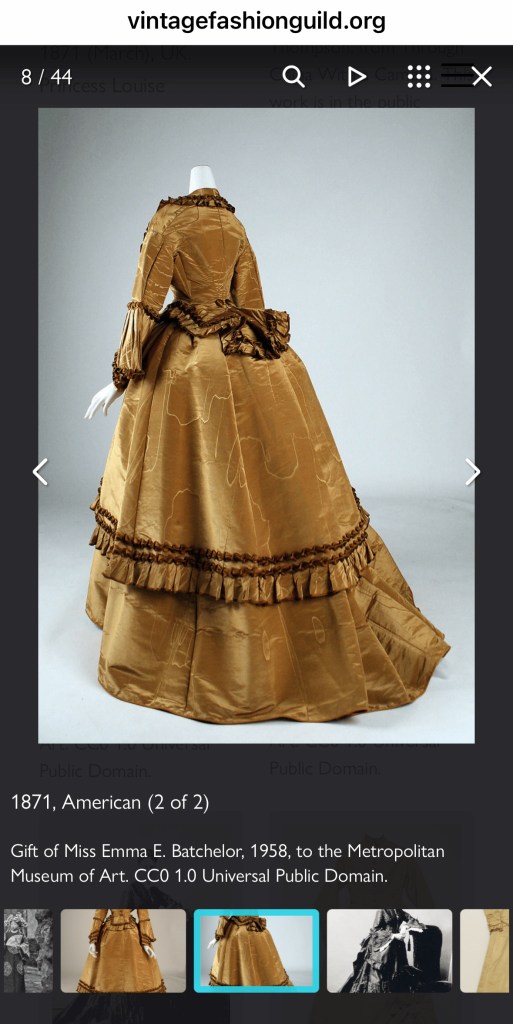
Here is an extant wedding dress from 1871 that better shows the shape achieved.
So I’m really thankful again that I didn’t start making that hoop! But now I need to figure out how to make those wire channel pocket thingies.
It was suggested I design the garment after the Truly Victorian TV108 Grand Bustle, although that seems like the next fashion era to me.
Then there is the Truly Victorian TV101 Petticoat with Wire Bustle, which again feels later to me.
I must continually remind myself this is for a 20” doll. No one would even blink if I made no bustle garment at all!!
Busy, busy fingers. I have been working diligently on Julia’s foundation garments. In my last post I shared the completed chemise, drawers and corset. Today I will share the next items.
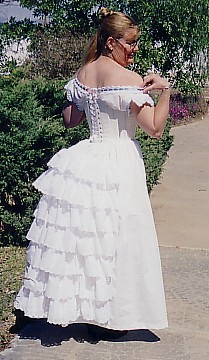
First up, I completed the empire hoop. This is the second time I’ve made this particular item and I’m less than delighted with both of them.
Side view Back view
I feel like the hoop is meant to support a smaller skirt than Julia will likely be wearing. We shall see. The first time I made the empire hoop, I discovered the instructions didn’t tell you to hem it! Obviously I remembered that this time and added a sweet gathered lace.
I don’t love how the back just seems to collapse instead of standing out, but maybe I’m picturing the wrong thing. A grand bustle hoop would stand far out and that’s not the silhouette I’m going for here.
To compensate for the uninspired shape, I’m making a small crescent shaped cushion bustle. More like a bum roll. I saw this on a vintage recreation of an elliptical hoop and I think it’s going to provide the shape and lift/support I’m looking for here.
Vintage buttons
I do love these buttons. They are vintage glass buttons and yes, I did handsew the button holes.
I’ve considered making a different elliptical hoop based on original garments, but what a massive amount of work that will be. Talk me off the ledge!
Bummer
Later…
I’ve made the crescent shaped bum pad and I don’t love it, either! It’s possibly too full and stands out too straight of an angle from her body.
Bumper pad
If I try to flatten it down it has a better profile, but even that isn’t realistic to maintain. I also tried putting it under the empire hoop but that just threw off the way that garment hung and fit, so that was a no-go. This is just going to be set aside for the time being.
I had made the bum pad while waiting for some laces to be delivered for the petticoat.
Lacy petticoat
Here you can see the petticoat, which I do rather like. It is about 1.5” shorter than the hoop and I don’t think that is correct even though it exactly matches the measurements in the book. Le sigh.
I’m just going to focus on what I like. I like the tucks. I like the lace insertion. I like the ruffled hem.
Pretty petti, ugly hoop
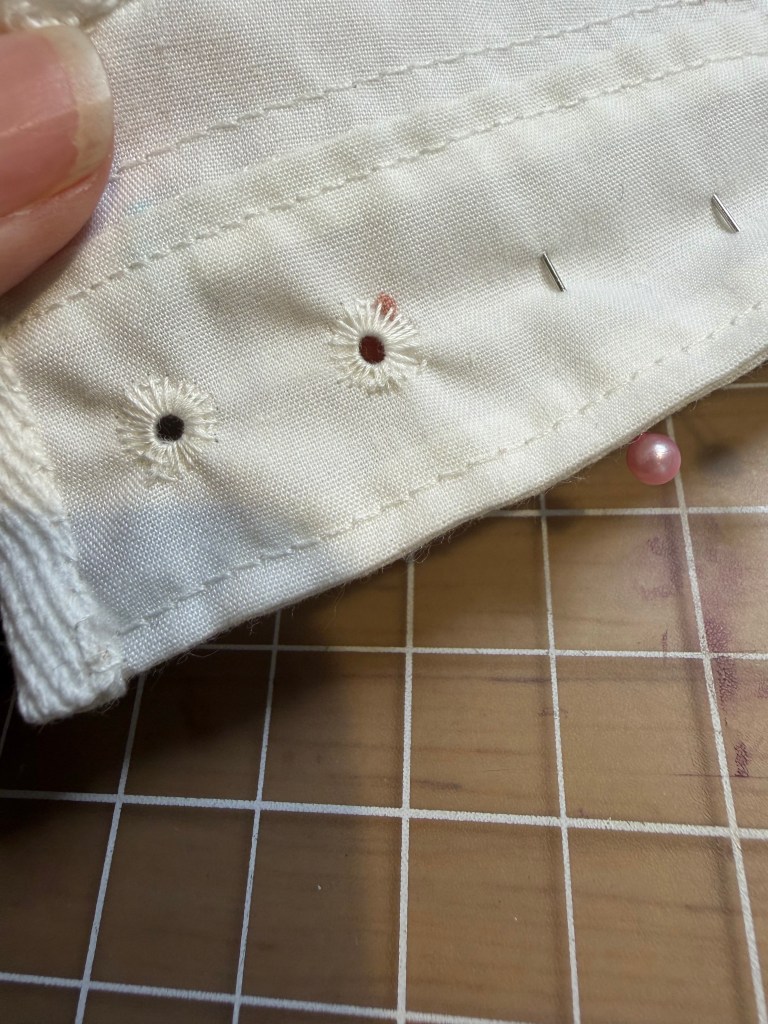
At the center back are two itsy worked eyelets for the drawstring. I’m rather good at eyelets. I really should be great at buttonholes because they are just elongated eyelets, right?
The drawstring waist allows me to draw more of the fabric to the back of Julia’s body. This is perfect for the 1872 profile I am hoping to accomplish here.
Part of Julia’s issue is that she is sort of potato shaped through the body. I can’t make much of a waist on her, even with the corset. It’s not a big deal because she is a doll afterall. I just want her to be a beautiful bride once finished with the project!
I started working on the new garments for Julia Tudor, who will be getting married in 1872. Based on the lovely drawing in the 1872 La Mode Illustree, she will be wearing an ivory silk satin with blush silk trimming, French lace undersleeves, and a bobinet veil.
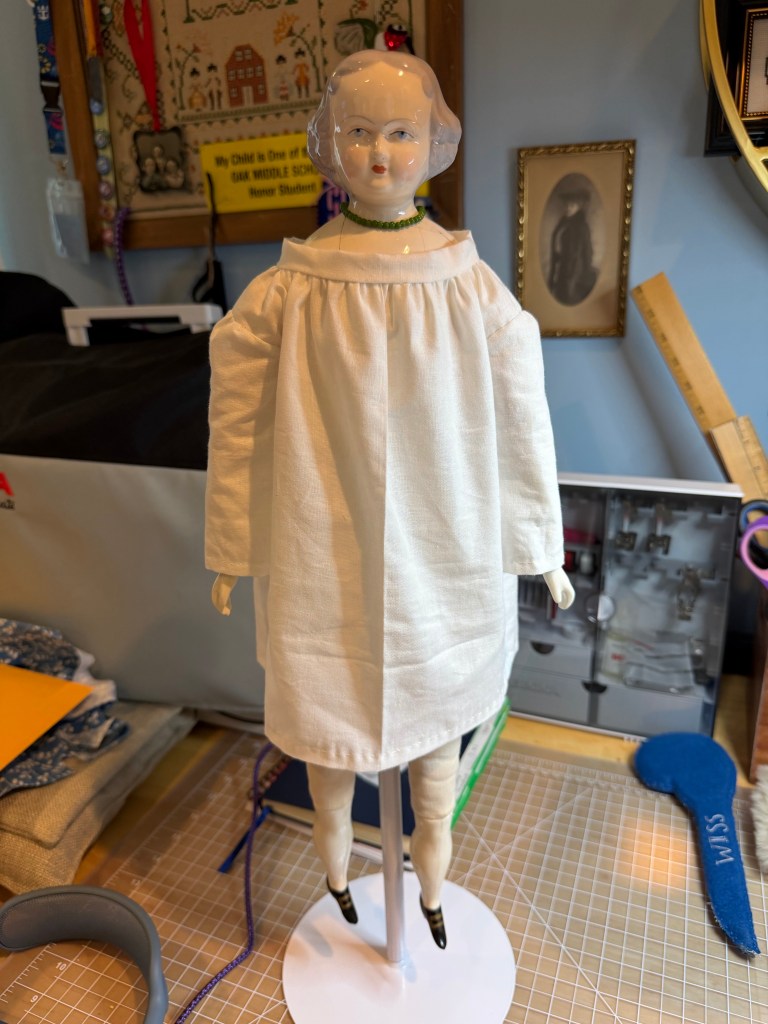
Of course before she can don her bridal finery, she must have the appropriate undergarments. I have completed the following so far.
A fine batiste chemise with delicate lace on the neck and arm openings.
Delicate batiste drawers featuring tucks, hem lace and white embroidery in a tulip stitch.
Please ignore the messy work table!
A gold silk taffeta corset, boned and fully lined, featuring orange blossoms embroidered on the front.
Orange blossoms for good fortuneBack view showing lacing
Still to be finished are a practical corset cover of crisp cotton, a luscious petticoat featuring tucks, insertion and also lace at the hem, and an empire hoop of cotton/linen blend. I will share more as they come!
I have a number of things I want to work on this year now Ruby is completed.
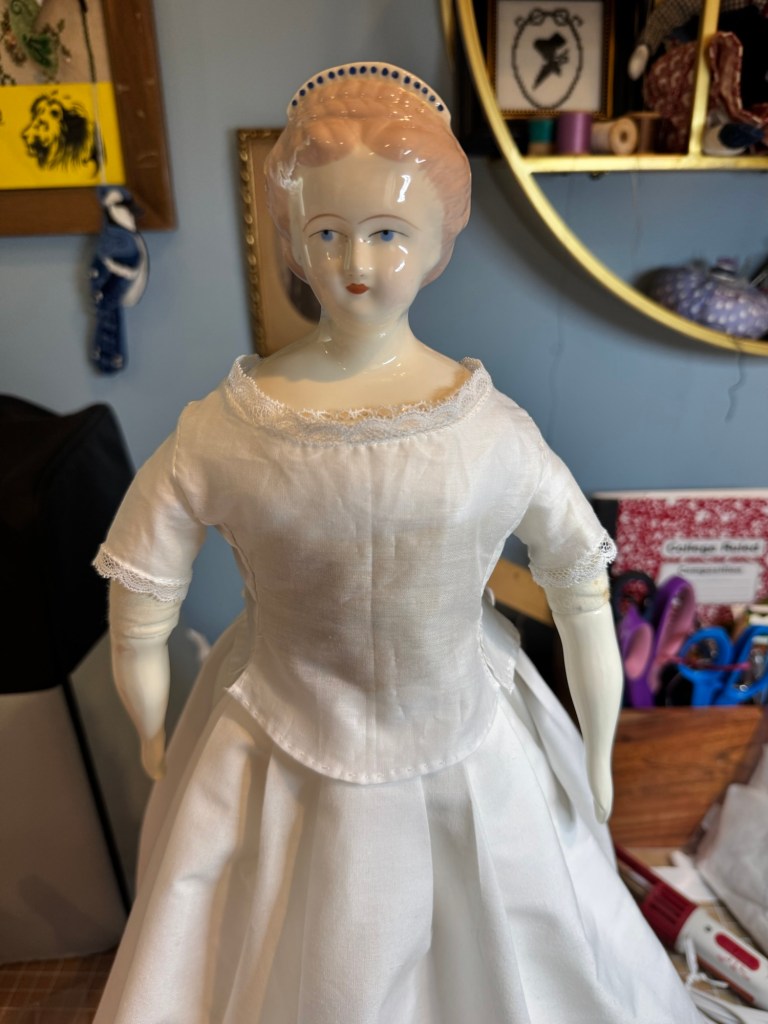
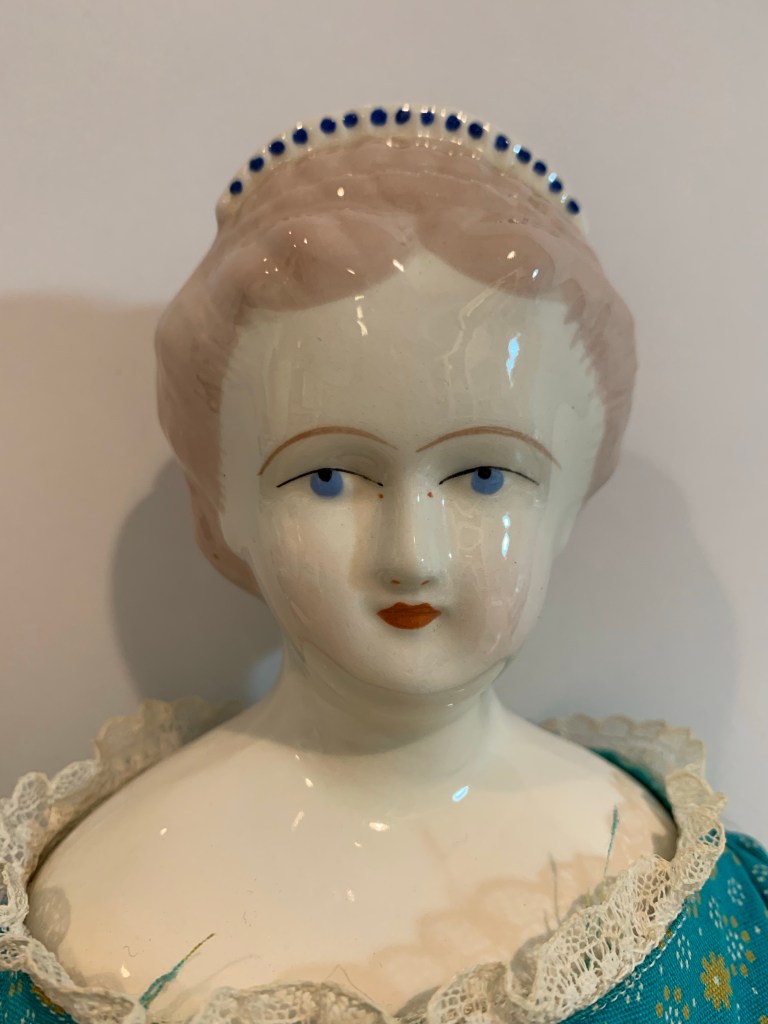
Julia Tudor
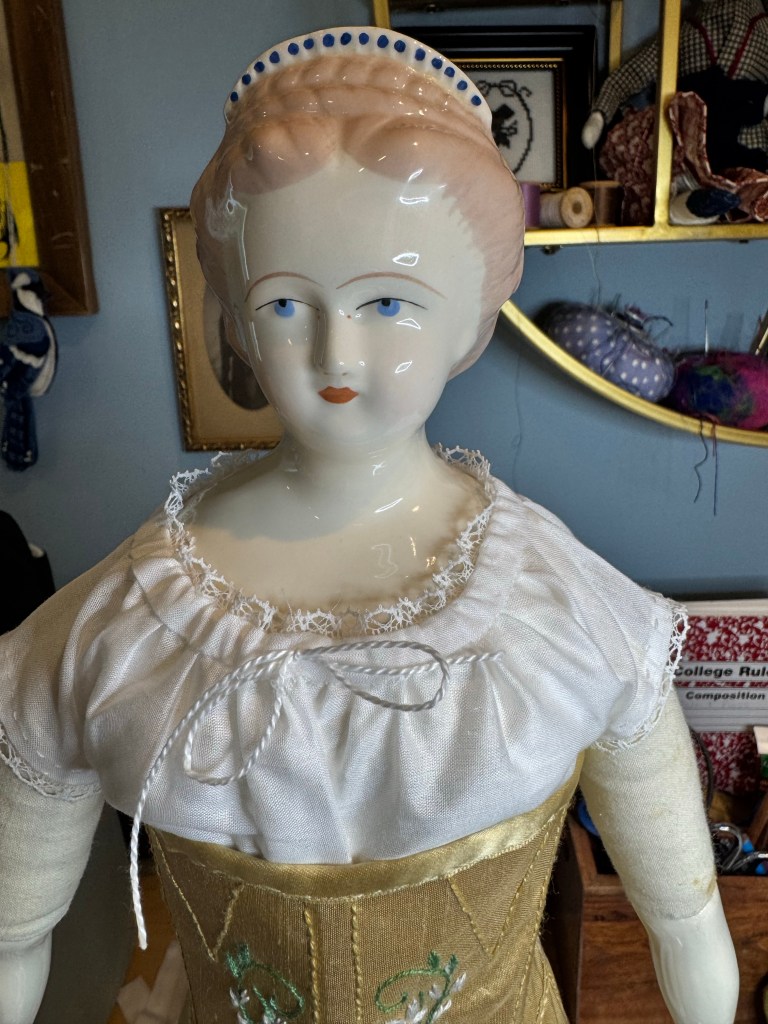
This doll is about 20” tall and will make a lovely bride. She has a tiara on her head and I am trying to figure out how to make a veil stay in place. My vision is an 1872 wedding dress in ivory and blush pink. Or it could be blush pink with ivory, I haven’t finalized that yet. I’m drafting the pattern from the 1872 La Mode Illustree’ and so far there is only one confusing bit.
Preparing for her upcoming matrimony
Amelia
I’d like to make an 1850s styled doll and give her a Bloomer Suit. This fashion was popularized by Amelia Bloomer, hence the name. I’m undecided if I will use a china headed doll or make a cloth lady doll for this. 1850s heads are rare and expensive. If I decide to make a cloth lady doll, I will try a Susan Sirkis method for attaching hair.
Could be interesting!
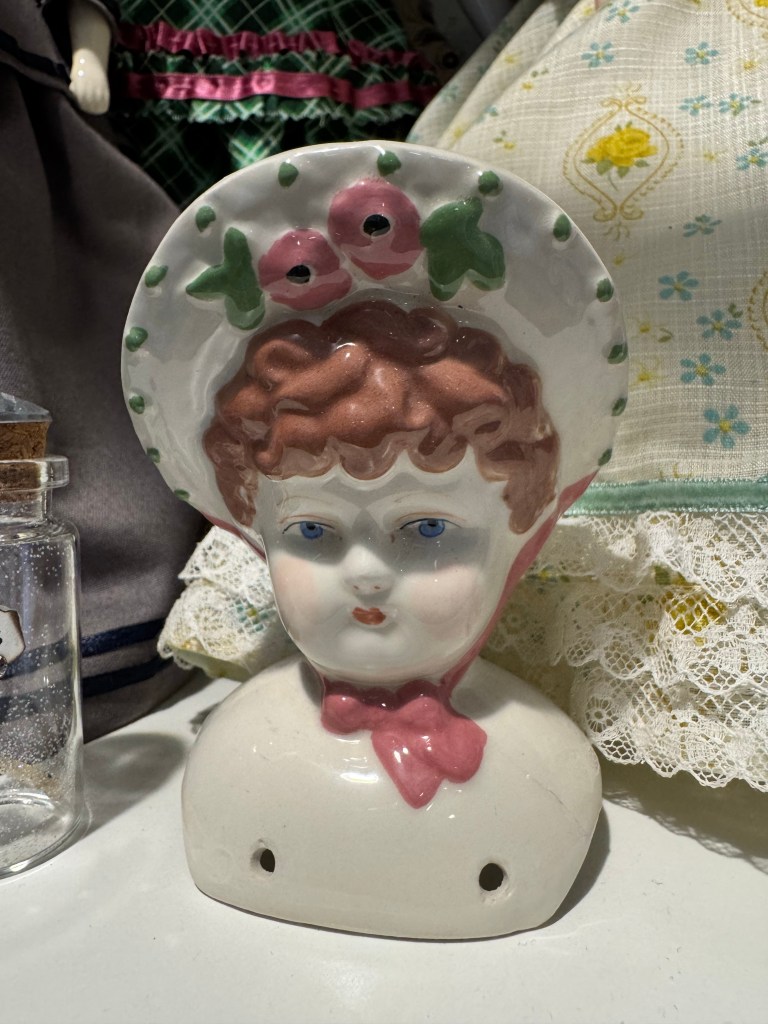
Amy Tudor
It’s a stretch goal for me but I would like to make this pretty bonnet head doll. I only have the head so I’ll need to decide if I will purchase china arms and legs or make fabric ones. Bonnet head dolls are based on 1840s styles even though they were produced around 1910 apparently. I’d like to dip into this time period though as I know nothing about it.
I’d like hands and feet, please
Minerva
This beautiful doll doesn’t need much but a repair to her broken foot. I had an idea that I could make boots and stockings, fill them with emery or something similar, then fit them to the broken china on her foot, pull up the stockings to hide the transition. We shall see. I got this idea from Ruby actually since she has her own boots and stockings.
My foot hurts!
Charlotte
I just acquired a 3” tall frozen Charlotte doll. Of course she’s nude. Clothing her will be a challenge due to her itty bitty size so that could be a fun little project. I have some ideas based on other frozen Charlottes with clothing I have seen.
Brr it’s so cold I’m frozen!
So there you have it – my ambitious goals for the year. Of course I’ll be posting here with my progress. And no, I haven’t forgotten the various other dolls I have to work on, they just might need to wait until 2026 lol.
Did you know I have an Instagram where I post lots of interim photos of my work? Look for me under norkio and follow for progress shots and other fun stuff.
A proper Victorian lady doll must have a handbag for the various items she’d like to carry with her when visiting friends. Perhaps calling cards, a pencil, a coin and a house key might be needed during her day. I wanted to make Ruby a little handbag and devised this pretty one. You can make one too, just follow these easy instructions.
To make this embroidered silk handbag you will need:
Silk outer fabric
Cotton lining fabric
Silk thread
Sewing needle
Scissors
Pins
Embroidery floss
Embroidery needle
Tissue paper
Pencil
Begin by cutting one silk and one cotton piece 2 inches wide by 5 1/2” long. On one short end, make a point that is stepped back 1/2” from the end.
Forgot to take a before picture!
Trace the embroidery pattern you like onto tissue paper. I went with this continuous line art found in A French Fashion Doll’s Wardrobe.
Pin that where you want your embroidery to be. Make sure to leave space for 1/8” seams on all three sides of this flap. Using 2 strands of your floss, stitch directly through the tissue paper and follow the pattern.
I chose to do this in a backstitch but you may like a split stitch or a standard embroidery stitch. Let your creativity decide. When you have to end your stitching be careful not to catch any of the silk in your anchor stitches.
Once you have completed your embroidery, tear away the tissue paper. Make sure to pick out any caught in a stitch or under a thread. I used the blunt end of a crewel needle to do this but you could also use craft tweezers.
Fold right sides together so you make a 2” square pouch, and then stitch down the sides. Repeat with the lining.
Pin the lining and silk right sides together on the flap and stitch around the flap only. Turn your work and push out the corners. If you like you can lightly iron the flap to roll the lining to the inside.
Set this aside for a moment to make your handle. This tutorial includes a braided embroidery floss handle but you could use ribbon, cord, chain, really whatever you might like as long as it isn’t too heavy.
Measure out 24” of embroidery floss, then section that into three 8” strands. Knot one end, then tape it to your work surface. Braid the floss until you have 4 or 5” of braid. Knot the end and clip off the tail.
Open the silk pouch and tuck the lining inside. Make sure the corners go all the way inside.
Next tuck one end of your handle in between the silk and the lining at the flap fold. Pin that in place.
You will need to tuck under the silk and the lining so all raw edges are inside the seam. Carefully stitch a blind stitch, making at least two stitches through the handle. When you reach the other side, tuck the other handle end in and stitch through it.
All the raw edges should be inside, the handle should be nicely secured. Finger press the flap closed so the embroidered side looks pretty. If you like you can add a hook & eye or snap. Depending on the embroidery you select you could make a buttonhole and add a decorative button.
I’m tickled that I can share with you the new body created for Ruby. I was very happy to save her original stockings and shoes!
Ta-da!
I’m tempted to open her up and add some more stuffing to make her body more firm. The more I work with her the softer the cotton stuffing becomes. She has been filled with 100% organic cotton.
Her head was glued with Aileen’s tacky glue. I hope it holds for as long as the original glue did. For that matter I would be thrilled if her new body lasts as long as her original did!
My name is…
I also created her first piece of clothing. It’s a sweet chemise of the softest 100% cotton voile. The lace is also 100% cotton from my favorite heirloom sewing site Farmhouse Fabrics. The button is a vintage mother of pearl with the 2-hole “eye” look.
Ah, new clothes
I looked at the Bloomingdale’s Illustrated catalog for design inspiration. The placket front was very popular in 1886.
Next I will move on to some drawers and a petticoat. See you again soon!
I threatened you with a tutorial on how to make these cute $2 craft boxes into hat boxes for your dolls, and here it is!
Naked boxes
To make these specific hat boxes (also called band boxes) you will need 1 larger sized piece of fancy wrapping paper – 18×24 is plenty. The reason for this is the outside measurement is greater than 12” which is the standard large size you will find at your local big box store. Original Victorian hat boxes came in many different shapes and sizes, but the ones we are most familiar with today are the round variety. I found reference to an enterprising young woman who created beautiful boxes covered with wallpaper so I tried to find papers that looked a bit like doll-sized wallpaper. Unfortunately I lost track of the website where I read this and can’t give you more detail.
If you are looking for a source of large format paper, you might be interested in the site Mulberry Paper and More. It’s a bit overwhelming at first, but they have an amazing selection of papers that would be perfect for this use case. This tutorial is being shown with Japanese Chiyogami Yuzen paper. I’m visual so there will be a lot of pictures to illustrate this project.
Supplies
You will need:
Tape measure
Pencil
Scissors or exacto knife
15” ruler
Sewing ruler for small, precision measurements
Craft glue
Paper towels
Craft paper
Measure your box carefully. Allow for overlaps and edges! These boxes from Dollar Tree are 3 5/8” diameter on the lower box portion and 3 7/8” diameter on the lid. The circumference is equally important. Use your tape measure to find the circumference (outside and inside) plus a 1/2” overlap. I wound up cutting the following pieces:
(1) 12 1/2” X 3 5/8” rectangle (box outside sidewall)
(1) 11 3/4” X 2 1/2” rectangle (box inside sidewall)
(1) 13” X 1 1/4” rectangle (lid outside sidewall)
(1) 12 1/2” X 5/8” rectangle (lid inside sidewall)
(2) 3 5/8” diameter circles (box inside bottom and underside)
(1) 4 1/2” diameter circle (lid outside)
(1) 3 3/4” diameter circle (lid inside)
Each piece was labeled so I would know where they went.
Pieces
Once you have everything cut the assembly goes quite quickly.
1. Glue in the box inside bottom circle (for fun you could make this piece from a newspaper print which was done in the past)
Inside bottom
2. Glue in the box inside sidewall. Be careful to overlap and press out any excess glue. I forgot to take a picture of this step, sorry!
3. Glue the outside box sidewall. This piece should extend past the box edges on both top and bottom. These extended sections will be folded down.
Lower edge extension
4. Run a bead of glue where you will fold down the extended section on the bottom of the box. Then press down the paper into the glue, making overlapping wedges so the paper confirms neatly to the round shape of the box.
Lower edge gluing & folding
When it is folded down, press the paper flat firmly so the glue squishes into all the places it needs to be, and then use a paper towel to wipe off any that oozes out from under the paper.
Upper edge extension
On the upper edge, run your glue onto the paper extension. This piece is going to be folded to the inside of the box. You may want to prefold it before putting the glue. Once you have run the glue, fold the paper inside the box and press, making sure it conforms to the shape and working the glue into place with your fingers. Wipe away any that oozes out.
5. Turn the box upside down and glue on the circle to the underside. All the folded edges should be covered by this circle. Set the box piece aside to dry.
Bottom of the box
The lid will follow a similar method, except in a slightly different order.
6. Glue in the inner circle to the lid.
7. Glue in the inner lid sidewall.
Lid inside
8. Glue the outside lid circle. It may be helpful to trace the lid onto the plain side of this circle so you place the lid right in the center.
Lid centered in the circle
Next, place the glue onto the box side and fold down the paper around the circle of the lid, again working the glue evenly and wiping off any excess.
Lid edges
9. Glue the outside lid sidewall. To do this, put glue on only half of the paper – the other half will be folded inside the lid.
Lid sidewall
Place the paper edge just a smidge under the top edge of the lid.
Lid side placement
As you did with the box sidewall, carefully fold the paper edge to the inside. Press firmly and wipe away any glue that oozes out.
Set the pieces aside to dry thoroughly. The lid will be tight at first but as you use the box it will ease. Use the box for hats or any other storage.
Your finished fancy box!Filled with doll treasures