Making an easy blanket for your pet

Even your smallest members of the house need a lovey, right? I have been making these blankets for my cats and dogs for many years. My mother made them for the family dog when I was growing up. They can be placed around the house where your pet likes to sleep, they protect your light colored carpets and linens from dark colored hair deposits and pet “gunk”, and can make it so your pet can sleep on the bed without being right up in your face.
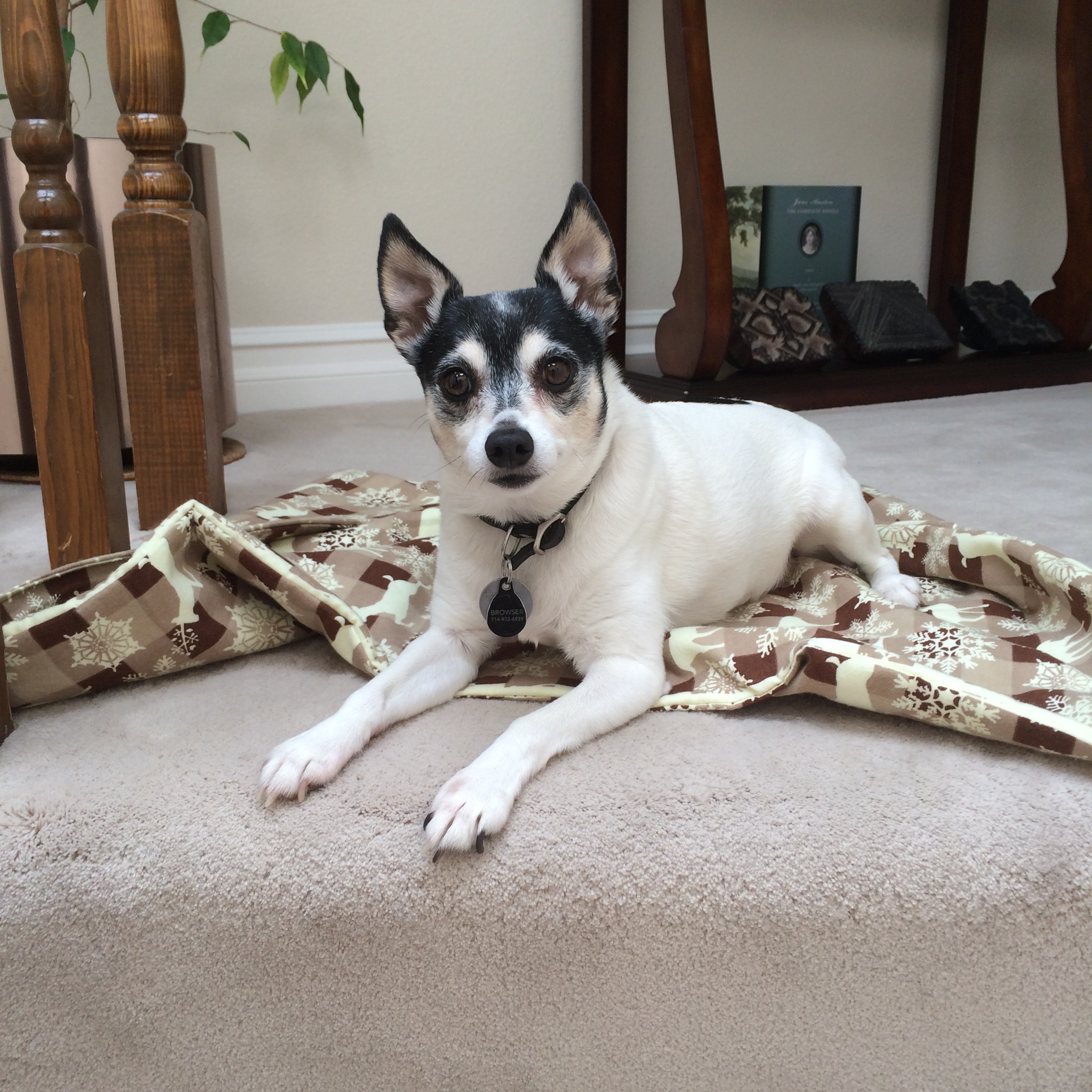
Browser likes to hang out on the stairs

Browser likes to hang out on the stairs

To make your pet a warm bed that is also machine washable, you will need:

1 yard of cotton flannel or regular cotton

1 package of Warm & Natural batting, 34×45″ size (or any low loft batting, I just like the weight of this type)

Cozy to be

Cozy to be

Step One

Lay out the fabric to make sure the edges are even and straight. Trim where necessary.

Trim edges

Trim edges

Step Two

Lay the batting on your table, then lay the fabric on top. Match the edge of the batting to the folded edge of your flannel. The flannel is going to be your guide for cutting. Cut out the batting.

Cut batting to the edge of the fabric

Cut batting to the edge of the fabric

Step Three

You should now have one yard of flannel folded inside out and then layered on top of the batting. Keeping everything configured exactly like that, stitch around the open edges, leaving yourself a 6″ opening where you will turn the fabric. Backstitch to anchor your stitching.

Before turning, trim any edges.

Cut out extra bulk before turning

Cut out extra bulk before turning

Step Four

Turn your project by reaching in through the hole and grasping the other end. Pull everything through the hole. Once it’s right side out, reach back in and pop out the corners. Next, turn in the raw edges at the opening, pin closed, then stitch.

Pin and stitch

Pin and stitch

You can either just stitch it straight down the side, or you can stitch all the way around the entire project to make a more finished look. I stitch this about 1/8″ from the edge. Finally, stitch a straight line from edge to edge in the center of the blanket. This will keep the batting from drifting around and getting lumpy in the washer or when Fido digs around in his bed for the perfect spot to settle. If you are feeling really motivated you can stitch an X from corner to corner or other designs. I find that I am not precise enough to do this and I always wind up taking a tuck in the fabric, and that makes a pucker, and that bugs me. :-)

Step Five

Present to Fluffy and collect the furry gratitude you are owed for your efforts. Start to finish this project should take about 15 minutes.

Heavy sigh....

Heavy sigh….

If your pet is bigger than medium size, you can make a similar blanket using 1 yard of flannel backed with 1 yard of cotton or flannel cut into a square, and the batting sandwiched in the middle. Follow the same steps, just stitching around four sides instead of three. I suppose you could also make a kid blanket this way too.  :-)

Handmade Fairy

Here’s a fun little activity brought to you by FairyMomCreations.com. We met the Fairy Mom at a recent event. Melody was fascinated by her little dolls and their houses. These are not just any doll and doll house. These are whimsical, dream-inspiring, beautiful little dolls. Melody and her friend Lily played all afternoon with these dolls – see Lily’s grandfather bought them each a doll, then Lily’s grandmother bought them each a doll kit, then Melody’s mommy bought them each a key…these girls know the power of shopping with different people with a soft spot for the littles. :-)

Anyway, the kit was more than we could do at the event, so yesterday Melody and I sat down to make her very own handmade fairy. I wish I had taken progress pictures, but I was so absorbed with the doll that I completely forgot! The kit cost $5. FIVE DOLLARS!  What a bargain.

As of yet unnamed fairy

As of yet unnamed fairy

Fairy wings

Fairy wings

The kit includes everything you need to make a flower skirted fairy, including wings, flower, yarn to wrap the body, wool for the hair and lots of beads and sequins. All it takes is glue and a little time. Took about 30 minutes start to finish. The kit includes photo illustrated instructions.

Whee!

Whee!

Here she has landed atop the fairy house we also purchased from the Fairy Mom. She has a variety of really neat and clever houses, castles, cabins, pirate ships and even a mushroom house. They are so cute, and the sides of the standard type structures come off easily because they use velcro!

Melody and fairy

Melody and fairy

Fairy family

Fairy family

The fairy abode came with this little family. They are so adorable. The quality is very high, too. They won’t fall apart at the first play session. They definitely are not for little littles, but girls 6 and up will find hours of entertainment with them.

The Fairy Mom is going to a number of events throughout California this year, but it looks like the next time we will run into her is during the Huntington Beach Civil War Days event over Labor Day weekend. Check her website for amazing creations, ideas and her calendar. They are worth the $5-$7 you will spend!

Working with an antique bed frame

I love my antique bed. It has been in our family for over a hundred years. My grandfather slept in it, my mother slept in it, I slept in it, and now my daughter sleeps in it. I don’t know why a bed, such a mundane item of furniture, should hold my affections so firmly, but for some reason it does. I remember a long long time ago in Sunday School they were asking us littles about what we would be most sad to lose in a fire. I had no thought of the clothing, toys or other childhood treasures. For me, it was the bed. Even at that young age I had been captured in the spell of history, antiques and family treasures.

As a kid, I liked to crawl under the bed and look at the support structure, wondering about all the people who had slept on it. The supports of the bed originally consisted of five 2×4 slats that rest on small footers, a framed spring, and then the mattress. The top of the mattress was lower than the top of the footboard and it had a lovely sleigh bed profile. But, since that support structure was worn out and very old, my parents had a new box spring and mattress built. Of course, it is a non-standard size, so it had to be custom built. With the addition of the box spring, the top of the mattress became higher than the top of the footboard and for a while I was upset. I felt it spoiled the look of my bed. :-) We retained the slats to disperse the weight of the mattresses.

As an adult I learned about bed skirts. Particularly for an antique bed, which usually has a 12″-15″ opening below the bed, these are a great way to hide anything you store under the bed, or just give it a softer look. Since my bed has been modified from it’s original structure over the years, this project does not damage it any further. If your antique bed is in its original condition, think about whether you plan to take it on Antiques Roadshow before making alterations.

Because of the slats under my bed and the large box spring, I can’t simply lay the bed skirt over the box spring and leave it at that, so I had to devise a way to attach the skirt. First I tried a system of rails that lay over the slats, but I still had to remove the mattress (heavy) and box spring (insanely heavy) to install and remove the skirt. The other day I came up with the simplest of all methods: velcro.

Slats, underside of the bed

Slats, underside of the bed

Here you can see the slats and a bit of the underside of the bed. I apologize for how terrible these images are, but have you ever tried to take a picture of the underside of a bed? It’s not easy, haha.

IMG_4631

Velcro placement

I used adhesive backed velcro and placed it right on the edge of the inside underside of the bed frame.

IMG_4628

Velcro placement on the skirt

Next, I cut the center out of the bedskirt so that I had one long ruffle. I placed the other side of the velcro along the seam of the ruffle. Do not cut on the ruffle side of the skirt – I left about 2″ of the center portion as a buffer, just in case my measurement of the drop was off. I broke the velcro into three sections – side, foot and side – making sure to allow room to go around large corner posts. First, place the velcro on the bed frame. Then place the velcro on the skirt. The measurement should match up exactly. With this particular bed, I used a queen sized skirt because the bed is not a twin and not a full. I took a large pleat in the center of the foot section to make up for the overage. Continue along the other side until the skirt is placed.

IMG_4626

Completed bed

The finished bed looks lovely! Since my black cat likes to go under the bed to hide, it will now be much easier to remove and wash the skirt to remove her hair that sticks to the skirt. If I decide to change the skirt for some reason, I will leave the velcro in place on the bed frame, and just reuse the pieces on the skirt. Keep in mind that the adhesive may wear out over time and you may need to baste the velcro onto the skirt.

Good luck with your antique bed, just remember to work with it, not against it!


Grown up coloring

At Christmas my daughter thought her Auntie would like some coloring books, since as a six-year-old Melody likes coloring. Lucky her, Auntie likes coloring and always has. Well, I thought some coloring books for grown ups were in order, and since I liked them so much, I bought myself a set. Of course, since we love Victorian clothing, that’s the theme of the books. I finished a couple recently. My daughter was playing on her iPad and I was the one coloring. Hee hee!

Evening Attire ca. 1891

Evening Attire ca. 1891

Walking Costumes ca. 1884

Walking Costumes ca. 1884

I hope you find yourself some good Dover Coloring books, a 100 color pencil set, and a little time to dream!

Speaking of Victorian clothing, we will be at the Southern California Civil War Association (SCCWA) reenactment at Prado Regional Park April 6-7. Visit my Victorian sister site Past Periods Press for more details.

Pattern review: Simplicity 2569 Princess Dress

Melody asked me to make her a purple princess dress for her birthday, since we are having a princess themed birthday party for her upcoming 6th birthday. We looked at different pictures, I assessed just how crazy this might be, and went over to Joanne’s to buy fabric.

Princess dresses galore

Princess dresses galore

Melody selected view A, which is the blue one shown above. The pattern calls for many yards of tulle and satin, plus some tissue lame for the inset and sleeve puffs, and a little trim. Right out of the gate I ran into difficulties, because Joanne’s had two completely different lavenders – one a pink lavender and one a blue lavender. After much deliberation (no joke, easily 30 minutes) I decided on the blue lavender. It just has a more of a true lavender look to me, besides the fact that Melody already has a Rapunzel dress that is in a more pink lavender. Next, I was thinking of using an embellished chiffon in the collection in place of the top layer of tulle, but Joanne’s had exactly 1/2 yard too little.

Once that obstacle was overcome, the cutter discovered that they had exactly 1/2 yard too little of the coordinating lining fabric.

Say what, Joanne?

Say what, Joanne?

Anyway, I’m flexible, made some adjustments then went home to get this project started. I had selected an iridescent sheer instead of the tissue lame because they didn’t have a silver lame, only gold and it didn’t look good with the lavender. Let me just say, I am pleased with the results but I really regret that fabric. It was very slippery. I backed it with white satin, flatlined them and treated them as one piece. The pattern has you apply this triangle shaped piece to the bodice front in the first step, fine. But upon reading through the pattern, they have you glue the trim on at the end. That didn’t work for me because I know my daughter. That trim would be ripped off within the first day. Here’s my second regret about this dress. I picked out a really pretty sequined trim that matched the fabric perfectly; it was sold by the spool so I couldn’t open it in the store. It was elasticized! And the sequins are made from something stronger than titanium because I broke three – yes three – needles stitching it on. Now I understand that Simplicity wanted the trim to lay on top of the seam because after sewing, turning and finishing the bodice I can see that part of the trim tucks inside and it’s not a “perfect” look. However, if you use something that doesn’t have sequins, why in the world would you not sew it on? A regular ribbon or floral trim is going to be just fine stitched inside the seam and it will be a much more finished look. So there.

The rest of the dress was so easy! The puffed sleeve is a two-part sleeve, meaning you cut a small piece out of the tissue lame (or slippery annoying iridescent stuff, in my case) and apply it to a regular sleeve piece. The gathering of the fabric gives you the puff and it is really very easy. The skirt is two layers of tulle plus an underskirt. My only thought is that you really want to use fine tulle here because a rougher one might be a bit scratchy on the inside. Also, the waist is finished by turning the seams toward the bodice and top stitching. With the horrid titanium sequins I had going on, I did not top stitch that section.

I found the directions for the back opening a tiny bit confusing. They have you extend and press back 1/2″ of the tulle on the center back, but it is unclear as to exactly where it is to be placed. Looking back, I can see now it was supposed to have been folded back and placed along the zipper placement line, not the raw edge. This would allow for there to be a gap in the tulle allowing the zipper to pass through nicely and the stitching to be neat and tidy. While you won’t be able to find it on this dress, I had to do some fancy zipper foot work to make that spot work.

With those two minor criticisms, however, I’d say this is a nice pattern. It’s not a beginner pattern, but certainly not an expert level either.

But, what do you think? It fits well and I made it large so she can wear it for more than a minute. I haven’t made the hat.

Ta dah!

Ta dah!

I’m considering going back and making one of cotton for a certain little girl who’s birthday is in July.

UPDATE: I went back and made the hat. It took about 30 minutes from start to finish, and darn if I didn’t find some regular purple ric-rac that I could have used on the dress instead of the sequins! Anyway, here are my thoughts on the hat. The instructions have you apply fusible interfacing to the inside of the hat, and the pattern requirements call for lightweight fusible interfacing. If you want the hat to flop over like one of those funny men’s nightcaps from 200 years ago, go ahead and use the lightweight. Otherwise, use a heavyweight fusible interfacing. Second, they have you hand stitch the tulle to the point of the hat after it’s finished. I don’t know about you, but my hands do not fit into that tiny diameter point. I suggest either catching the tulle in the seam when you stitch that, or attaching the tulle to the fabric before the seam is sewn. Finally, my daughter just didn’t want to wear the hat for more than a couple minutes at a time so I didn’t bother with the elastic band for under the chin, but you could easily replace that with ribbon ties stitched into the hat at the time you make the narrow hem. Way more secure, less hand sewing, and actually realistic historically speaking. :-)