Embroidered Silk Handbag

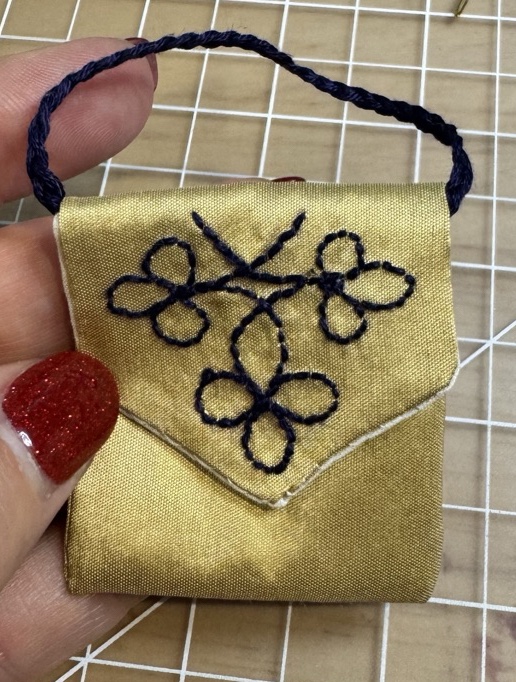
A proper Victorian lady doll must have a handbag for the various items she’d like to carry with her when visiting friends. Perhaps calling cards, a pencil, a coin and a house key might be needed during her day. I wanted to make Ruby a little handbag and devised this pretty one. You can make one too, just follow these easy instructions.

To make this embroidered silk handbag you will need:

Silk outer fabric

Cotton lining fabric

Silk thread

Sewing needle

Scissors

Pins

Embroidery floss

Embroidery needle

Tissue paper

Pencil

Begin by cutting one silk and one cotton piece 2 inches wide by 5 1/2” long. On one short end, make a point that is stepped back 1/2” from the end.

Forgot to take a before picture!

Trace the embroidery pattern you like onto tissue paper. I went with this continuous line art found in A French Fashion Doll’s Wardrobe.

Pin that where you want your embroidery to be. Make sure to leave space for 1/8” seams on all three sides of this flap. Using 2 strands of your floss, stitch directly through the tissue paper and follow the pattern.

I chose to do this in a backstitch but you may like a split stitch or a standard embroidery stitch. Let your creativity decide. When you have to end your stitching be careful not to catch any of the silk in your anchor stitches.

Once you have completed your embroidery, tear away the tissue paper. Make sure to pick out any caught in a stitch or under a thread. I used the blunt end of a crewel needle to do this but you could also use craft tweezers.

Fold right sides together so you make a 2” square pouch, and then stitch down the sides. Repeat with the lining.

Pin the lining and silk right sides together on the flap and stitch around the flap only. Turn your work and push out the corners. If you like you can lightly iron the flap to roll the lining to the inside.

Set this aside for a moment to make your handle. This tutorial includes a braided embroidery floss handle but you could use ribbon, cord, chain, really whatever you might like as long as it isn’t too heavy.

Measure out 24” of embroidery floss, then section that into three 8” strands. Knot one end, then tape it to your work surface. Braid the floss until you have 4 or 5” of braid. Knot the end and clip off the tail.

Open the silk pouch and tuck the lining inside. Make sure the corners go all the way inside.

Next tuck one end of your handle in between the silk and the lining at the flap fold. Pin that in place.

You will need to tuck under the silk and the lining so all raw edges are inside the seam. Carefully stitch a blind stitch, making at least two stitches through the handle. When you reach the other side, tuck the other handle end in and stitch through it.

All the raw edges should be inside, the handle should be nicely secured. Finger press the flap closed so the embroidered side looks pretty. If you like you can add a hook & eye or snap. Depending on the embroidery you select you could make a buttonhole and add a decorative button.

Very pretty!

Making a Feathered Victorian Fan for a Doll

As I’m wrapping up final bits and pieces for Ruby, I’m making some accessories for her. Every Victorian lady had a fan or three, so today I made a fixed type of fan – as opposed to a folding fan that looks like a half circle when open.

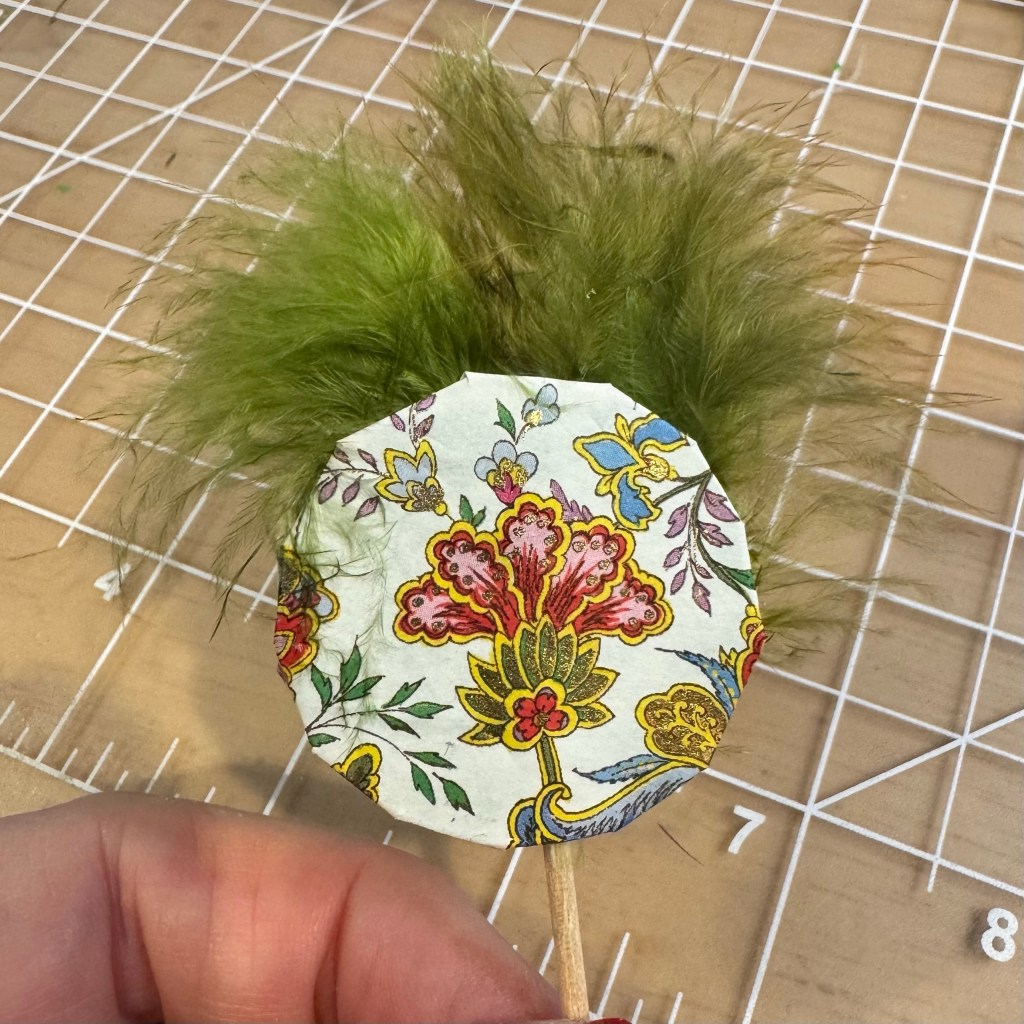
This two sided fan with feathers was delightful and easy to make.

You will need:

An index card

Some fancy scrapbook paper

A toothpick

Some feathers

A pencil

A spool of thread

Scissors

Craft glue – not a glue stick

Start by tracing your spool of thread on the index card to make two circles. Cut those out.

On your scrapbook paper, try to find a pretty motif that you want to be centered on the outside of your fan. Trace the spool of thread so those motifs are centered, and then draw a 1/4” margin around that circle. Cut out on the larger circle. The index card circle will fit in the inner circle. Using a bit of glue, glue that in place.

Carefully clip around the circle to make tabs in the scrapbook paper. This will allow you to fold it over the index card.

Put some glue right at the edge of the index card circle and then fold the tabs down, pressing them into the glue. Set that aside for a moment.

From your feathers, find 3-4 that you like. I chose these really fluffy feathers, but you could use some that have a design on them, really just choose the ones you like best. Lay them onto one circle in a pleasing arrangement. Clip the hard ends if necessary.

Take the toothpick and cut off one pointed end – maybe 3/8” up the shaft. This will be the handle of your fan. Put a glob of glue on top of the feathers, and then lay the pointed end of the handle in the glue – making sure it comes out opposite the feathers. In my case, one of my motifs has a stem so I wanted the handle to come out right at that spot.

Lay the other circle on top of the feathers and press the two sides together firmly. If any glue squeezes out wipe it away with a paper towel.

Allow the glue to dry. You can tie a 1/8” satin ribbon around the handle and then tie that to the hand of your doll if you want to display it. This fan took about 10-15 minutes to make.

I hope you will try this little project and if you do please share in the comments. You can try other shapes for the index cards as well. Let your imagination soar.

Much Progress!

I have been posting progress pictures over on my Instagram and just realized I hadn’t posted anything here in a while! I’ve made great progress on Ruby’s wardrobe. I won’t say we are on the homestretch, but the only thing left to make is her bodice, so we are almost there!

The last post I made was about her completed undergarments and since then I have completed the skirt and drape for her dress. In the 1880s, women’s dresses sometimes had asymmetrical features, like drapes that were pointed on one side, lapels only on one side of the bodice, things like that.

As an aside, funny how 100 years later in the 1980s, I myself wore asymmetrical styles – I had a wide leather belt that was wide on one side and the skinny end overlapped at the waist. And we can’t forget the bib front shirts that were meant to be worn half unbuttoned. Anyway, that’s a funny thing about fashion – everything old is new again.

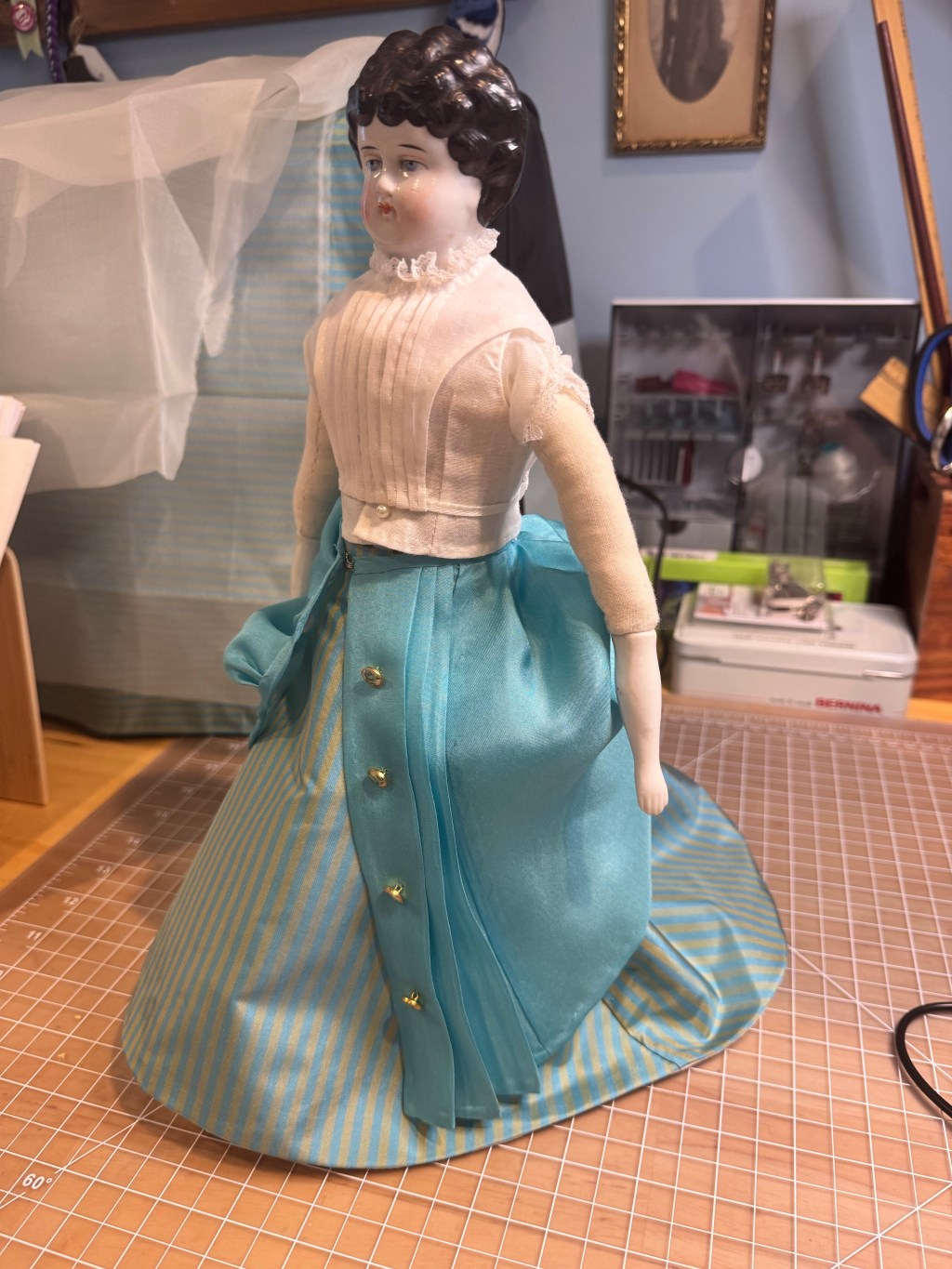
Here is the front of the lovely silk taffeta skirt. I really agonized before making this because the side panels are curved and I was really concerned the stripes would go awry on the side and back.

I was worried over nothing! The two large pleats on the side back take up much of the curved edge and in a way, correct the direction of the stripes.

The bustled look is accomplished by adding a set of tapes across the back of the skirt and then drawing up the tapes and tying them into place. I do know this method was used on original dresses back in the day. Here you can see the bias strip of batiste and the tape before it’s been cut in the center. The bias is stitched through both the lining and the outer fabric but for much of the rest of the skirt stitches are placed only through the lining for a very clean look.

Here’s the back of the skirt with the tapes drawn and tied. This silk taffeta is so luscious to work with. I wish all fabrics were as nice!

The next layer is the drape, and of course Susan Sirkus patterns are fiddly at best! I ended up writing out the instructions separately because much was missing from the method. At no point do the instructions tell you to hem the edges – one of my big complaints about her patterns.

But whatever, I know how to sew and what needs to happen to bring a garment together thankfully, but over and over I realize the Wish Booklets are just not for beginner sewers.

I used a softer silk for the drape that is just the color of the blue stripes in the taffeta and it coordinates perfectly. And because the Victorian era was one of embellishment, I decided some kind of design should be added to the drape. At first I thought maybe trim around the lower edge, but instead decided on an embroidered motif.

I found this design in the book A French Fashion Doll’s Wardrobe. It’s one continuous line.

Based on the image in the Wish Booklet, this part of the drape should lay across the side front, but it doesn’t. I just can’t get it to stay there. I know I followed all the instructions and was very careful in the construction, but this drape just sits high on the bustled skirt underneath.

I also have issues with where the pleats on the front fall. It’s one of those things – the drawing just doesn’t match the reality. Is this a problem? No. Does it bother me? A little.

And also based on the drawing, this back portion should cover the bustle instead of whatever it’s doing here.

But overall I still quite like the drape and how it works with the skirt. Could I redo it – yes of course and I could make changes based on my experiences. Is it worth it – no, it probably isn’t. This is a dress for a doll, not a live person.

I used these lovely cloisonné buttons I have had forever that just so happen to be perfect for this dress!

So pretty!