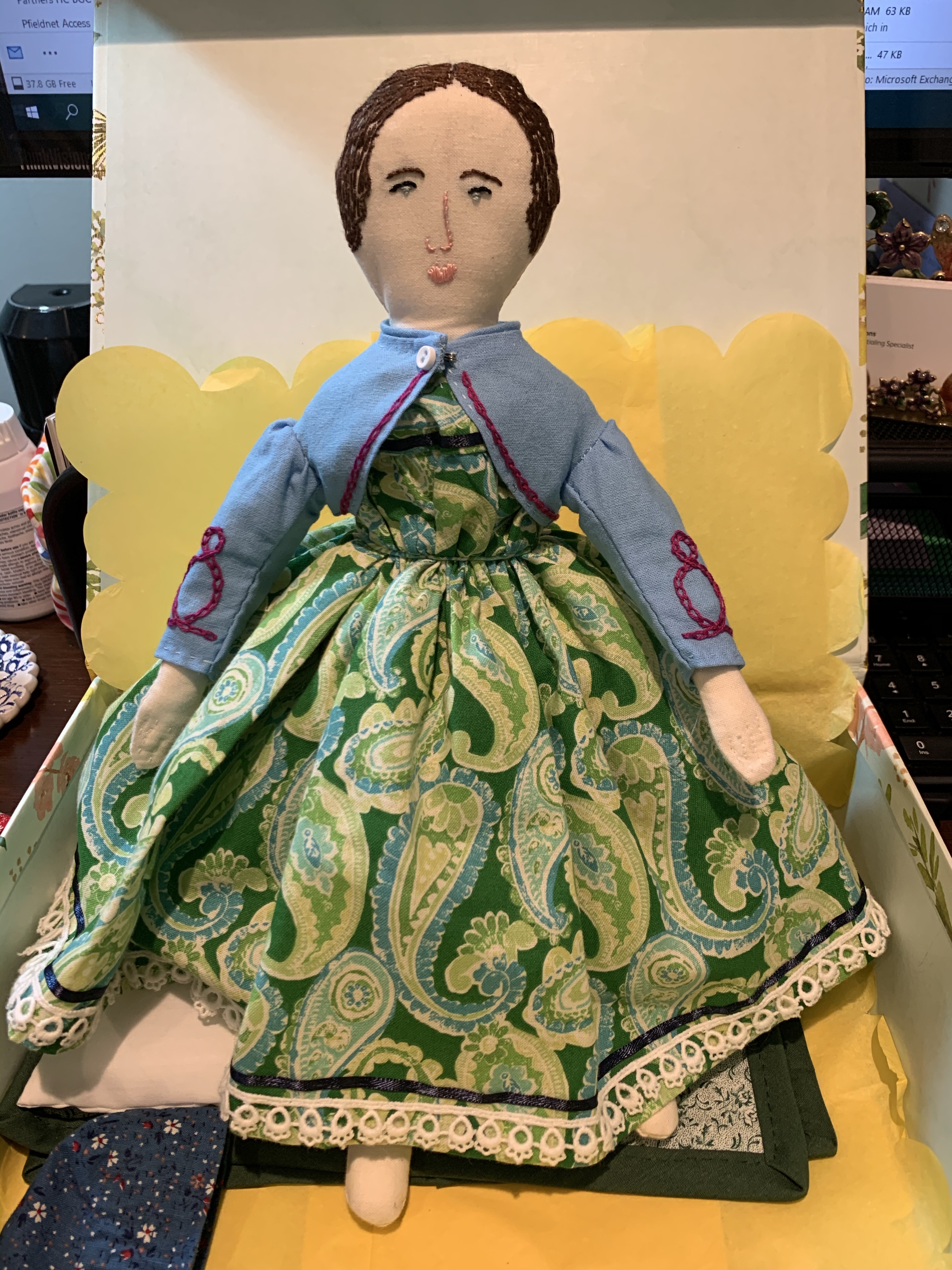
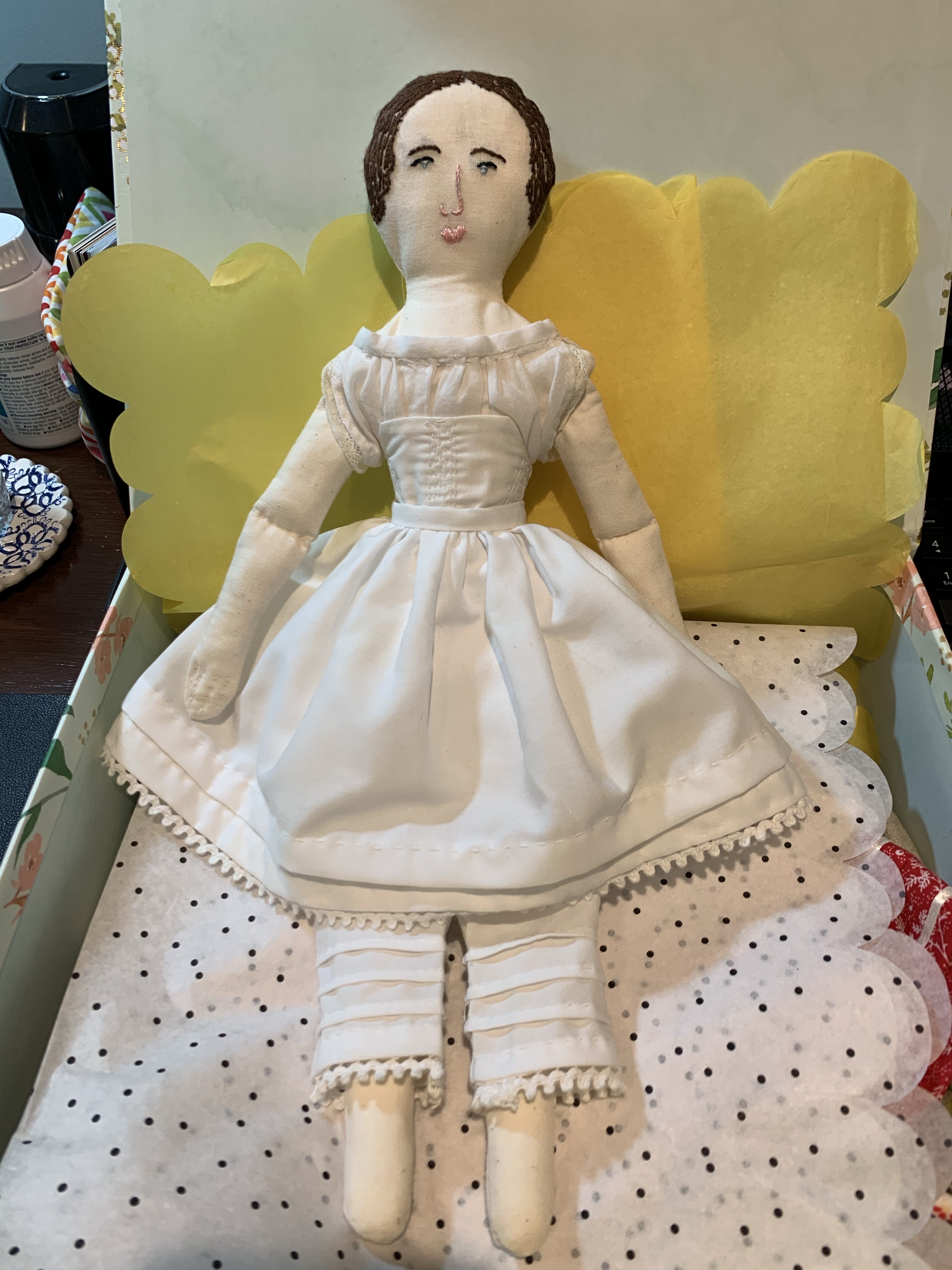
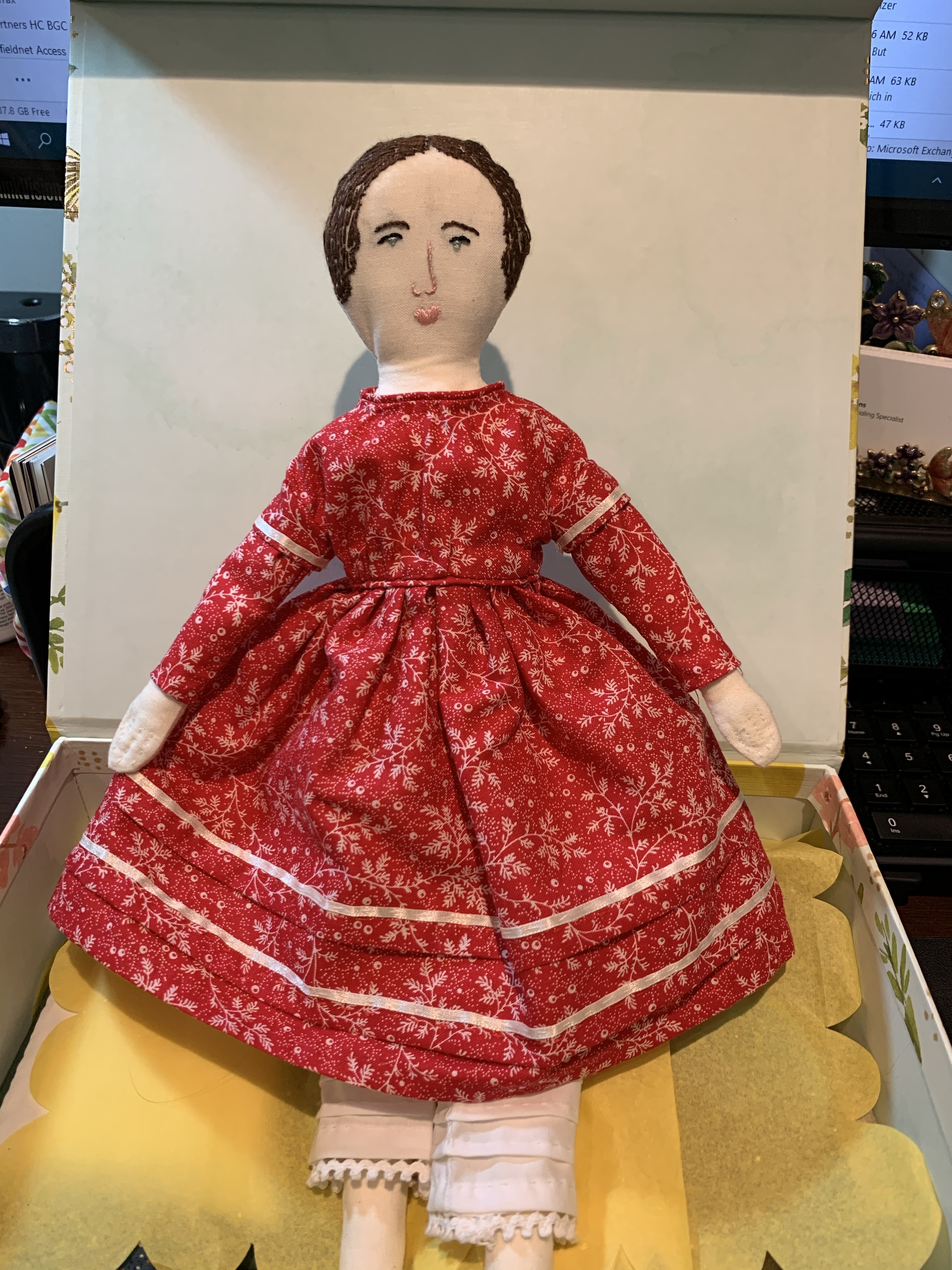
Dottie

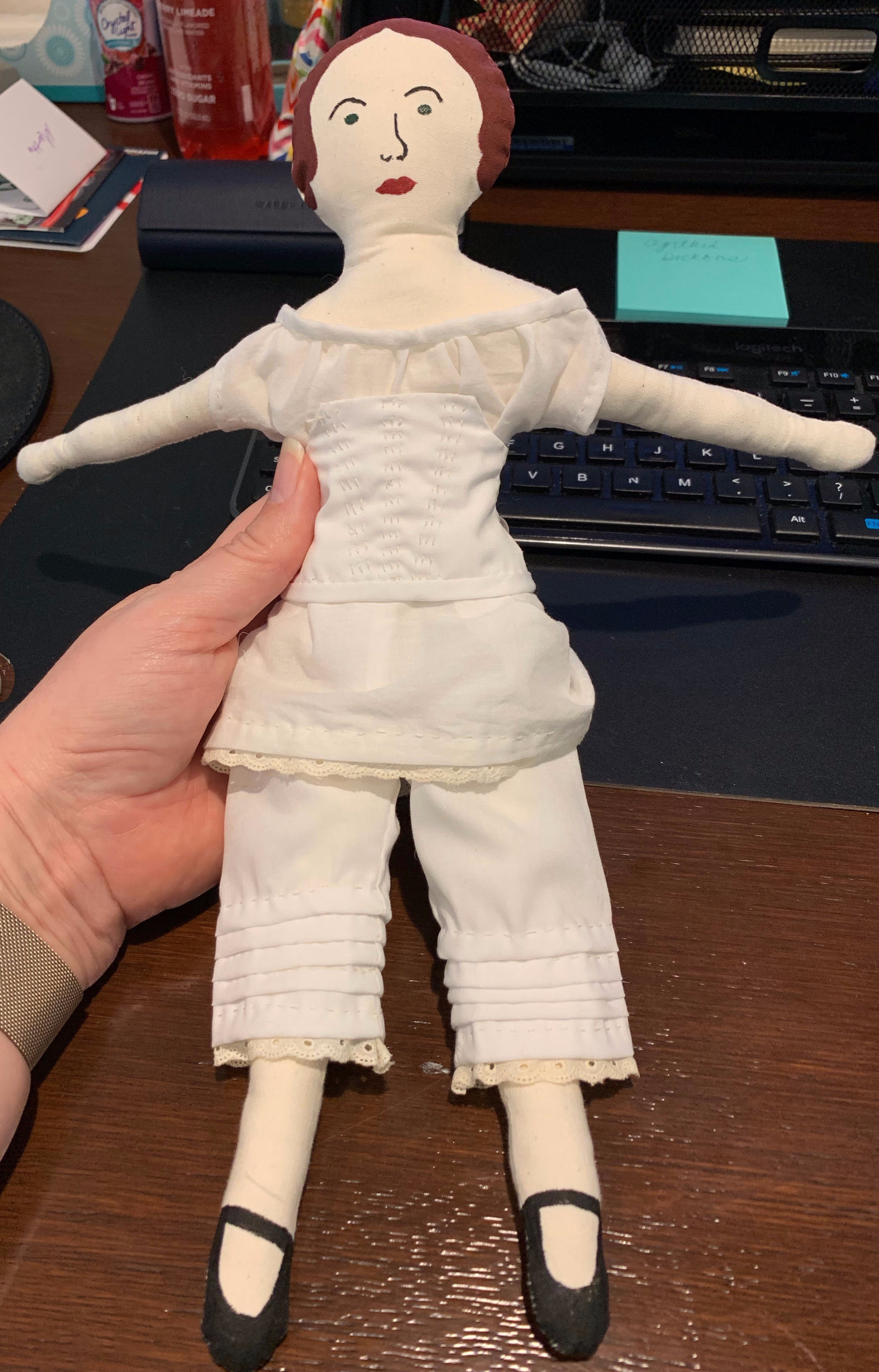
This doll named Dottie was made for my sister as a Christmas gift. It’s my third making of the Little Cloth Girl pattern from Elizabeth Stewart Clark. Needless to say, I love this pattern.

You will notice an immediate difference in Dottie’s appearance from Emalie and Mernie, and that is her face & hair are embroidered. I’m not the best at embroidery (that’s my sister’s specialty), so I had to be very careful. I actually remade her face since I didn’t like the first attempt. All the embroidery is silk and I think it came out nicely. I also stitched in her fingers – not an easy task, plus she has jointed elbows and knees.

She again has the undergarments appropriate for a girl in the mid 1860s. I decided on this go-round that I would make a full wardrobe since she was a gift.

My daughter picked out this red fabric – which I just love. The dress is a darted bodice with sleeve caps.

The second dress is made from fabric my sister has picked out to make herself a dress – probably a wrapper. I thought it would be fun to surprise her, so I just asked for a 1/4 yard of any fabric. Now, once she makes up her dress, she will have a friend in a matching dress. How sweet! This dress is a gathered front yoked bodice. I really like how it turned out.

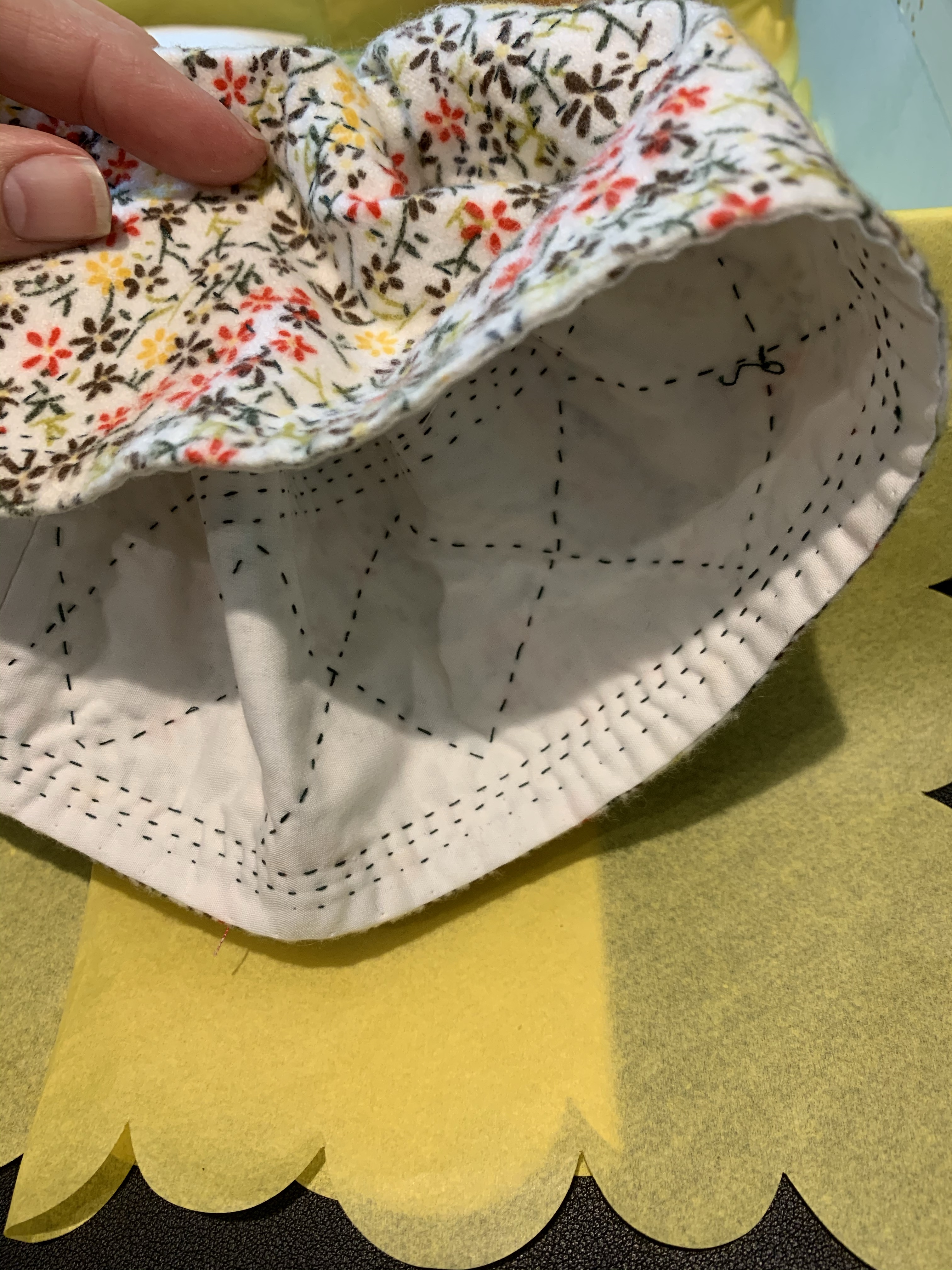
I made a quilted petticoat from flannel. While you can’t really see it, it has the same diamond pattern quilted in as Mernie’s.

The next piece I made was the basque coat. I used a sueded fabric to make it seem like wool or a heavier fabric. The trim is brown velvet and I love the nonfunctional buttons.

My favorite piece is the blue lightweight coat. Like I said earlier, I’m not much for embroidery, but I wanted this to look like it has braid, which was a common embellishment. The little button just finishes it off.

And just because I’m a glutton, I made a little handbag, a bonnet, a quilt that features all the fabrics used in the clothing, and a pillow. Oh, and inside that handbag are mini books I made. As an aside, I made another of these little bonnets for a Holiday Gift Exchange in the Historical Costuming For Dolls Facebook group. I’m not the only one obsessed with them!

I hope that you have enjoyed this tour of Dottie and her wardrobe. In the next post, I will showcase a costume made from a vintage fashion magazine.

Meet Nell

For someone who is a documented doll disliker, I have become fascinated by them. Not playing with dolls, or displaying them. And not all dolls; I like very specific styles of dolls designed in the mid-nineteenth century. Of course I can’t afford the real dolls – or, more accurately, I won’t afford them.

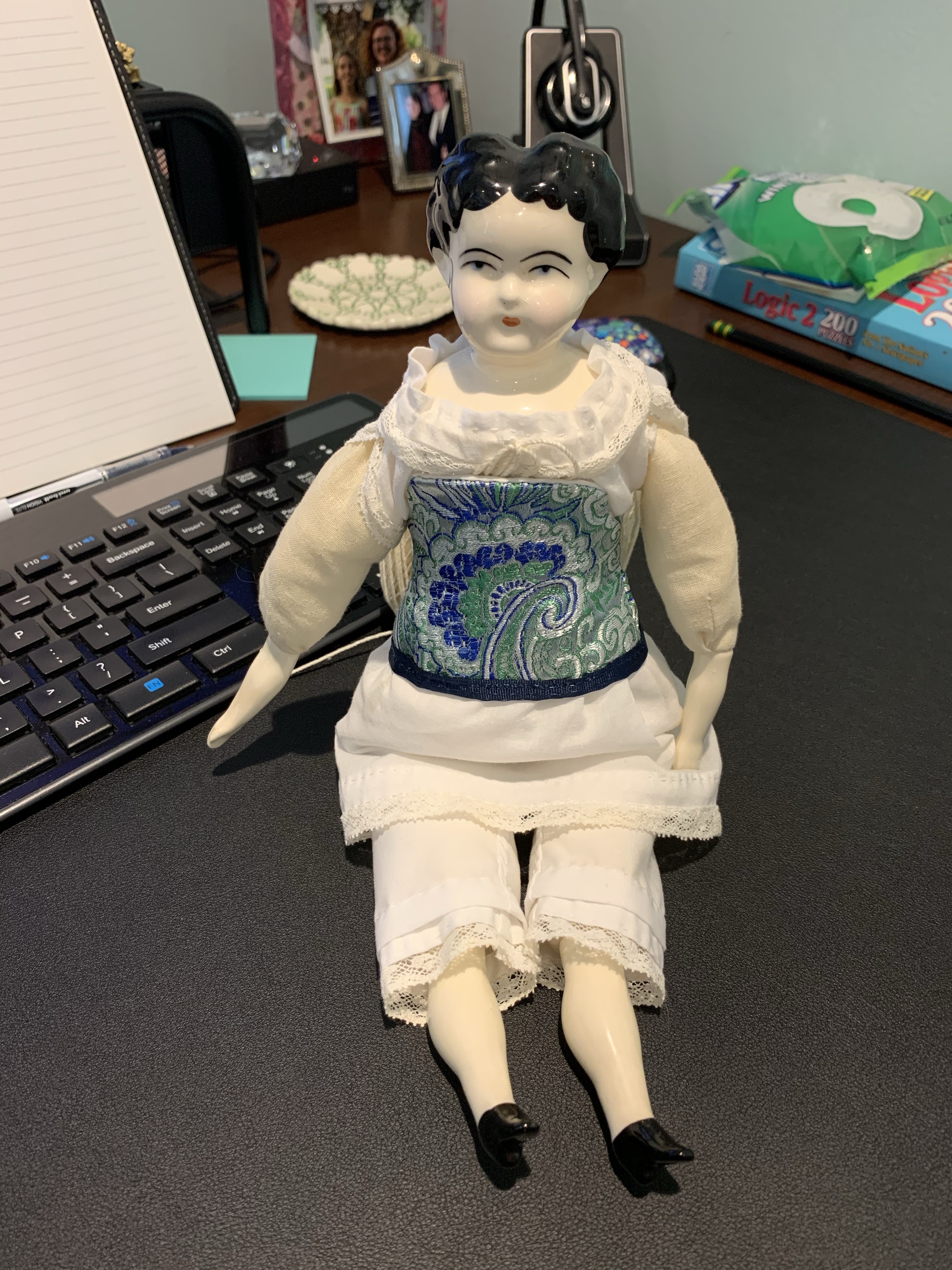
This doll, Nell, is a reproduction late 1860s-1870s cloth bodied doll. She has China head, hands and feet. I did not make her, but adopted her off eBay. She was designed by Tasha Tudor in 1977. I don’t know much about Tasha Tudor except to say she was an artist who loved dolls. In the 1970s there was a revival of these China head dolls sold as kits for home doll makers. Many brands offered the kits, and I don’t know how accurate they were.

Nell was poorly constructed – her legs are twisted and her arms are attached incorrectly as well as being rather fat. I could have remade her body, but I decided I love her as she is.

Sweet Nell came to me in a truly unattractive outfit. Remember she was made in the 70s. The dress was made from orange sprigged searsucker. Yikes.

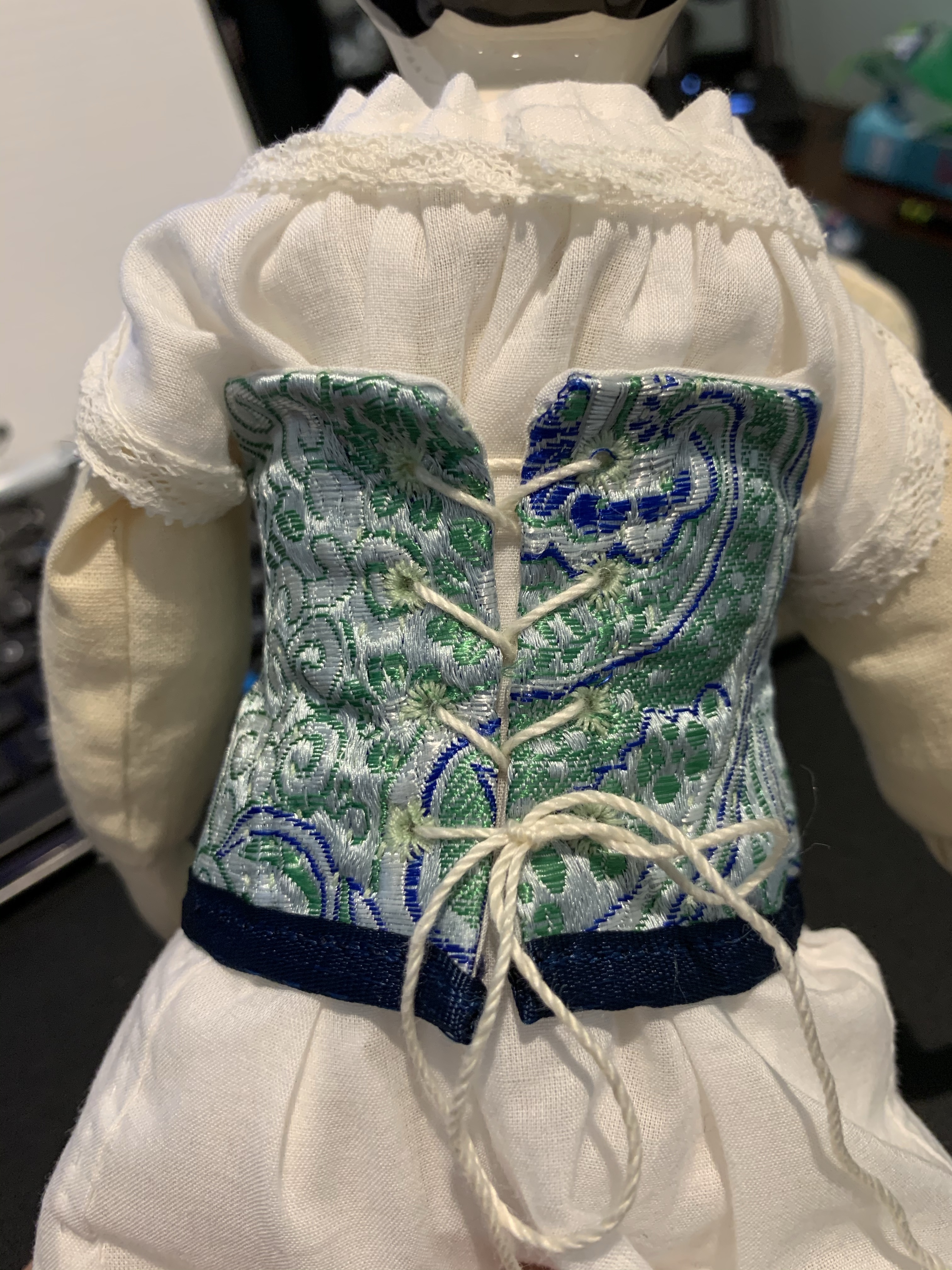
Since I want to eventually use my dolls for teaching and display at history events, I could not leave her in this crazy outfit. From the muslin out, I redressed her. First came a new chemise and drawers from white cotton. I figured for a nicer doll I could have some fun with her corset and made her a corded corset with this beautiful brocade I had. Add a nice tucked petticoat and we are ready to keep going.

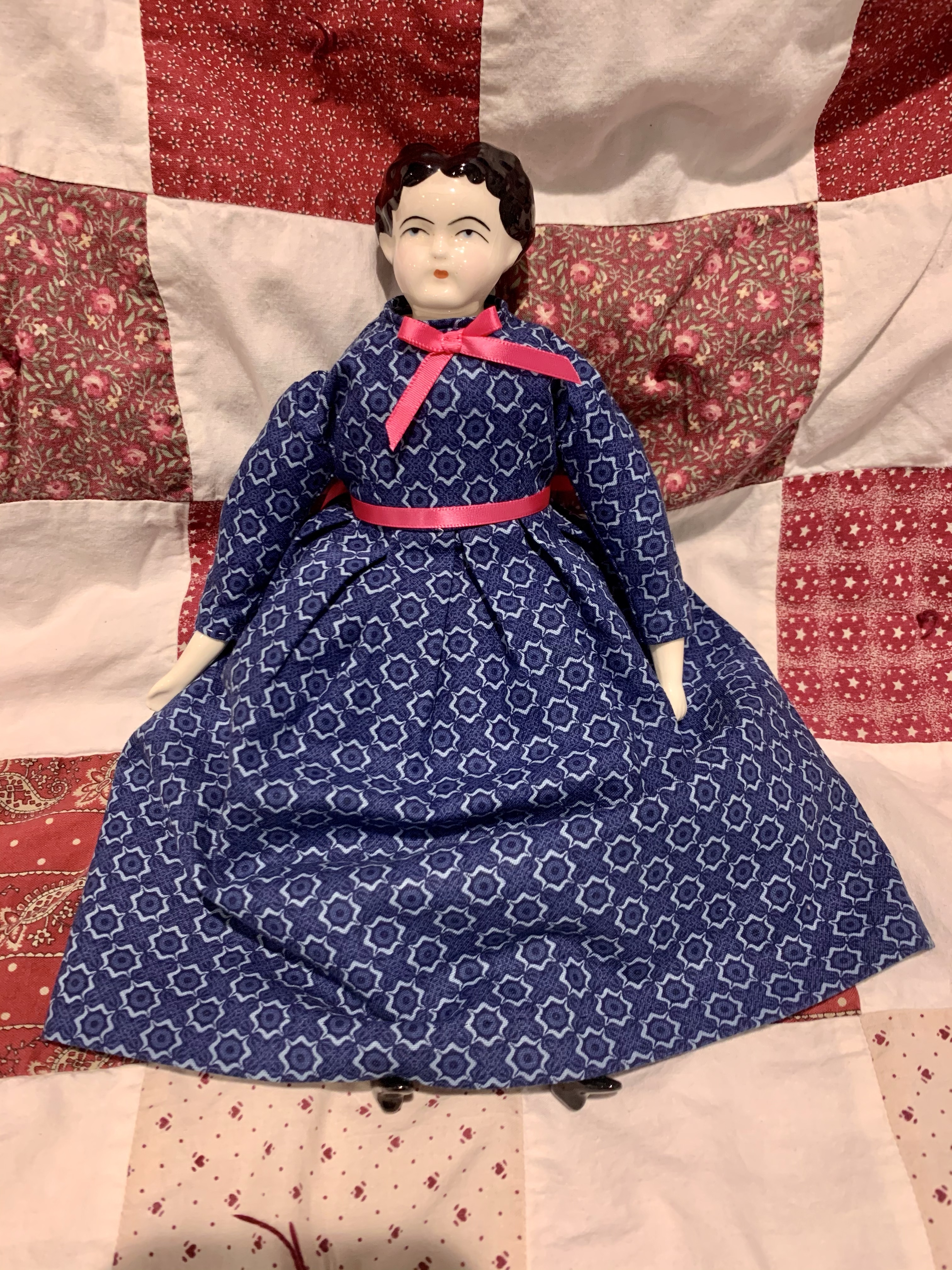
At some point after the first photos I remade her chemise. I never did like the first run at it. The new one is tucked to the neckband and lays much more smoothly. Unfortunately for Nell, it took me another several months to make her dress. I took a break to decide exactly what to make for her. Since she is later 1860s, I wasn’t limited to typical hoop skirt styles. While the basic bodice didn’t change too much after 1864, skirts and embellishments did.

I spent some time researching exactly what to make, delving into French fashion magazines and dreaming of the garments I would make her. And then I made a basic, almost boring, dress.

The fabric is cotton meant to mimic a patterned wool, which would commonly have been used. I modeled the dress off the amazingly versatile patterns from Liz Clark, modifying them to fit Nell. The skirt has box pleats at the waist, which were a more stylish method of attaching a skirt. It was a bit boring on its own so I added the pink ribbon bow and belt.

Next episode, look for the gift I created for my sister.

More Dolls

In all my spare time, I have made some more dolls. I never thought I would become so enthralled with dolls or their clothes, but 2020 was a year of sucki-ness, and I guess I actually did have some spare time. Anyway, I made a second doll from the Elizabeth Stewart Clark pattern.

This is Mernie. She has similar undergarments to Emalie, except I tried making a quilted petticoat. Since I had never even quilted before, this was quite a challenge for me. The pattern says to follow any quilting pattern. Well, I don’t know any quilting patterns, let alone an 1860s era pattern. So I made one up.

The pattern is really designed to hold the layers of fabric in place, I measured out the diamond pattern I wanted, adjusted, remeasured, then marked it out in chalk. I thought it would take forever. What I discovered was that quilting is kind of zen. I get in the zone and felt remarkably relaxed when I finished.

Mernie has a gathered front bodice with bishop sleeves. I like the gathered front, but let me just say that the cuffs of the bishop sleeve are insanely tiny. It was a challenge to finish them nicely – but one I felt up to completing.

I quite like Mernie. I feel I made improvements on my first attempt with this pattern.

Well hi there!

Yes, it’s been over a year since I wrote on this site. Finally I have something fun to write about – microblogging on Facebook just barely scratches the itch, but time has been a constraint too. So, here we go.

I never finished that “girls midcentury” dress project, because well, my girl has grown out of the chemise and drawers I made her, and is not really interested in history events any more (boo). She will go if I make her, but would prefer not to.

To fill the void, I have made another “child” to dress. Everyone, meet Emalie!

IMG_1266.jpeg

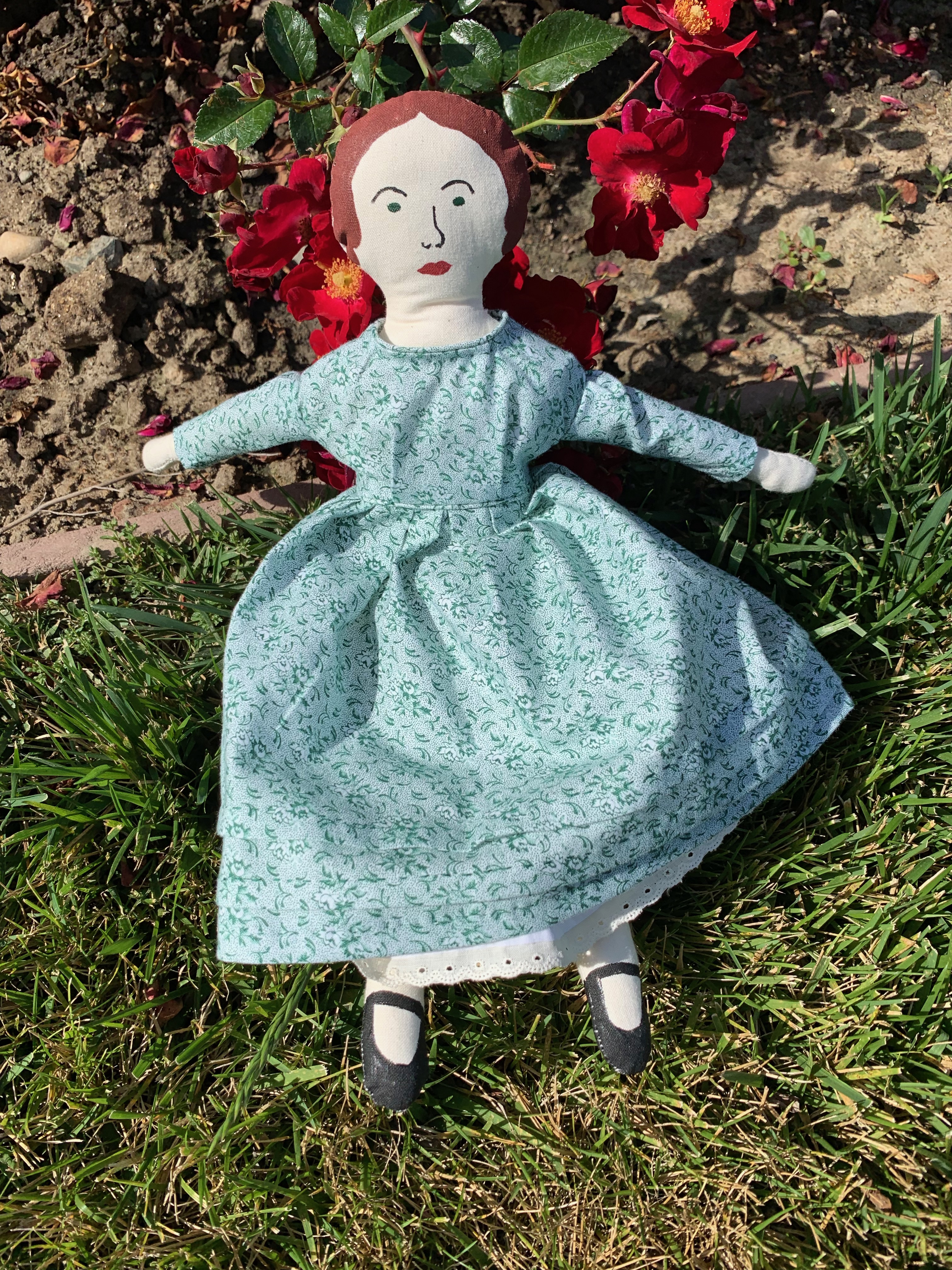
Emalie is based on a mid nineteenth century doll style and the pattern is a digital download from the amazing Sewing Academy by Elizabeth Stewart Clark. You can get the pattern at her website and it is easy to follow. There is also a lady sized doll that I’ll probably get next. Emalie is about 13″ tall, made from all cotton and sewn 100% by hand.

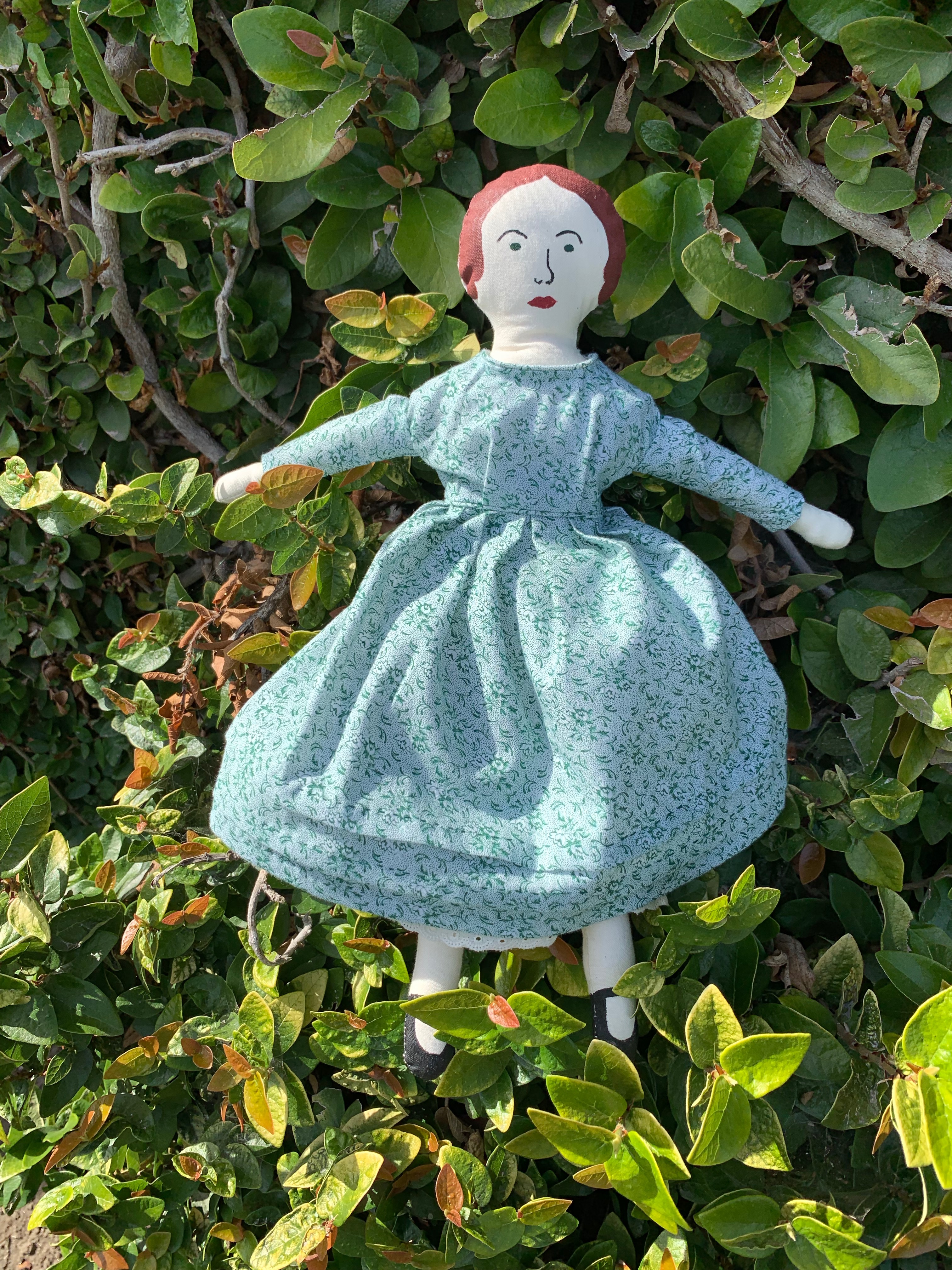
Before I was able to make her dress, I had to start at the beginning and make her! She is made from cotton muslin and stuffed with cotton. I chose to paint her face and hair as well as her little Mary Jane style shoes. Her hair is a red brown and her eyes are green. I could have done a better job at stuffing her, but since she is my first, I will have to accept the flaws. I also think I might have put her arms on upside down. The pattern was a bit unclear exactly how to position them and she just holds her arms out wide for a hug. Otherwise, making the doll body was super easy! I used cotton balls to stuff her, and just mangled them up a little bit to make them more flexible.

Next, I made her undergarments. I used a very lightweight cotton for her chemise and a stiffer cotton for her drawers. I’m not thrilled about the tucks on her left leg of the drawers as they got a little messed up. The scale is so small that even a minor mistake can take the whole seam off kilter pretty quickly. I used the same stiffer cotton for her stays.

img_1237.jpegIMG_1239.jpeg

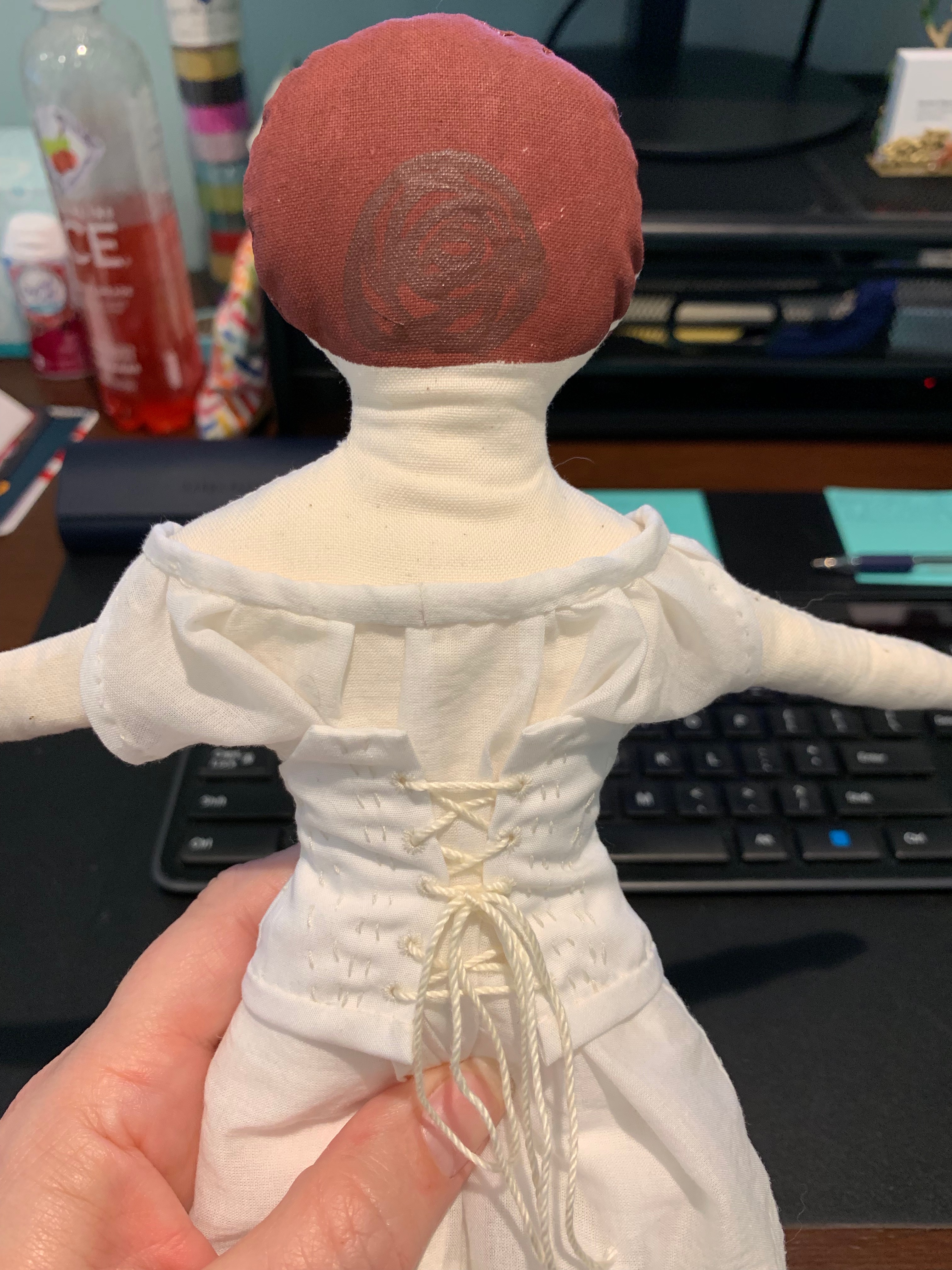
Like how I painted a bun on the back of her head? :-)

The chemise, drawers and petticoat are edged with some vintage lace whitework that a friend of my mother’s gave to me. For the stays, I stitched in the appearance of boning channels but there aren’t actually any bones or cord in them. I didn’t want to get “too” carried away, and I knew I would be hand sewing the eyelets for the lacing. I think I spent more time on the stays than on the rest of the clothing! The stays are laced with a narrow cord. Luckily for me, I had made the actual child sized stays for my kiddo a while back so I understood the process. The pattern has mistakenly forgotten to include the construction notes on the stays. I will forgive Ms Clark because she is awesome in so many other areas!

IMG_1257

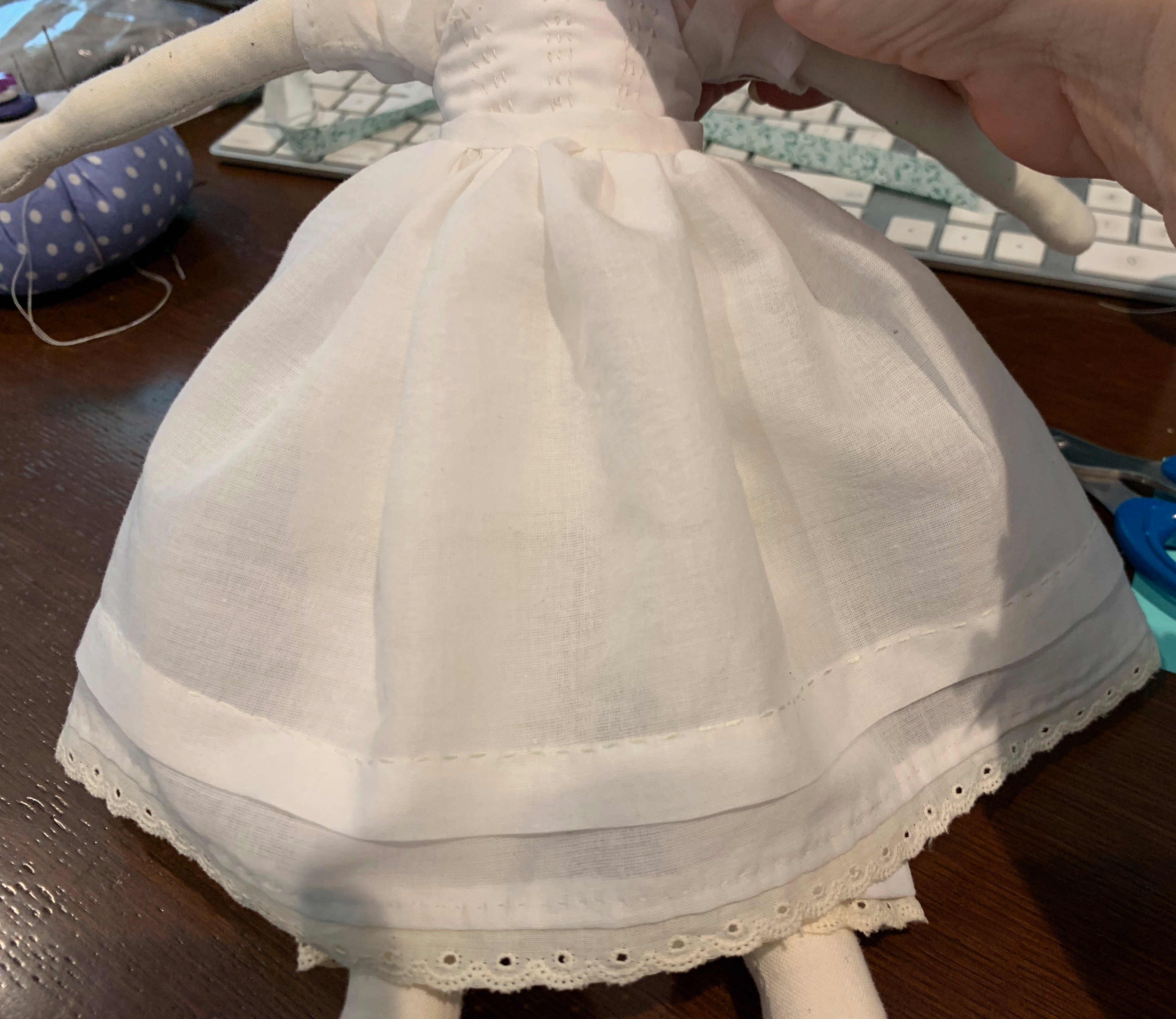
Here is her pretty petticoat with a wide 1/2″ tuck. If you ever want to fine tune or refine your hand sewing skill, a doll is a good way to do it. The pieces are small and there is almost instant gratification. I have found I can take very tiny stitches that look almost like machine stitching. It does cause some eye strain however.

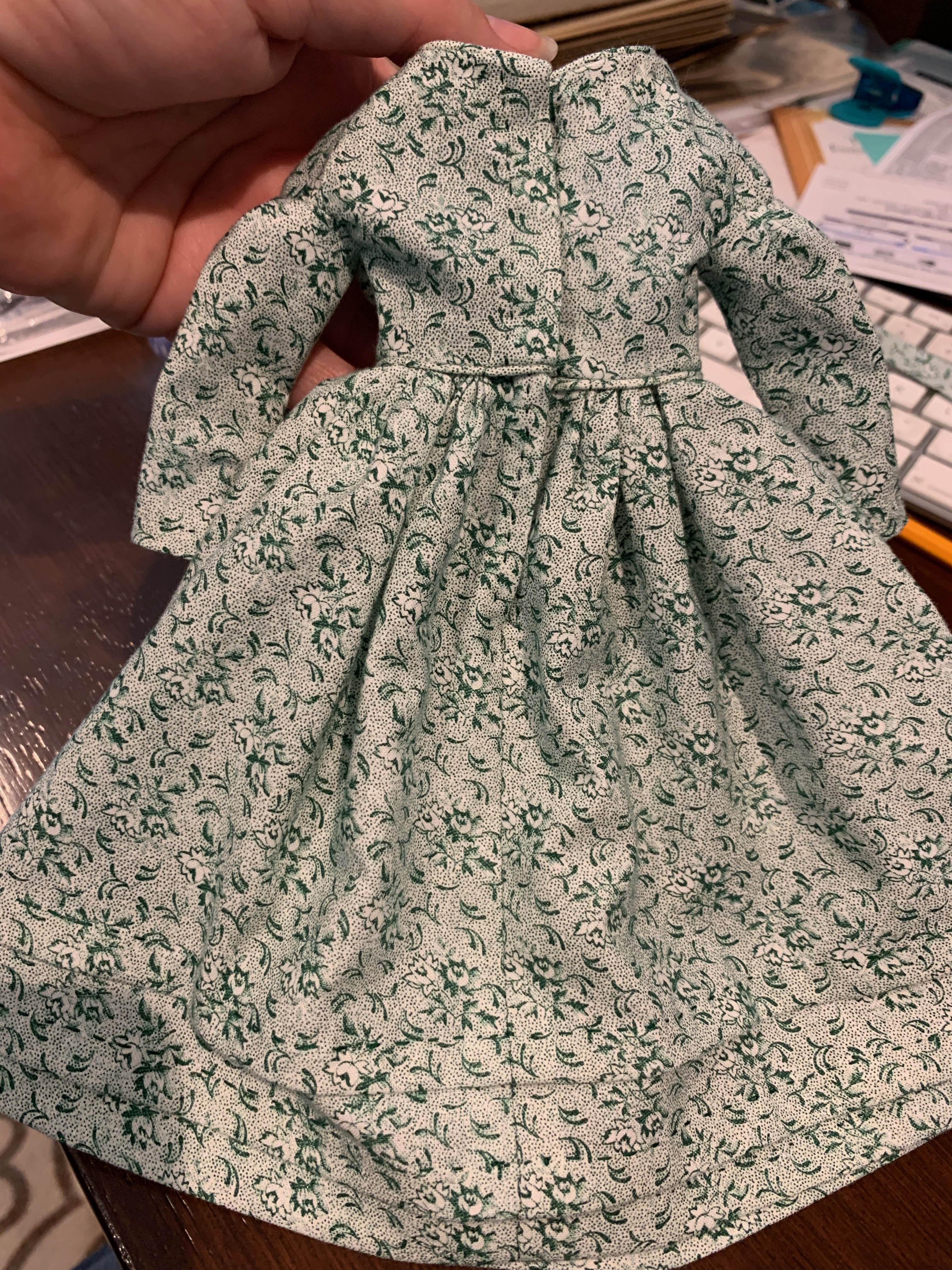
Finally, I made her a pretty green dress. I selected this fabric to make a dress for Melody when she was a baby. She grew so fast, she outgrew the pattern I had! IMG_1259.jpeg

Here you can see the tiny piping at the neckline and waist. This is how dresses were made in the mid century, so I chose to do that here. The piping is made on the bias and I used the same cord that I used on the stays. It was the perfect size.

IMG_1261.jpeg

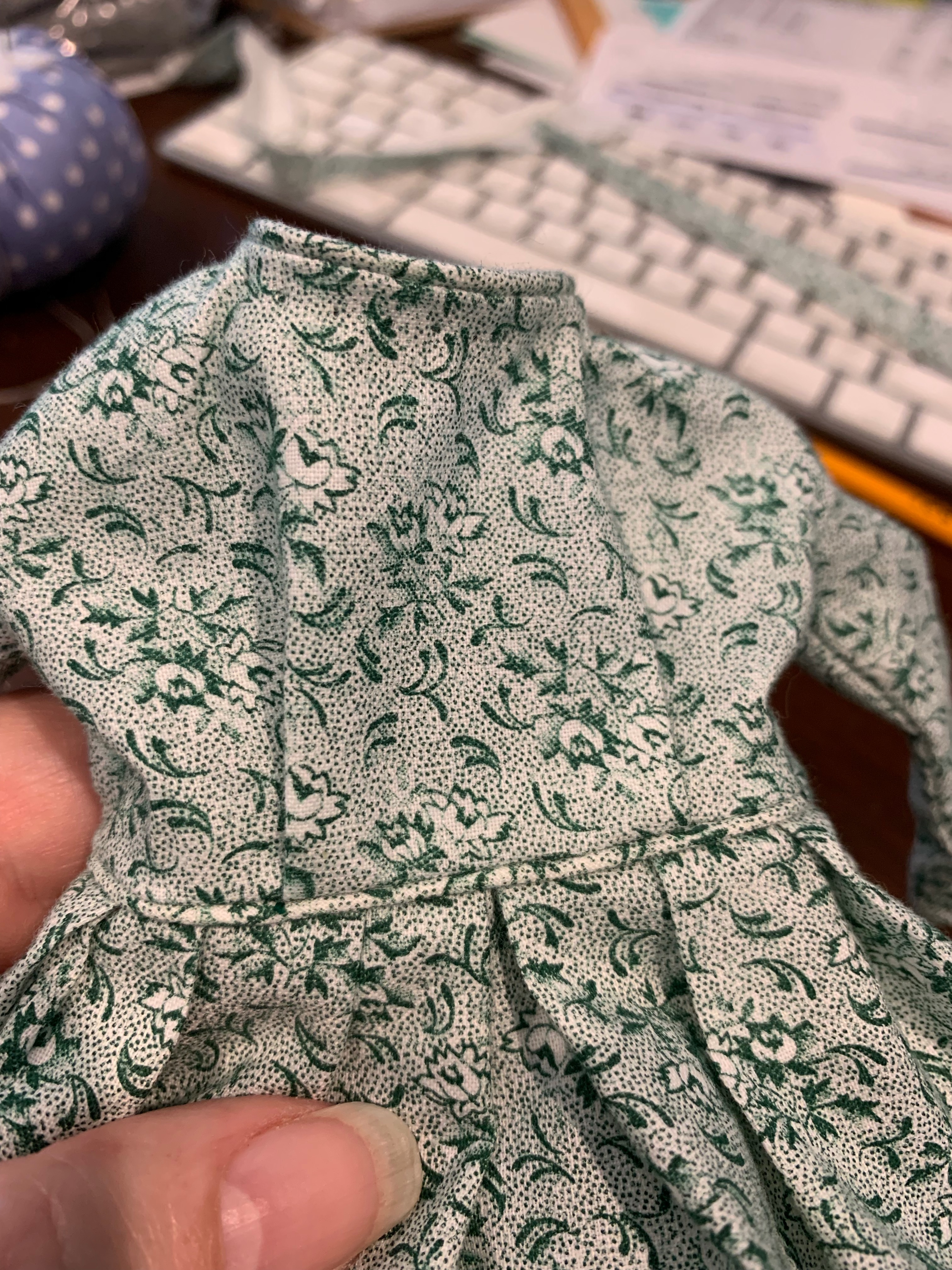
Here’s the back of the dress and you can just see the green stitching where I made the tucks in the skirt. Fortunately the thread sort of disappears in the floral pattern of the fabric. The dress, drawers and petticoat all close with a tiny hook and thread bar.

So there you have it! Miss Emalie will be visiting with us at events from now on and I’ll probably make her a pinafore at some point. She just looks so pretty, I couldn’t wait to share!

IMG_1265.jpeg

Living in, and through, your remodel

Remember that TV show Trading Spaces? The one where friends overhauled each other’s living rooms, sometimes with amazing success? My husband and I loved that show, and were inspired at the time to think that we could take on the task of repainting our kitchen cabinets. The home we lived in had these really dark brown circa 1972 kitchen cabinets that were just oppressive.

We learned the hard way that there are professionals for a reason. Although DIY projects are fun, and lots of people are capable of tackling these kinds of projects and having great results, we are not in that group of people. Our cabinet repainting project was not an amazing success. At all. At our next house, we worked with professionals, and we learned that home upgrades, when done by someone who knows what they are doing, are not all that bad. We enjoyed seeing the progress every day. The changes we made helped us sell that house and buy the home we live in now.

Our current home was effectively the same as it was in 1959, with updated appliances and flooring. We are now approaching the end of a significant remodel of this house, and we have stayed in the house through the entire process, except for three weeks we spent in a hotel when we had to leave due to health and safety concerns – you know, like asbestos removal. We started the project in August 2016 with the outdoor demo. It is now June 2017 and we still have a couple months to go.

Many people cannot afford to do their project if they have to move out and rent an apartment or second home, so staying in their home during the work is a popular solution. Living through a renovation is a serious decision that you and your family must commit to so you don’t run into too much family conflict. Had we fully known what to expect, we might have done a few things differently, so I wanted to share some of my learnings to hopefully help you make the plunge into happy home renovation.

Here are my tips on how to prepare for living in – and through – your renovation.

  1. Plan to discuss every decision with your partner openly, and reach an agreement together before taking any action. If you don’t agree with each other, you have to find some way to come together in compromise so you can happily live in your home once the work is done. Communication is important in general so that you don’t harbor any resentments or negative feelings that may develop during the project. Your remodel is a huge step in home ownership and should be one of excitement, not lingering anger or annoyance.
  2. Decide what your style will be. Once we realized we liked and wanted to embrace the mid-century modern style of our home, everything was easy. When you have no idea what you want things to look like at the end of the project, there can be confusion about floors, walls, door styles, baseboard styles, cabinets, etc. You don’t want styles to clash or not work with the flow of the home. You may choose to work with a designer, and that can be helpful if you are uncertain about what coordinates, but be sure to interview potential designers to make sure they “get” your style and you. We also spent literally hours researching on the internet. Any minor thing we were unsure of we looked for pictures. How should the baseboards meet the kerf jambs? Look on Houzz. Should we use light or dark grout on the kitchen tile? Google it. Another resource is YouTube. There are literally thousands of videos that just show snapshots of a theme – if you want to see French country kitchens, retro diner inspired interiors, or homes made out of Airstream trailers, well you can.
  3. Pare down your belongings as much as possible. This one is a hard one for many people, but what is the point of doing a massive remodel or upgrade, just to fill it up with “stuff” once finished? I’m not saying you have to get rid of Grandma’s quilt or Uncle Fred’s baseball collection, but do have storage solutions for the things you are going to keep. I have a collection of family serving dishes so we built a china cabinet into the kitchen cabinets so it can all be displayed and used. Referring back to #2 above, if you are changing your style, there is no sense in keeping things that won’t mesh with it. You can get rid of your old dishes and buy all new once your home is finished if you like. More importantly, if you are planning to live in your home during your remodel, you don’t need your stuff 1.) in the way or 2.) getting damaged. Keep only what you absolutely need for day to day. If your project will last several months like ours, make sure you keep your winter clothes handy while you are packing in late summer, otherwise you will find yourself cold and shopping in December (not that I speak from personal experience, ahem.) Be prepared to continually pare down your stuff as the project progresses. Finally, if you are planning to store your stuff off site, carefully evaluate whether the cost of storing that single-use appliance or collection of soup ladles is worth keeping them. For us, the answer was frequently “no” and the people at Goodwill knew our car by the time we finished packing.
  4. Work with professionals. Unless you are a general contractor, most people don’t have the contacts in the industry to hire all the necessary trades, schedule all the different jobs, arrange for city or county inspections, and manage the overall process. A licensed, insured and bonded general contractor is worth every penny. They will spell out everything in a contract so you shouldn’t have have any questions, and if you do they should answer them all. They also know lots of people and companies in the building industry, and can tell you who to talk to, and guide you to brands they have good experiences with. Any additional personnel you hire should also be professionals – architects, designers, landscapers – and should be able and willing to work with your general contractor to move the project along toward completion. When the trades work against each other it only creates delays and headaches. Finally, if there is an issue during the project your general contractor should be your advocate to ensure you get what you want.
  5. Negotiate pricing wherever possible. We worked with a local appliance wholesaler who would price match. You bet we searched every item on sites like Amazon and Best Buy. When we were researching tile for the kitchen, we talked not only to the distributor our contractor likes, but several others, and we did shop them against each other. No shame here, this is a major investment. Get the best price you can without being cheap or rude. Remember that the people you talk to at the wholesale houses just work there. If the tile you like gets discontinued before you place your order, it’s not their fault so don’t scream at them. Don’t forget that you get what you pay for, so be educated on the differences between laminate, hardwood, vinyl, and tile, for instance. If you buy cheaper supplies, you may have to replace sooner than later.
  6. It will be much more dusty, dirty and inconvenient than you could imagine. We were fortunate to have two bathrooms and the ability to split our project into two parts so we would have a full working bathroom throughout the project. However, sharing a small bathroom with your whole family involves coordination and patience. Try to keep routines whenever possible (for kids in school, work schedules, etc) but be flexible with one another. Keep the spaces you use as tidy as possible. Cramming your whole family into one bedroom can get crowded, and clutter will just make Mom and Dad irritated, leading to yelling and crying – no fun for anyone. There is very little privacy. Consign yourself to wearing slippers and/or shoes all the time – if you are like me and like bare feet, this is no fun at first but there will be nails, screws and splinters dropped on the floor. Drywall dust is pervasive and you will find it everywhere, even in the rooms you don’t touch. If your kitchen is being redone, consider setting up a place in your house for a toaster oven, microwave and coffee maker. This will be your kitchenette for the duration, and will help keep you more healthy than if you eat out every meal. Don’t forget that you will be washing dishes in your bathroom sink. If you enjoy wine, don’t be afraid to drink it.
  7. Accept that there will be delays and things may take longer than you expect. There will inevitably be delays. Things happen and there will be situations that are out of your control. We had a window get delivered in CO instead of CA and the extra shipping broke it. Getting a new custom built window delayed us almost a month. This is no one’s fault. The installation of flooring is precision work and should be done with care and attention to detail. If your contractor budgets 2 days to tile a 2000 square foot house, something is not right there. Some days we could hear the workers hammering but had no idea what they had done all day. While demo, framing and drywall are very visual and seem to go really fast, the detail work is slow but just as important.
  8. Draw a line in the sand on change orders. As you install wiring for a wall-mounted TV, you may be tempted to install wiring in every room in the house. If you did not include it in the original project, this is a change order, and change orders are what send well planned projects over budget. The new kitchen cabinets may make the unchanging bathrooms look shabby. If you paint the walls but keep the existing floors, the floors might start to look dingy. Prepare for changes during the project but agree upon a point where there will be no more changes. This will save you money and heartache in the long run.
  9. Be prepared to cut things from your project. This can be necessary if there is hidden damage exposed when drywall comes down, or previous work on your house isn’t up to code. Having a set amount of money is a blessing and a curse at times. You only have so much, so you need to prioritize how you spend that money. When it came down to it, we chose to replace large plate glass windows with safer tempered glass and we cut into our A/V spending. Health and safety come over in-wall speakers.
  10. Get to know your crew. We have developed a healthy respect for the various trades and the people who perform this work for us. Living and working here, we see them every day. Not too many people ever think about what goes into building or remodeling a home, but it is the largest purchase most of us will ever make. Know the people who are helping to make your house into your dream home. Not only will you appreciate their workmanship, they will want to do the very best job they can for you.

BONUS ITEM – Take tons of pictures. Of course, you will take pictures! Take more than you think you will need. We have saved ourselves some pain long after the fact because we took pictures during the framing, plumbing, electrical, and every other stage. Once that drywall is up, you might not remember where the sheer wall ends, where exactly those pipes were set, or where the electrical wires wind through a stud. A photo can give you and your team a better idea when they have to make adjustments. If your camera can do a panorama view, take a few of those from the same location throughout the project. It is fun to see how that space changes over the months. We used a time lapse camera for some parts of the project, such as framing, drywall installation and flooring. It really works best in a large space. We also did monthly video recordings updating what had happened in the previous month. These will be fun for us to review in the future.

I hope that these tips help you as you prepare for your remodel. Make it as enjoyable as you can so that once the project is concluded, you will have many happy memories of it coming together. For some fun, check out my Instagram feed for pictures of stucco going on, custom cabinets getting installed and more.

Christmas Memories

Some years ago, my sister gave me a box of photos from our childhood. As the keeper of the photos, she had access to them and I didn’t have many in my possession, so this was a very sentimental gift. They are mostly from Christmas, and so what a great time to share these memories with you. Our “new” house was built in 1972. We moved in just a month before my 4th birthday, so I was always able to quickly figure how long we’d lived there by subtracting 4 from my age.

Every year on Christmas Eve, my mother would read to us from an original copy of Rudolph the Red Nosed Reindeer. I have it now and although it has seen its years, it is still in great condition. The story goes that Grammie Hennie went over to Montgomery Ward (a long defunct department store) and picked up a handful of copies. They gave them away for free as a promotional item. I assume she gave one each to her kids, but I have no idea if any remain…Steve? Carey? Anyway, as the book became more fragile, we were more careful with it, one year Kathy even carried it on a really fancy pink tufted pillow that she had. :-) Today we use a reprint.

Somewhere, packed among my photo things, I have all the Christmas cards that my parents sent out every year from the time Kathy was 1 or 2 until she was 21. They are a fantastic study of clothing through the seventies and eighties! I’ll try to find those and share them as well. Until then, Merry Christmas, happy holidays, joy to all.

This slideshow requires JavaScript.

Pattern Review: TV 447 1863 Sheer Dress

I have been sitting on this pattern for several years, all while sweltering in the summer heat. I purchased my fabric easily three years ago and have been wanting a sheer dress for probably five years. Summer in multiple layers of clothing is definitely more warm than it has to be! So, this past spring, I finally decided to just do it! I have researched various patterns available on the market, including some Big Three patterns, Peachtree Mercantile, and others, but I know that Truly Victorian makes beautiful, accurate, and easy to follow patterns, which is why I settled on this one.
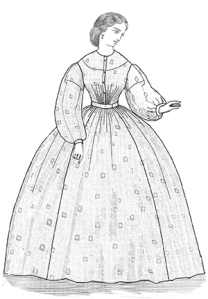
Truly Victorian TV447 1863 Sheer Dress

Truly Victorian TV447 1863 Sheer Dress

I chose a lovely sheer cotton in blue and white stripes that I found on clearance at a chain store. I know of more than one person who has made a sheer of this fabric. Hopefully we won’t all be at the same event together!
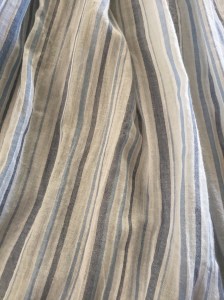
Pretty pretty

Pretty pretty

The fabric is 54″ wide, but since at the time I didn’t know what pattern I would be using I purchased 10 yards. Lucky for me, this overestimation was a good one. The sleeves on this dress are full and wide, plus since my fabric was directional, I was able to cut the stripes going from shoulder to wrist. Anyway, before any of that, I calculated my measurements and pattern size following the instructions on the pattern. The thing about the TV patterns is they allow you to custom fit your garment before you even start sewing. And once you do that, you can easily make up a muslin for a better idea on fit.

Dark image of my muslin

Dark image of my muslin

Sorry this is not better quality, but almost all the mirrors in my house that are big enough are impacted by light diffusion. What I learned here is that the waist of the under bodice was a little too full but the bust was a pretty good fit. So I took in the darts a bit and retested it. I did not do this all by myself, by the way. I submitted my questions to the Civilian Civil War Closet group on Facebook for hints and help – there are clothing historians, professional seamstresses and experienced clothiers there who are willing to help for free. I just couldn’t overlook that knowledge base. I also asked my friend Shelley Peters for real world tips as she has made this pattern a lot. Had I needed it, the amazing Heather McNaughten at Truly Victorian would have helped too. As an aside, this just confirms for me that this community really wants its members to succeed!

Anyway, after the changes to the muslin, I traced that as my new under bodice pattern piece and went forth to sew! This is the first time I have made my own bias and bias piping, which was used on the neckline facing and armscyes. I found the instructions sufficient, but had used better instructions on a Simplicity costume pattern and did that instead. They just made a bit more sense to my thinking, the result is the same.

IMG_2434

Piped facing to finish the raw edges of the under bodice.
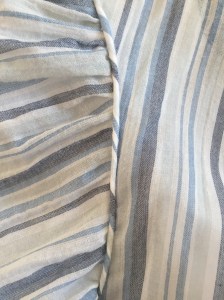
IMG_2439

Piped armscye

The construction of the garment is for the most part very easy. I found the TV method of inserting the sleeve into the armscye backwards to what I am used to so I just adapted and made notes on the pattern.

Hand buttonholes

Hand buttonholes

I sewed this in a combination of machine and hand sewing. My fabric was so very delicate that even though I have a high quality machine, it sometimes would bunch up in the feed dogs. I wound up hand sewing much of the finishing stitching, such as on the piped facings, and also hand sewed all the button holes. My reasoning here was twofold – I wanted historically accurate buttonholes and since the fabric was so delicate it was impossible for me to machine sew them to the standard I desired. I used silk thread for the buttonholes. The buttons are vintage shell buttons, much higher quality than the cheap flaked mother of pearl available these days. They were purchased through Farmhouse Fabrics.

IMG_2441

Sleeve band

For visual interest I cut the sleeve band on the bias. Maybe there is a chance of this stretching over time, but the band is so generous around the wrist that I don’t expect that to happen.

IMG_1985

Finished bodice

At this point, I went back to the Civilian Civil War Closet for help. The pattern does not include a collar pattern. I don’t care for my look without a collar, so I googled for tutorials. The best suggested laying the pattern pieces for the bodice front and back together as though they were sewn, then tracing the curve from center front to center back, next extending that to a simple collar width. I did that, but found mine to be fluttery and off. The amazing Liz Clark of the Sewing Academy helped me immensely with tips on how to correct this and redraft the collar. I’m delighted to say that I was successful!

IMG_2438

Finished collar

I added the fine tatted lace which I purchased at Farmhouse Fabrics.

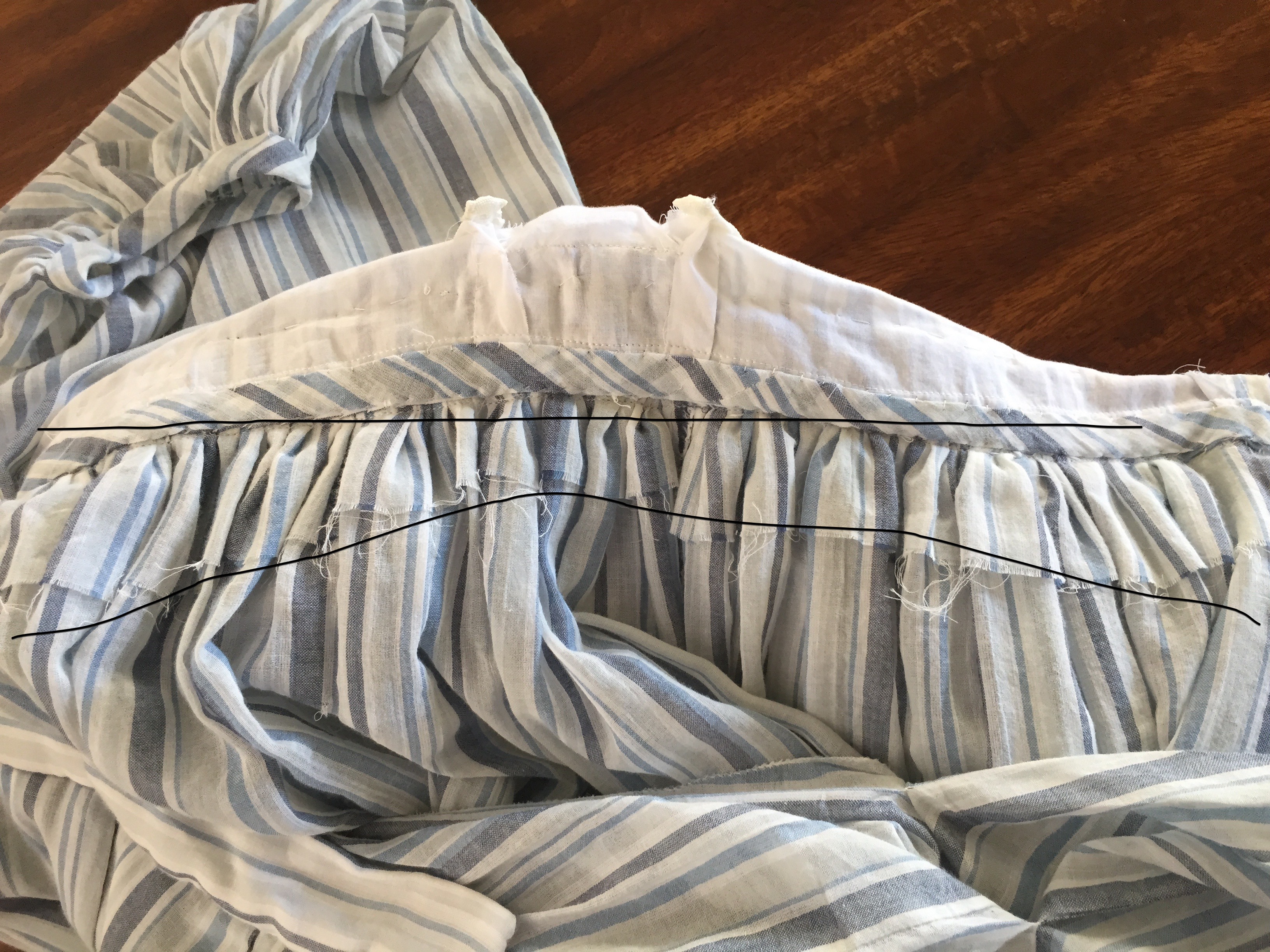
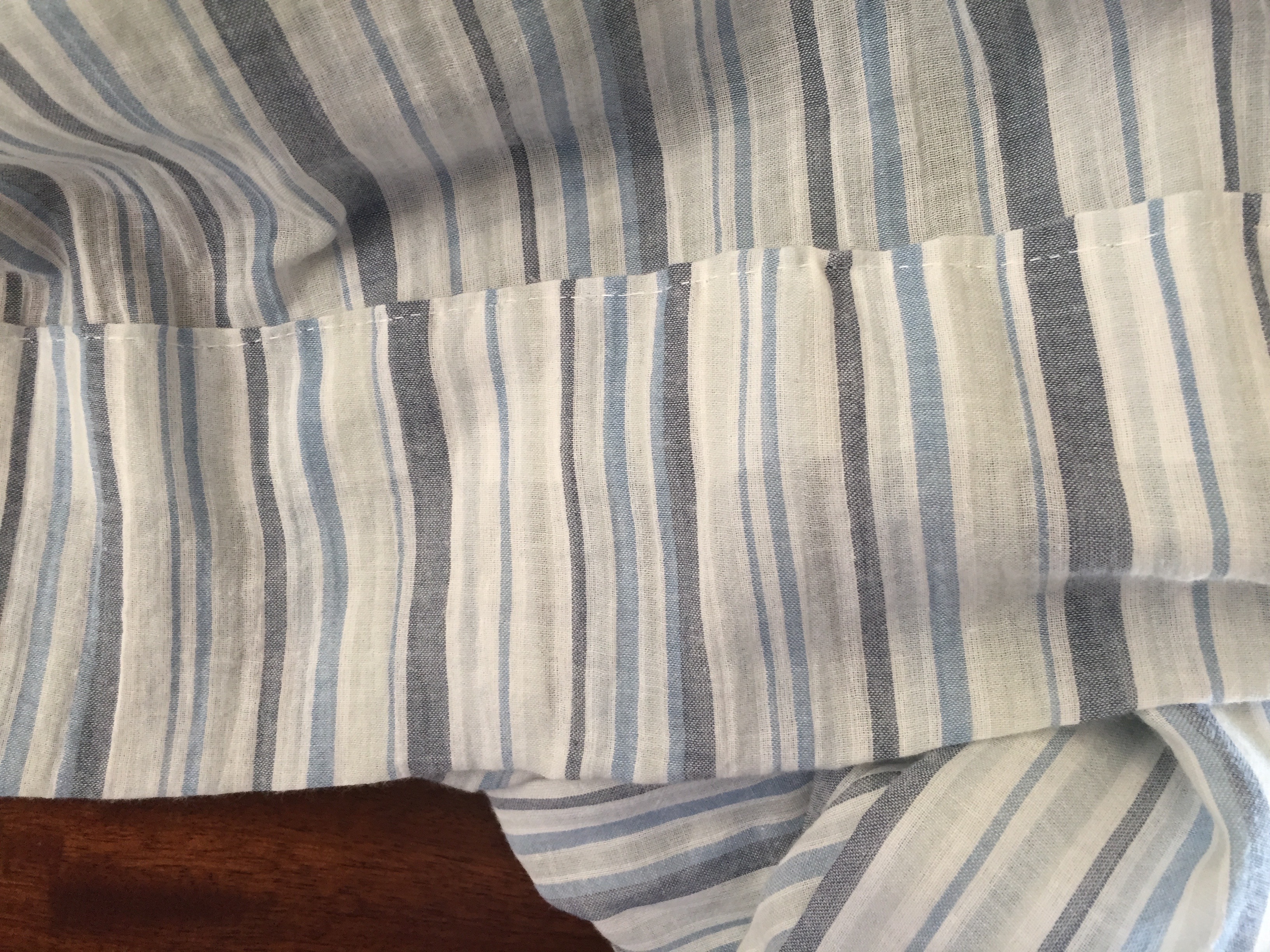
Next, waistband finishing. Since my fabric is 54″ wide, I didn’t want to cut it down to  four 40″ panels to follow the TV skirt instructions. I retained the selvages as was done in historical garments, and used three panels instead of four. The skirt has a very deep pocket at the center left where the skirt pieces overlap with the waistband. Each panel was cut to the same length, but since your skirt front and skirt back are different lengths, there has to be a way to do this without cutting your fabric. Again, drawing on the Closet knowledge, I did as was suggested and folded over the waist edge of the fabric. This gave added stability to the fabric as well as achieving the lengths needed. The pattern instructions have you cut your fabric at the waist to the desired angle which will give you your length. I don’t recommend that on a sheer just because of the off chance of it tearing.
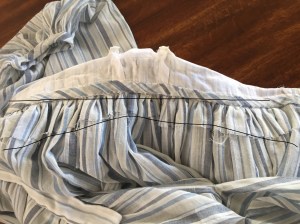
IMG_2446 -1

Waist inside

You can see in this very amateurly photoshopped picture the angle of the folded-over fabric. This is center back where the skirt is a bit longer than in the front.

IMG_2443

Double box pleats

For the skirt attachment, the pattern gives you liberty to choose your preferred pleating or gathering method. Here I am showing you the double box pleats I used to pleat the skirt onto the waistband. Originally I had knife pleated the front and cartridge pleated the back, but I didn’t get enough fabric taken up in the front. So I went to the double box pleats in front and cartridge pleats in back. I’m quite happy with this look as it’s smooth and polished.

IMG_2445

Yes that hem is hand stitched

I wanted to make sure that the hem folded straight up so the lines didn’t go off kilter, so I ended up hand sewing the hem. I used a single thread and every fourth stitch went through all layers. Every 8th stitch was taken twice to keep the thread from coming undone if it were to break for any reason. If you kept up with my thinking on the skirt width, you will realize that’s a 178″ hem. It took me a couple hours to do it.
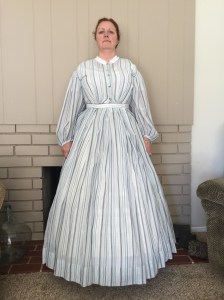
IMG_2447

Picture taken by an 8 year old

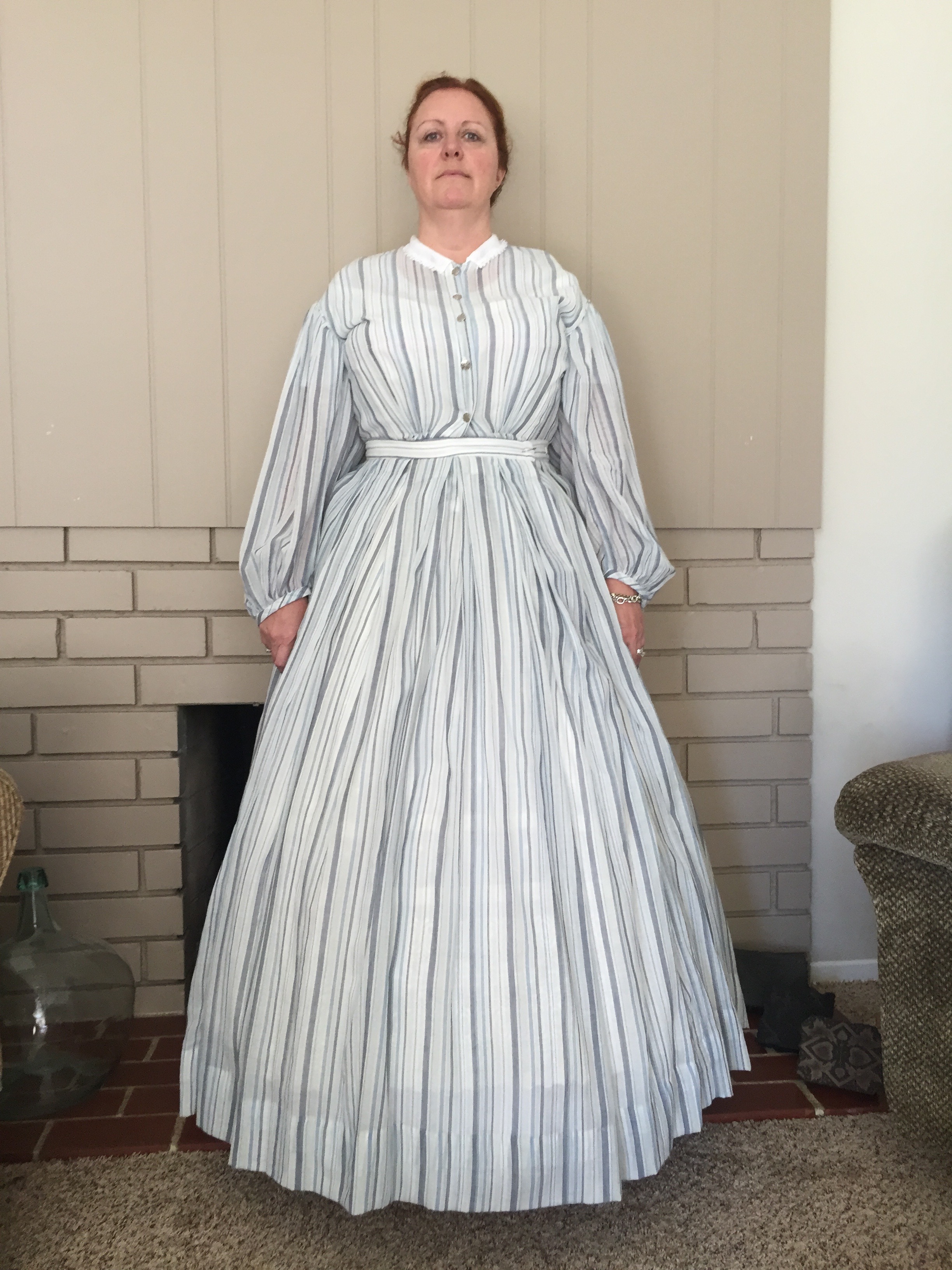
This is the finished dress, although it’s not the best picture of me lol. I’m looking down toward my daughter haha. Also, I realize that I must not have been laced as tightly in my corset as usual because I couldn’t fasten the waistband correctly. I wasn’t going to mess with it today and I’m certainly not taking the dress apart, so I’ll have to lace better next time.

IMG_2450 (1)

Side image

Here you can see the under sleeve just below my shoulder. This makes the dress very cool and airy. I had considered adding a silk stripe down the sleeve for interest, but I decided against it as it might weigh down the fabric. I may make a belt, as the silk I have is the exact color of the darkest stripe in the fabric.

You can also see the shadow of my petticoat under the skirt. I have an eyelet petticoat with two large pleats in it. This isn’t an historically accurate petticoat and someday I will make a plain cotton one, but for now this is quite pretty.

Overall I am thrilled with the result of the Truly Victorian TV447 Sheer Dress pattern. The instructions were easy, but true to the sewing techniques available to our ancestresses. It is not a pattern for a beginner, certainly, but if you have some knowledge of sewing, you can make this pattern truly customized to your preferences. If at times the instructions don’t make sense, just take them one sentence at a time. My mother told me when in doubt just do what the instructions say. These patterns will not take you down the wrong path, trust them and you will get something incredibly beautiful. And of course, email them, ask your friends who have made the pattern, or google for help. Truly Victorian patterns are very popular due to them being among the best on the market today, so lots of people make them! I am eager to wear this dress to one of our hottest events coming up soon, Huntington Beach Civil War Days.

Links & Resources

Truly Victorian

Farmhouse Fabrics

Civilian Civil War Closet

Sewing Academy

Huntington Beach Civil War Days

Nest learning thermostat learned to be a jerk

We installed a Nest learning thermostat last year when we replaced the heating & air conditioner. It’s nifty, we thought! It will learn our preferences, we thought!

For quite a while (read, summer time) it was wonderful. Sometimes we would adjust the temperature on the fancy iPhone app, but it usually kept the house comfortable.

Now it’s winter time, which in Southern California means we have chilly nights and can get up to 80 degrees during the day. This morning it was 40 and it’s forecasted to be 75, so a 35 degree split. This seems like the perfect challenge for a Nest learning thermostat! Figure out that we like the house to be right around 70-72, so give us a little heat in the morning and maybe a little cool in the afternoon (if at all), then only if it gets cold outside, give us a little heat at night. Not too difficult.

Recently, we found that every afternoon, the heater was coming on and running hell bent for leather because the Nest had set itself to 77 degrees. We turned the temperature down. The next day, the same thing happened, we turned the temperature down again. The next day, repeat…until I finally googled this and it seems Nest will automatically set target temperatures based on what it thinks you like.

I have never set the heat to 77 degrees. Ever. My husband is a walking heater so he certainly hasn’t set it to 77. Where did Nest get this idea?

It's lying to you

You set it here, but psych! it’s 77

As it turns out, other people have been complaining about this very thing. One poor guy’s Nest was kicking up the heat to 90! The Nest is supposed to learn your schedule as you use it, and then it creates scheduled temperature actions, such as heating or cooling, based on your habits. Since we haven’t ever set the heat to 77 I’m not sure why Nest thinks we want that, but I digress. The only way to try to trick the Nest is to delete the preset schedule. Hurray! we thought, we have fixed it! John deleted the full week’s worth of preset temperature spikes to 77 degrees in the afternoon.

Wouldn’t you know it. Nest has added a full preset schedule to send that temperature up to 77 every morning.

I don’t want it to be 77 in the house. Ever. That’s the point I start thinking of turning on the air conditioner. Searching the Nest community forums revealed that you cannot really get rid of this scheduling feature. You can only “teach” your Nest better. Really? 8 months of teaching this thing isn’t enough for it to know that 77 degrees is hot. It’s frustrating.

The concept of a learning thermostat is only as good as the programmers that allow the consumer to actually teach the damn thing their preferences. At this point, resetting the Nest to its original out-of-the-box status and starting over might be the only way to teach it we don’t want to roast. The one thing Nest does have going for it is the convenience of the iPhone app. If I had to interrupt work to walk over and reset the thermostat every time it had a hot flash, I’d be tempted to smash it off the wall instead.

Armistice Day / Veterans Day

The beautiful “The Green Fields of France” pays tribute to the terrible war that ultimately brought us Veteran’s Day. Armistice was called to take place at 11:11 a.m. on the 11th day of the 11th month – November 11. After WWI, Armistice Day was observed, really by a moment of silence at 11:11 a.m. Later on in America and elsewhere, it was changed to honor all veterans, because sadly, The War to End All Wars didn’t accomplish that.
Scroll down for a photo video with The Fenians playing this haunting song, and then a simply beautiful version of the Star Spangled Banner by the Fenians at our local pub Muldoons.

“The Green Fields Of France”
(originally by Eric Bogle)

Oh how do you do, young Willy McBride
Do you mind if I sit here down by your graveside
And rest for a while in the warm summer sun
I’ve been walking all day, and I’m nearly done
And I see by your gravestone you were only nineteen
When you joined the great fallen in 1916
Well I hope you died quick
And I hope you died clean
Or Willy McBride, was is it slow and obsceneDid they beat the drums slowly
Did they play the fife lowly
Did they sound the death march as they lowered you down
Did the band play the last post and chorus
Did the pipes play the flowers of the forestAnd did you leave a wife or a sweetheart behind
In some loyal heart is your memory enshrined
And though you died back in 1916
To that loyal heart you’re forever nineteen
Or are you a stranger without even a name
Forever enshrined behind some old glass pane
In an old photograph torn, tattered, and stained
And faded to yellow in a brown leather frame

Did they beat the drums slowly
Did they play the fife lowly
Did they sound the death march as they lowered you down
Did the band play the last post and chorus
Did the pipes play the flowers of the forest

The sun shining down on these green fields of France
The warm wind blows gently and the red poppies dance
The trenches have vanished long under the plow
No gas, no barbed wire, no guns firing now
But here in this graveyard that’s still no mans land
The countless white crosses in mute witness stand
To man’s blind indifference to his fellow man
And a whole generation were butchered and damned

Did they beat the drums slowly
Did they play the fife lowly
Did they sound the death march as they lowered you down
Did the band play the last post and chorus
Did the pipes play the flowers of the forest

And I can’t help but wonder oh Willy McBride
Do all those who lie here know why they died
Did you really believe them when they told you the cause
Did you really believe that this war would end wars
Well the suffering, the sorrow, the glory, the shame
The killing and dying it was all done in vain
Oh Willy McBride it all happened again
And again, and again, and again, and again

Did they beat the drums slowly
Did they play the fife lowly
Did they sound the death march as they lowered you down
Did the band play the last post and chorus
Did the pipes play the flowers of the forest

Hating Columbus

All across the internet yesterday I saw numerous posts and articles about how horrible Christopher Columbus was because in 14 hundred and 92 he sailed the ocean blue – and accidentally landed in the Bahamas instead of India.

All these posts bashing Christopher Columbus just irritate me.

I find it disingenuous to constantly lambast Columbus.  Europeans were coming to America before him (Leif Ericson in 1001) and continued to come after him.  If we didn’t celebrate Columbus Day, we would celebrate some other explorer’s day. People were moving around, finding out what they could do, it was the Age of Exploration, for goodness sakes! The cost of goods coming overland from the East was high and the demand for those goods inspired the quest for better trade routes. Whether they sailed south along the coast of Africa or west across the Atlantic Ocean, financial gain and greed drove the explorers onward.

People tend to forget that within ten years of Columbus landing in the West Indies, John and Sebastian Cabot landed in Canada (1497), Vasco de Gama sailed around the Cape of Good Hope (1498), Alonzo de Ojedo explored what became Columbia and Venezuela (1499), Vicente Pinzon and Juan Dias de Solis discovered Brazil (1500), Rodrigo de Bastidas and Juan de la Cosa discovered what we now know as Panama (1500), and Amerigo Vespucci – who America was really named after – explored the coast of South America (1501). Only 14 years after his famous voyage, Columbus was dead (1506). Within twenty years of that, explorers had visited Argentina, Florida, Uruguay, Mexico, the Gulf Coast, New York Bay, Nicaragua, Grenada, Honduras, Guatamala, El Salvador, Yucatan, Jamaica, Cuba, Hispaniola, and Haiti, and Hernan Cortez had looted the Aztec kingdom.

The day could more accurately be called European Explorers Day.

But, these people did not know they were bringing disease to the citizens of The New World. The early explorers barely understood that washing their hands and bodies was a good thing, let alone that it would prevent the spread of disease in many cases. People had been interacting with one another for thousands of years across Europe, Africa and Asia. They didn’t understand herd immunity or that isolation from disease would lower the immune systems of the native peoples. They brought colonists – just as they had in the Old World – to settle in the newly discovered lands. The colonists brought the things they liked, such as horses, pigs and cattle, coffee, citrus fruits and cotton. The new lands gave them tobacco, tomatoes, vanilla, turkeys and potatoes.
This silly meme that says “celebrate by going into your neighbor’s house and claiming you live there” is just that, silly. Throughout human history, kingdoms had been conquering their neighbors and claiming the new territory as their own – and don’t think that kind of behavior was exclusive to Europeans. The native peoples over here did the same thing, fighting among and between tribes for territory, peace treaties and alliances, and even marriages between princes and princesses of the tribes to expand territory and secure numbers. This is human nature.

We have to remember one thing. They thought they were doing the right thing based on their understanding of the world *at that time*.  Spreading Christianity was mandated by the Bible, and since many people were devout, they did as they were taught. No one seemed to “own” the land as they could comprehend, so they just took it in the name of their sponsor country. To them, the conquering and plunder of local peoples was no different from the conquering of Constantinople by the Ottomans (1453). As with so much of history, we can accept that it didn’t work out well for everyone involved, but we can’t change it by criticizing the participants.  We should not apply our own knowledge and understanding of the world and then judge our uneducated predecessors. That only serves to pander to our own egos and make us feel superior from the safety of our computers and smart phones.

But don’t hate Columbus. That’s like trying to turn a river with a teacup.