Nell’s 1866 Promenade Dress

When I was researching what to make for Nell, I came across a source for La Mode Illustree, a French fashion magazine popular through the 19th century. They frequently published doll costumes as a means for girls to learn dress making. While it took me some time to commit to one of the patterns, I have finally completed one.

Being as the magazine was written in French, I first had to translate the text. I’m not fluent but I have a very basic understanding of the language, and Google translate did the heavy lifting.

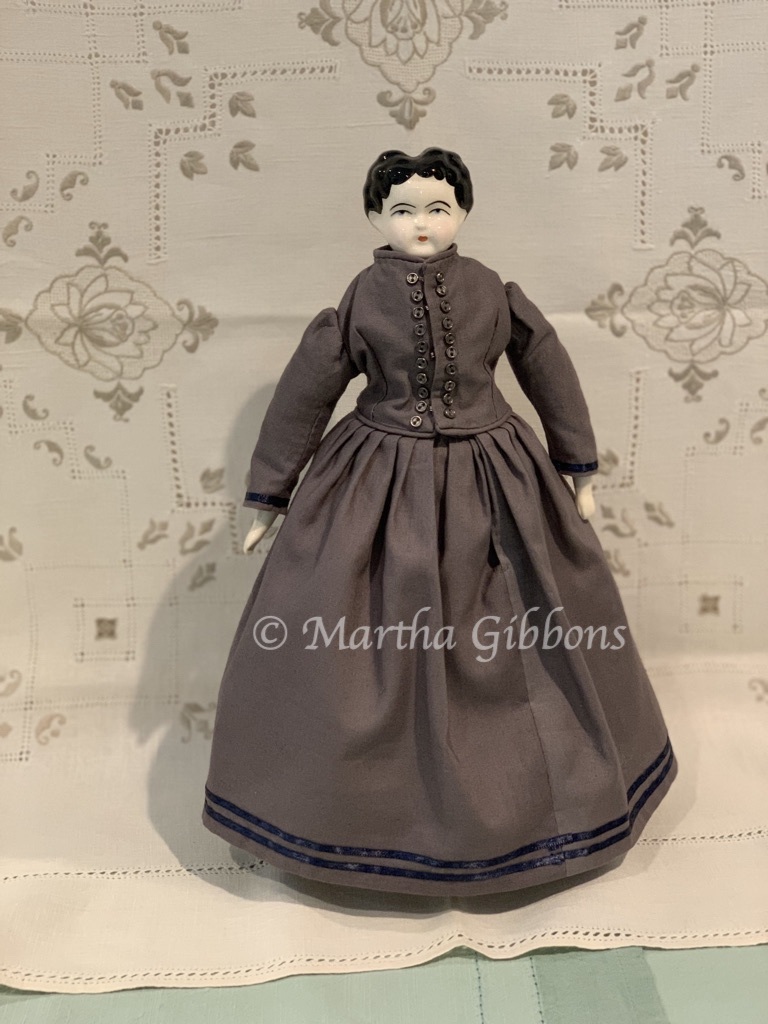
I decided to create a walking dress, or costume du promenade. It was described as being made from gray lindsay- a type of fine wool – with navy blue velvet trim. The original patterns were intended for a doll a bit larger than Nell, so I had to be careful to size it to her. I did not use wool because I don’t want to afford it for a doll, plus the majority of modern wool available at a big box retailer is a blend with a synthetic fiber to keep costs down and/or is heavier than I would need for a 12” doll. I substituted a nice cotton with a firm hand but fine weight.

Doll Sitting in Armchair

The source material includes the pattern page which has every pattern piece in the magazine all on two pages. The lines of each pattern were unique so you would find the dotted, dashed or starred lines, trace them and then make your garment. I followed this process, next having to print them and size them. I then proceeded to make a couple mock-ups of scrap to make sure it would fit Nell. It was quite an intensive process as I’m not completely knowledgeable in dressmaking. However, I persevered and eventually came up with a fit I liked.

As it turns out, these doll clothes were literally miniature dresses, made exactly how full sized garments were made. They were intended to teach little girls how to sew their own clothing, which makes a lot of sense. Just, the construction methods of the nineteenth century don’t always make sense to our modern thinking. Usually doll clothes fasten in the back and the front just simulates the intended look. Fortunately I have experience at making 1860s dresses so I knew what to do with the pieces. Also, there aren’t actually any construction notes, just the pattern pieces. So, the description of this was:

The doll is 48 centimeters tall, head not included. Her dress consists of a dress and a coat in gray lindsay. The overcoat, sleeveless, is retained by a belt. The skirt is 32 centimentres in length, 1 meter 50 centimentres wide; it is bordered with two bands in blue cotton velvet. Same trim for the sleeves and the collar of the bodice, whose figures 46 to 50 represent half. The belt clasps under a rosette. The overcoat is made from Figures 51 to 53; we put small pockets in it. The blue taffeta hat is made of stiff gauze, according to Figs. 54 and 55, furnished with archal thread, covered with taffeta, adorned with hives underneath, black lace on top.

La Mode Illustree, January 1, 1866

So here she is in her completed 1866 Promenade Costume. The dress includes a dogleg opening in the front, which requires careful attention to detail to ensure it stays centered. The bodice is darted as was appropriate in the era. While it shows 20 (count them all!) tiny, 5 mm buttons, they are nonfunctional and only for looks. This wasn’t unheard of in the 19th century either. I sewed on the buttons, which were squirrely to say the least, didn’t like how they looked, took them off and sewed them on again. I wound up sewing under the magnifying glass because they are tiiiiny. For reference, Nell is around 12″ – the height of a Barbie doll.

I haven’t attempted to make the hat because I have never made a hat and don’t know what to expect. But, at some point I will try it with scrap fabric. I do have some blue silk here that I have been dying to use for years.

The pattern pieces include letters in the various corners, which the person making them was expected to know meant that the two pieces with letters L and M, for instance, were to be sewn together between those two points. As I was making the third mock-up of the bodice, I started writing down the instructions. Not that I expect to share these with anyone, but it’s kind of fun to make a pattern with the sense that someone might sit down to sew your creation one day.

Since the dress is constructed exactly as an adult sized dress would have been, the knowledge of vintage clothing construction came in very handy! Perhaps one day I will convert this Promenade Dress to a dolly version that closes in the back, which would make it soooo much easier to reproduce. In its current form, it is an advanced intermediate skill level, but a dolly version would be just as pretty and much easier for less skilled hobbyists.

In the next post, I’ll dive into the construction of a cloth bodied China doll.

Dottie

This doll named Dottie was made for my sister as a Christmas gift. It’s my third making of the Little Cloth Girl pattern from Elizabeth Stewart Clark. Needless to say, I love this pattern.

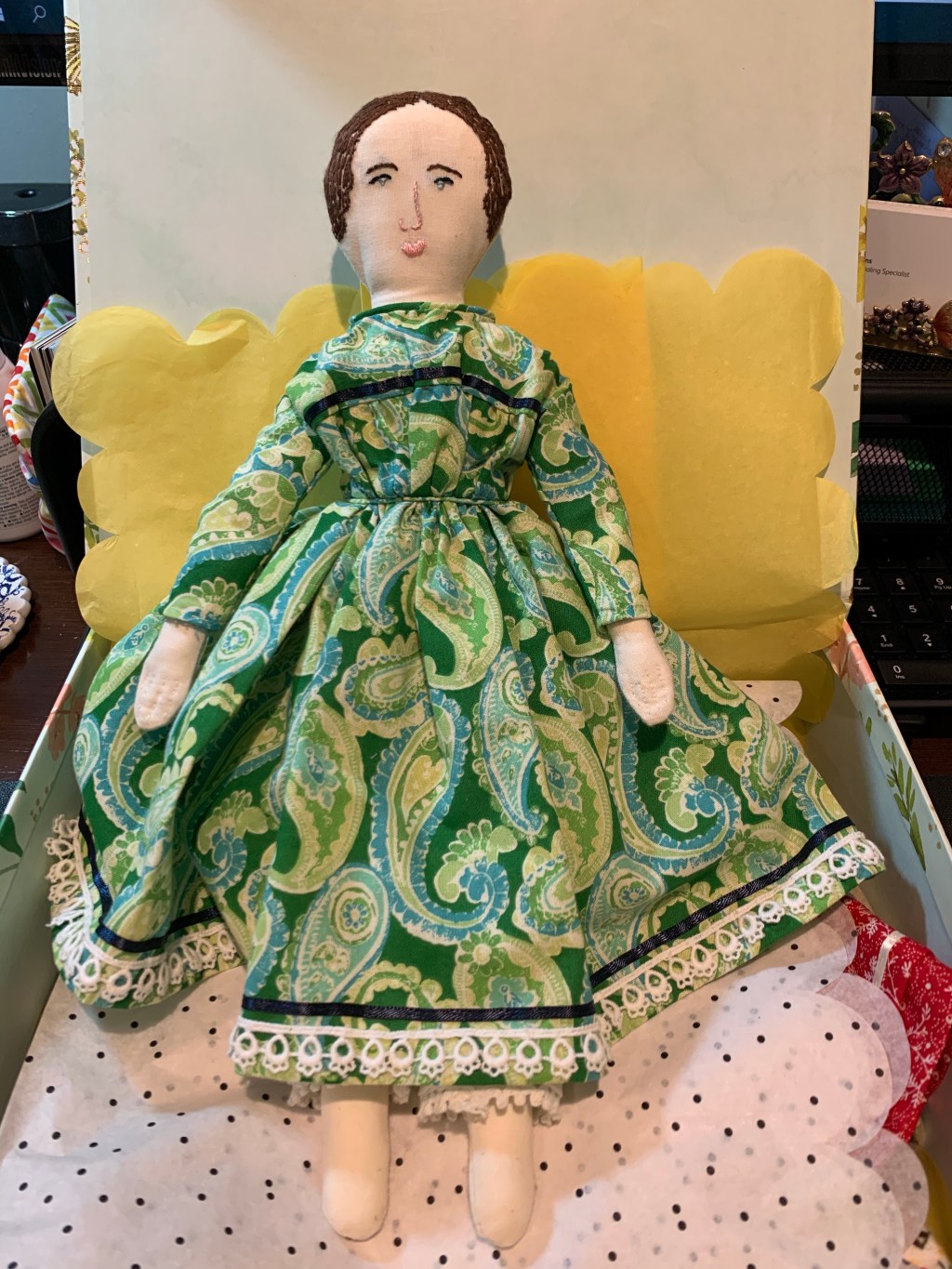
You will notice an immediate difference in Dottie’s appearance from Emalie and Mernie, and that is her face & hair are embroidered. I’m not the best at embroidery (that’s my sister’s specialty), so I had to be very careful. I actually remade her face since I didn’t like the first attempt. All the embroidery is silk and I think it came out nicely. I also stitched in her fingers – not an easy task, plus she has jointed elbows and knees.

She again has the undergarments appropriate for a girl in the mid 1860s. I decided on this go-round that I would make a full wardrobe since she was a gift.

My daughter picked out this red fabric – which I just love. The dress is a darted bodice with sleeve caps.

The second dress is made from fabric my sister has picked out to make herself a dress – probably a wrapper. I thought it would be fun to surprise her, so I just asked for a 1/4 yard of any fabric. Now, once she makes up her dress, she will have a friend in a matching dress. How sweet! This dress is a gathered front yoked bodice. I really like how it turned out.

I made a quilted petticoat from flannel. While you can’t really see it, it has the same diamond pattern quilted in as Mernie’s.

The next piece I made was the basque coat. I used a sueded fabric to make it seem like wool or a heavier fabric. The trim is brown velvet and I love the nonfunctional buttons.

My favorite piece is the blue lightweight coat. Like I said earlier, I’m not much for embroidery, but I wanted this to look like it has braid, which was a common embellishment. The little button just finishes it off.

And just because I’m a glutton, I made a little handbag, a bonnet, a quilt that features all the fabrics used in the clothing, and a pillow. Oh, and inside that handbag are mini books I made. As an aside, I made another of these little bonnets for a Holiday Gift Exchange in the Historical Costuming For Dolls Facebook group. I’m not the only one obsessed with them!

I hope that you have enjoyed this tour of Dottie and her wardrobe. In the next post, I will showcase a costume made from a vintage fashion magazine.

Meet Nell

For someone who is a documented doll disliker, I have become fascinated by them. Not playing with dolls, or displaying them. And not all dolls; I like very specific styles of dolls designed in the mid-nineteenth century. Of course I can’t afford the real dolls – or, more accurately, I won’t afford them.

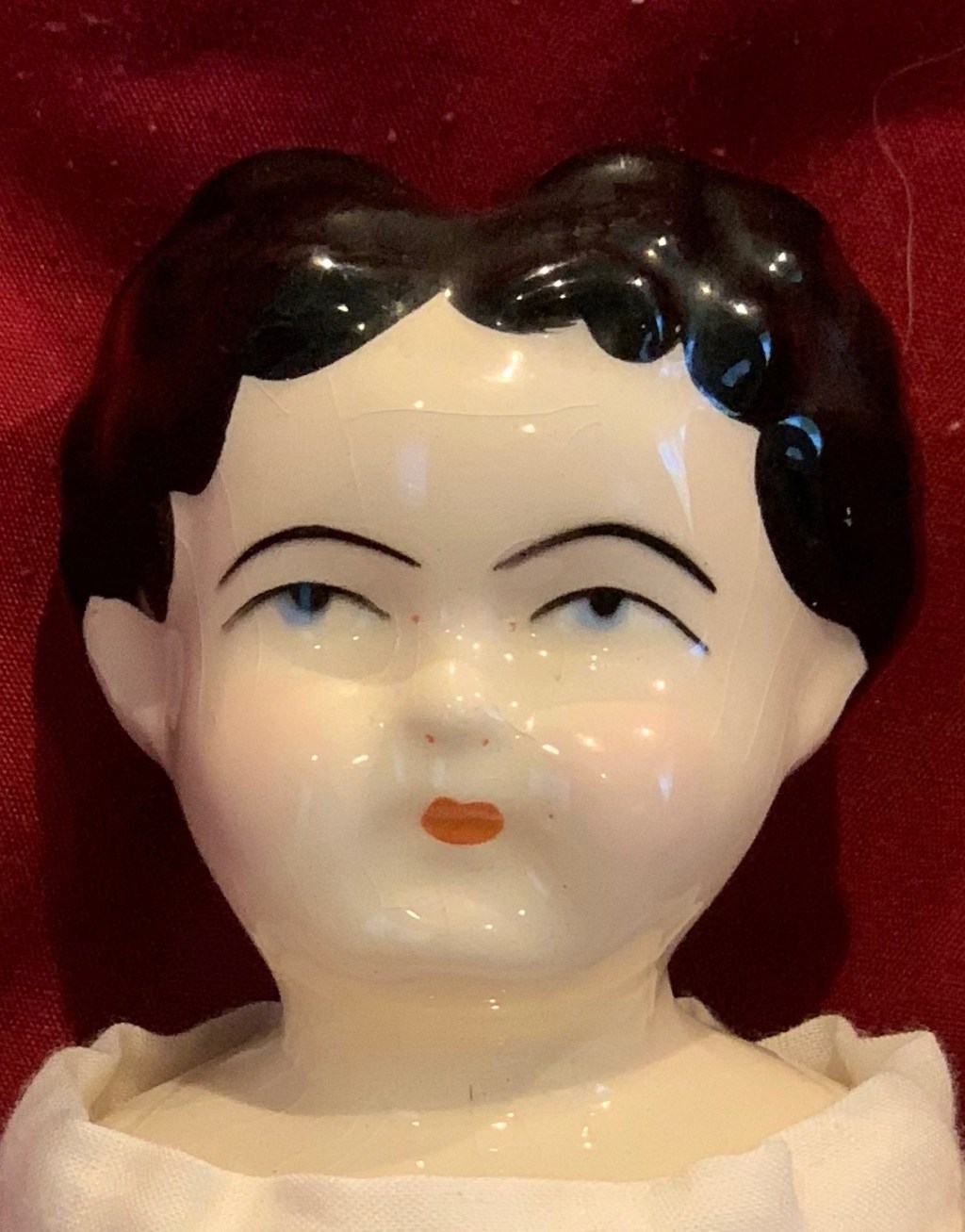
This doll, Nell, is a reproduction late 1860s-1870s cloth bodied doll. She has China head, hands and feet. I did not make her, but adopted her off eBay. She was designed by Tasha Tudor in 1977. I don’t know much about Tasha Tudor except to say she was an artist who loved dolls. In the 1970s there was a revival of these China head dolls sold as kits for home doll makers. Many brands offered the kits, and I don’t know how accurate they were.

Nell was poorly constructed – her legs are twisted and her arms are attached incorrectly as well as being rather fat. I could have remade her body, but I decided I love her as she is.

Sweet Nell came to me in a truly unattractive outfit. Remember she was made in the 70s. The dress was made from orange sprigged searsucker. Yikes.

Since I want to eventually use my dolls for teaching and display at history events, I could not leave her in this crazy outfit. From the muslin out, I redressed her. First came a new chemise and drawers from white cotton. I figured for a nicer doll I could have some fun with her corset and made her a corded corset with this beautiful brocade I had. Add a nice tucked petticoat and we are ready to keep going.

At some point after the first photos I remade her chemise. I never did like the first run at it. The new one is tucked to the neckband and lays much more smoothly. Unfortunately for Nell, it took me another several months to make her dress. I took a break to decide exactly what to make for her. Since she is later 1860s, I wasn’t limited to typical hoop skirt styles. While the basic bodice didn’t change too much after 1864, skirts and embellishments did.

I spent some time researching exactly what to make, delving into French fashion magazines and dreaming of the garments I would make her. And then I made a basic, almost boring, dress.

The fabric is cotton meant to mimic a patterned wool, which would commonly have been used. I modeled the dress off the amazingly versatile patterns from Liz Clark, modifying them to fit Nell. The skirt has box pleats at the waist, which were a more stylish method of attaching a skirt. It was a bit boring on its own so I added the pink ribbon bow and belt.

Next episode, look for the gift I created for my sister.

More Dolls

In all my spare time, I have made some more dolls. I never thought I would become so enthralled with dolls or their clothes, but 2020 was a year of sucki-ness, and I guess I actually did have some spare time. Anyway, I made a second doll from the Elizabeth Stewart Clark pattern.

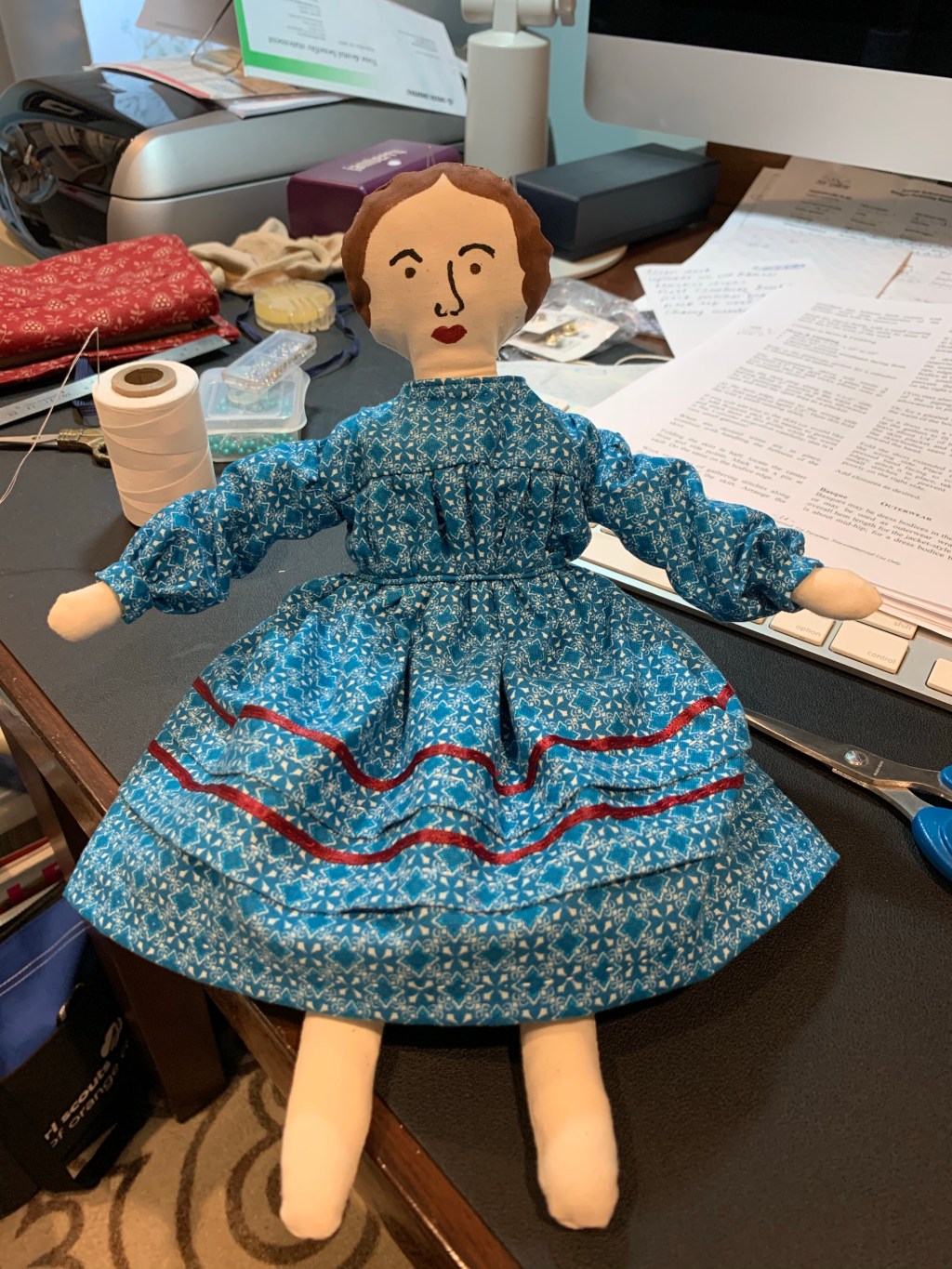
This is Mernie. She has similar undergarments to Emalie, except I tried making a quilted petticoat. Since I had never even quilted before, this was quite a challenge for me. The pattern says to follow any quilting pattern. Well, I don’t know any quilting patterns, let alone an 1860s era pattern. So I made one up.

The pattern is really designed to hold the layers of fabric in place, I measured out the diamond pattern I wanted, adjusted, remeasured, then marked it out in chalk. I thought it would take forever. What I discovered was that quilting is kind of zen. I get in the zone and felt remarkably relaxed when I finished.

Mernie has a gathered front bodice with bishop sleeves. I like the gathered front, but let me just say that the cuffs of the bishop sleeve are insanely tiny. It was a challenge to finish them nicely – but one I felt up to completing.

I quite like Mernie. I feel I made improvements on my first attempt with this pattern.